QUESTION IMAGE
Question
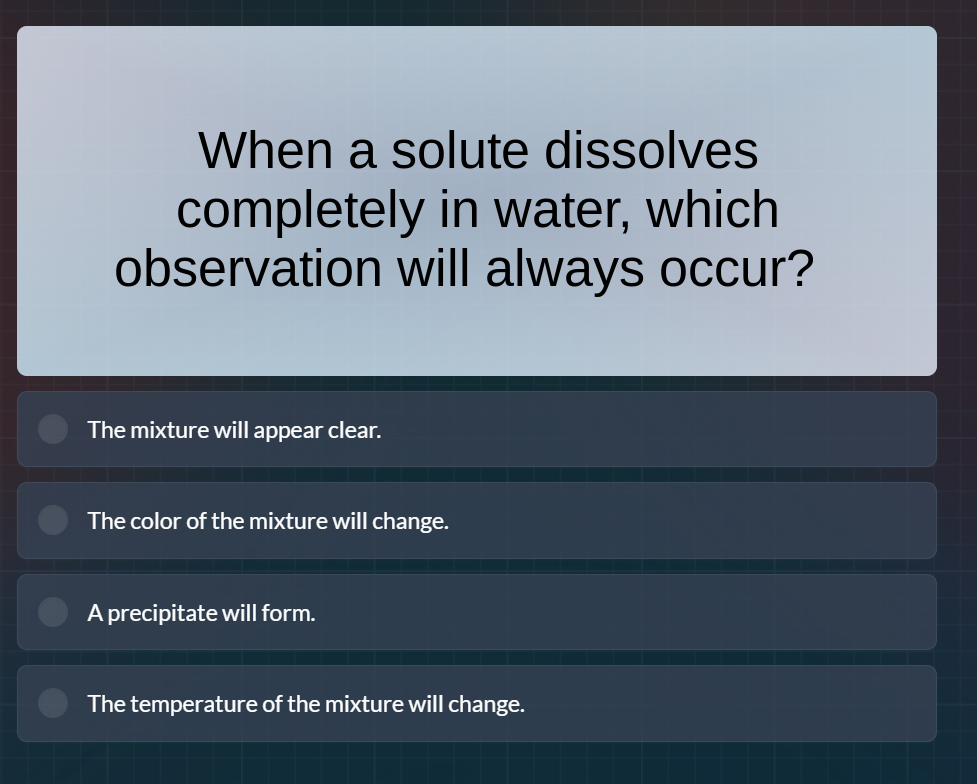
when a solute dissolves completely in water, which observation will always occur? the mixture will appear clear. the color of the mixture will change. a precipitate will form. the temperature of the mixture will change.
Brief Explanations
- For the option "The mixture will appear clear": When a solute dissolves completely in water, the solute particles are evenly dispersed at the molecular or ionic level, resulting in a homogeneous mixture (solution) that appears clear as the particles are too small to scatter light significantly.
- For "The color of the mixture will change": This is not always true. For example, dissolving table salt (NaCl) in water does not change the color of the mixture (both are colorless).
- For "A precipitate will form": A precipitate forms when an insoluble substance is produced, but when a solute dissolves completely, no precipitate is formed (precipitation is the opposite of dissolving completely).
- For "The temperature of the mixture will change": While some dissolving processes are exothermic or endothermic (e.g., dissolving ammonium nitrate cools the solution, dissolving sodium hydroxide warms it), not all solutes cause a temperature change when dissolving. For example, dissolving table salt in water has a negligible temperature change.

Snap & solve any problem in the app
Get step-by-step solutions on Sovi AI
Photo-based solutions with guided steps
Explore more problems and detailed explanations
A. The mixture will appear clear.