QUESTION IMAGE
Question
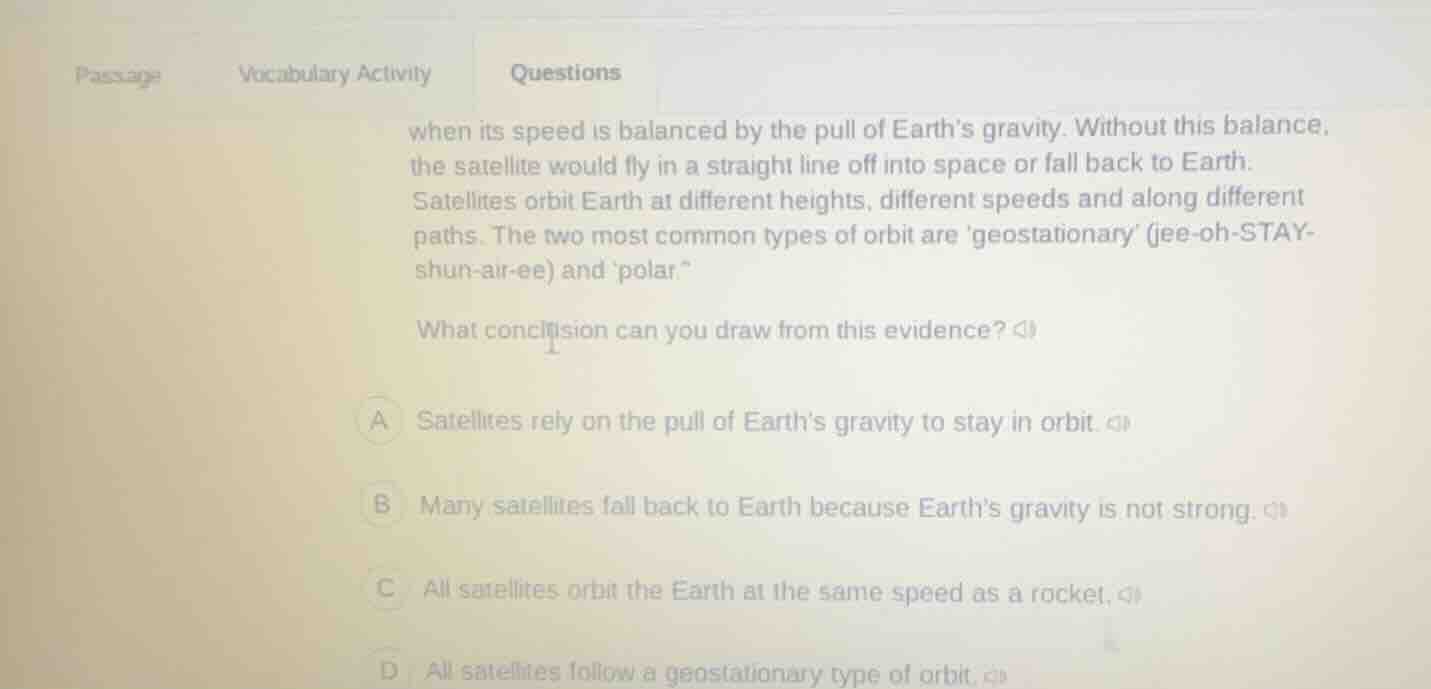
when its speed is balanced by the pull of earth’s gravity. without this balance, the satellite would fly in a straight line off into space or fall back to earth. satellites orbit earth at different heights, different speeds and along different paths. the two most common types of orbit are geostationary (jee - oh - stay - shun - air - ee) and polar. what conclusion can you draw from this evidence? a satellites rely on the pull of earth’s gravity to stay in orbit. b many satellites fall back to earth because earth’s gravity is not strong. c all satellites orbit the earth at the same speed as a rocket. d all satellites follow a geostationary type of orbit.
- Option A: The passage states that a satellite stays in orbit when its speed is balanced by Earth’s gravity, so satellites rely on Earth’s gravity to stay in orbit. This matches the evidence.
- Option B: The passage says without the balance of speed and gravity, a satellite would fall back, but there's no info about Earth’s gravity being not strong or many satellites falling back. Eliminate B.
- Option C: The passage mentions satellites orbit at different speeds, so they don't all have the same speed as a rocket (no info about rocket speed either). Eliminate C.
- Option D: The passage says the two most common orbits are geostationary and polar, so not all satellites follow geostationary orbit. Eliminate D.

Snap & solve any problem in the app
Get step-by-step solutions on Sovi AI
Photo-based solutions with guided steps
Explore more problems and detailed explanations
A. Satellites rely on the pull of Earth’s gravity to stay in orbit.