QUESTION IMAGE
Question
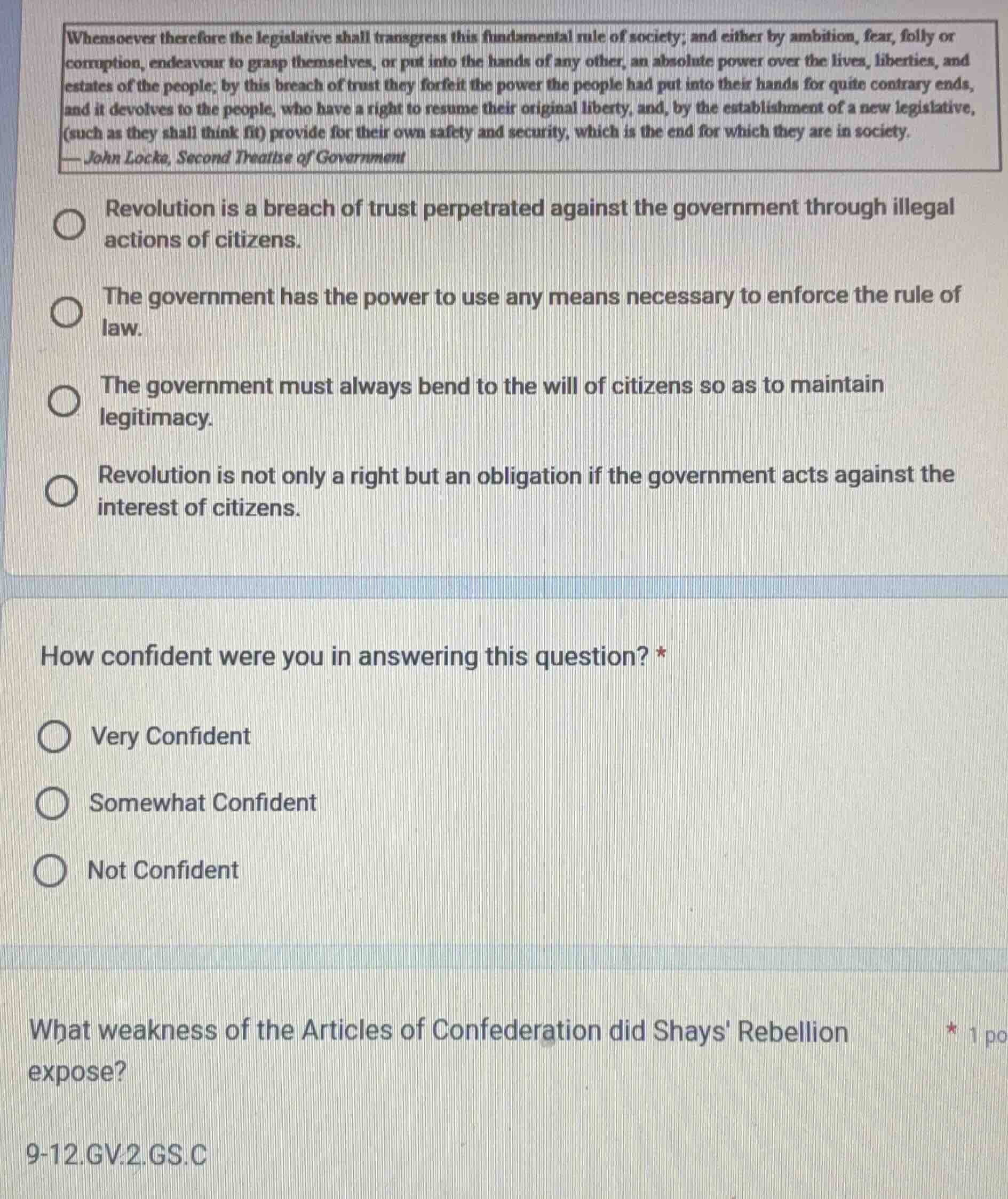
whensoever therefore the legislative shall transgress this fundamental rule of society; and either by ambition, fear, folly or corruption, endeavour to grasp themselves, or put into the hands of any other, an absolute power over the lives, liberties, and estates of the people; by this breach of trust they forfeit the power the people had put into their hands for quite contrary ends, and it devolves to the people, who have a right to resume their original liberty, and, by the establishment of a new legislative, (such as they shall think fit) provide for their own safety and security, which is the end for which they are in society. — john locke, second treatise of government revolution is a breach of trust perpetrated against the government through illegal actions of citizens. the government has the power to use any means necessary to enforce the rule of law. the government must always bend to the will of citizens so as to maintain legitimacy. revolution is not only a right but an obligation if the government acts against the interest of citizens. how confident were you in answering this question? * very confident somewhat confident not confident what weakness of the articles of confederation did shays rebellion expose? 9-12.gv.2.gs.c
First Question (John Locke Quote)
- Analyze each option:
- First option: The quote says the legislative (government) breaches trust, not citizens acting illegally. Eliminate.
- Second option: The quote is about government overreach, not government enforcing law. Eliminate.
- Third option: The quote says if government breaches trust, people can resume liberty and form new legislative, implying government must act in citizens' interest to stay legitimate (bend to will to maintain legitimacy).
- Fourth option: The quote says people have a right to revolution, but not an obligation. Eliminate.
- The confidence level is subjective, but for a student familiar with John Locke's theory (related to the first question) and the Articles of Confederation topic, a "Somewhat Confident" response is reasonable as these are standard US history/political science topics.
- Recall: Shays' Rebellion (1786 - 1787) was a revolt by Massachusetts farmers. The Articles of Confederation had a weak central government with no power to tax, raise an army, or enforce laws. The rebellion exposed that the national government (under Articles) lacked the power to put down internal rebellions (or address economic unrest effectively, as the central government couldn't help states with debt crises, and had no standing army to suppress the rebellion). Specifically, the Articles' weakness was the lack of a strong central government (or the federal government's inability to maintain order/raise troops).

Snap & solve any problem in the app
Get step-by-step solutions on Sovi AI
Photo-based solutions with guided steps
Explore more problems and detailed explanations
The government must always bend to the will of citizens so as to maintain legitimacy.
Second Question (Confidence)
This is a subjective question, but if we assume a typical response (or based on knowledge of the topic), a common choice could be "Somewhat Confident" (as the first question's topic is from political theory, which is learnable but requires recall).