QUESTION IMAGE
Question
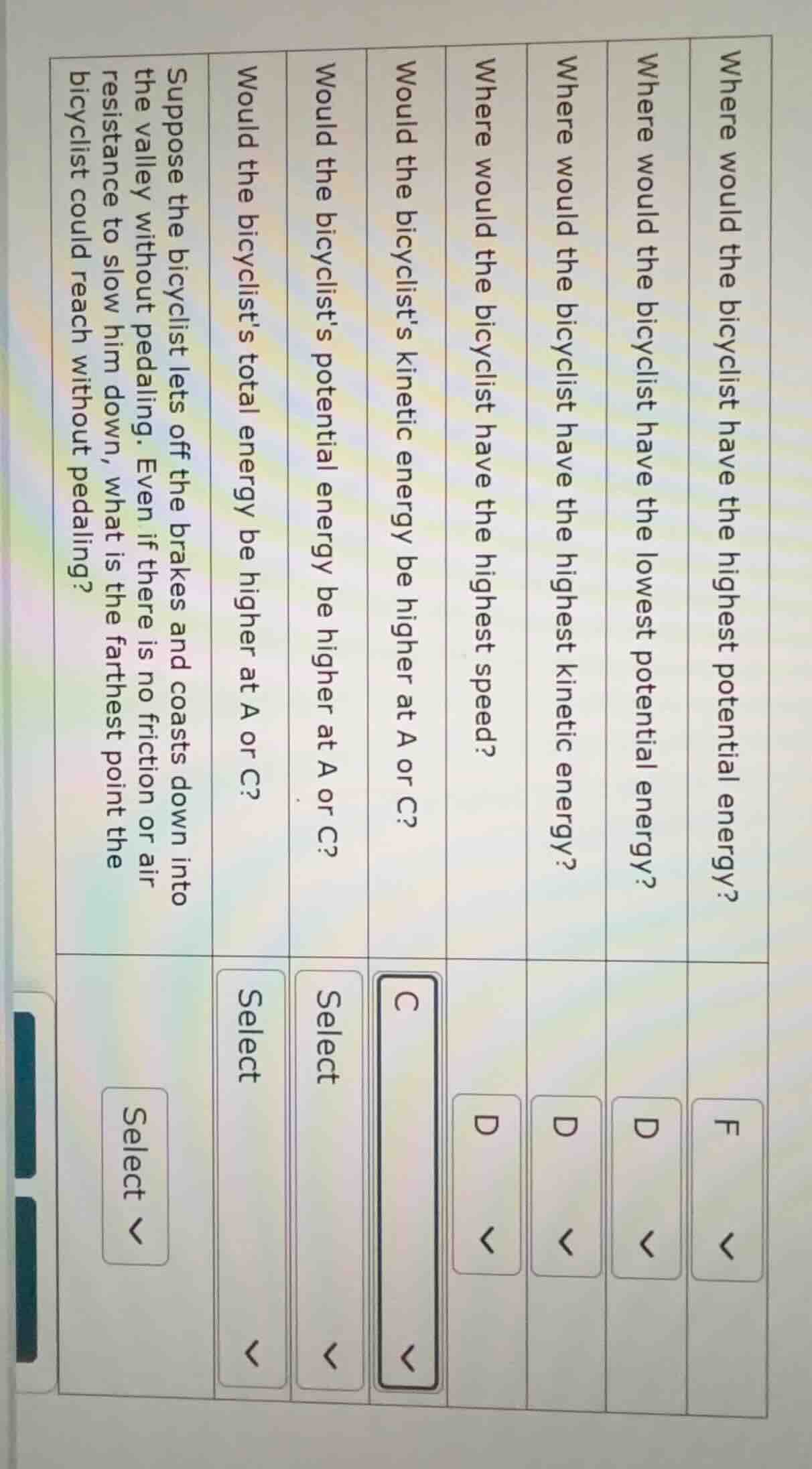
where would the bicyclist have the highest potential energy? f \
where would the bicyclist have the lowest potential energy? d \
where would the bicyclist have the highest kinetic energy? d \
where would the bicyclist have the highest speed? d \
would the bicyclists kinetic energy be higher at a or c? c \
would the bicyclists potential energy be higher at a or c? select \
would the bicyclists total energy be higher at a or c? select \
suppose the bicyclist lets off the brakes and coasts down into the valley without pedaling. even if there is no friction or air resistance to slow him down, what is the farthest point the bicyclist could reach without pedaling? select
To solve these questions, we use the principle of conservation of mechanical energy (potential energy + kinetic energy) and the relationship between speed, kinetic energy, and potential energy. Here are the answers to each sub - question:
1. Where would the bicyclist have the highest potential energy?
- Brief Explanations: Potential energy ($PE = mgh$, where $m$ is mass, $g$ is acceleration due to gravity, and $h$ is height) depends on height. The higher the position, the greater the potential energy. From the options, $F$ is at the highest height.
- Answer: F
2. Where would the bicyclist have the lowest potential energy?
- Brief Explanations: The lowest potential energy occurs at the lowest height. Among the options, $D$ is at the lowest height.
- Answer: D
3. Where would the bicyclist have the highest kinetic energy?
- Brief Explanations: Kinetic energy ($KE=\frac{1}{2}mv^{2}$, where $m$ is mass and $v$ is speed) is highest when speed is highest. The lowest point (where potential energy is lowest) will have the highest kinetic energy (by conservation of energy, as potential energy is converted to kinetic energy when moving down). $D$ is the lowest point, so kinetic energy is highest at $D$.
- Answer: D
4. Where would the bicyclist have the highest speed?
- Brief Explanations: Speed is related to kinetic energy ($KE=\frac{1}{2}mv^{2}$). Higher kinetic energy means higher speed. Since kinetic energy is highest at $D$ (from the previous question), speed is also highest at $D$.
- Answer: D
5. Would the bicyclist’s kinetic energy be higher at A or C?
- Brief Explanations: By conservation of mechanical energy, if we assume no non - conservative forces (friction, air resistance), the total mechanical energy is conserved. But if we consider the height, if $A$ is at a higher height than $C$, then at $A$ potential energy is higher and kinetic energy is lower. If $C$ is at a lower height than $A$, then kinetic energy at $C$ is higher (because potential energy at $C$ is lower, so more of the total energy is in the form of kinetic energy). From the context (as $C$ is a point in the valley - like path), $C$ is at a lower height than $A$, so kinetic energy at $C$ is higher.
- Answer: C
6. Would the bicyclist’s potential energy be higher at A or C?
- Brief Explanations: Potential energy depends on height ($PE = mgh$). If $A$ is at a higher height than $C$, then potential energy at $A$ is higher (since $h$ is greater for $A$).
- Answer: A
7. Would the bicyclist’s total energy be higher at A or C?
- Brief Explanations: In the absence of non - conservative forces (friction, air resistance), total mechanical energy (potential energy + kinetic energy) is conserved. So the total energy at $A$ and $C$ is the same.
- Answer: Same (A and C have the same total energy)
8. Suppose the bicyclist lets off the brakes and coasts down into the valley without pedaling. Even if there is no friction or air resistance to slow him down, what is the farthest point the bicyclist could reach without pedaling?
- Brief Explanations: By conservation of mechanical energy, the bicyclist can only reach a point where the potential energy is equal to the initial potential energy (since initial kinetic energy, if starting from rest, is zero). So he can reach a point at the same height as his starting point. If he starts from a point at height corresponding to $F$, he can reach a point at the same height as $F$ (let's say the point is symmetric to $F$ on the other side of the valley,…

Snap & solve any problem in the app
Get step-by-step solutions on Sovi AI
Photo-based solutions with guided steps
Explore more problems and detailed explanations
To solve these questions, we use the principle of conservation of mechanical energy (potential energy + kinetic energy) and the relationship between speed, kinetic energy, and potential energy. Here are the answers to each sub - question:
1. Where would the bicyclist have the highest potential energy?
- Brief Explanations: Potential energy ($PE = mgh$, where $m$ is mass, $g$ is acceleration due to gravity, and $h$ is height) depends on height. The higher the position, the greater the potential energy. From the options, $F$ is at the highest height.
- Answer: F
2. Where would the bicyclist have the lowest potential energy?
- Brief Explanations: The lowest potential energy occurs at the lowest height. Among the options, $D$ is at the lowest height.
- Answer: D
3. Where would the bicyclist have the highest kinetic energy?
- Brief Explanations: Kinetic energy ($KE=\frac{1}{2}mv^{2}$, where $m$ is mass and $v$ is speed) is highest when speed is highest. The lowest point (where potential energy is lowest) will have the highest kinetic energy (by conservation of energy, as potential energy is converted to kinetic energy when moving down). $D$ is the lowest point, so kinetic energy is highest at $D$.
- Answer: D
4. Where would the bicyclist have the highest speed?
- Brief Explanations: Speed is related to kinetic energy ($KE=\frac{1}{2}mv^{2}$). Higher kinetic energy means higher speed. Since kinetic energy is highest at $D$ (from the previous question), speed is also highest at $D$.
- Answer: D
5. Would the bicyclist’s kinetic energy be higher at A or C?
- Brief Explanations: By conservation of mechanical energy, if we assume no non - conservative forces (friction, air resistance), the total mechanical energy is conserved. But if we consider the height, if $A$ is at a higher height than $C$, then at $A$ potential energy is higher and kinetic energy is lower. If $C$ is at a lower height than $A$, then kinetic energy at $C$ is higher (because potential energy at $C$ is lower, so more of the total energy is in the form of kinetic energy). From the context (as $C$ is a point in the valley - like path), $C$ is at a lower height than $A$, so kinetic energy at $C$ is higher.
- Answer: C
6. Would the bicyclist’s potential energy be higher at A or C?
- Brief Explanations: Potential energy depends on height ($PE = mgh$). If $A$ is at a higher height than $C$, then potential energy at $A$ is higher (since $h$ is greater for $A$).
- Answer: A
7. Would the bicyclist’s total energy be higher at A or C?
- Brief Explanations: In the absence of non - conservative forces (friction, air resistance), total mechanical energy (potential energy + kinetic energy) is conserved. So the total energy at $A$ and $C$ is the same.
- Answer: Same (A and C have the same total energy)
8. Suppose the bicyclist lets off the brakes and coasts down into the valley without pedaling. Even if there is no friction or air resistance to slow him down, what is the farthest point the bicyclist could reach without pedaling?
- Brief Explanations: By conservation of mechanical energy, the bicyclist can only reach a point where the potential energy is equal to the initial potential energy (since initial kinetic energy, if starting from rest, is zero). So he can reach a point at the same height as his starting point. If he starts from a point at height corresponding to $F$, he can reach a point at the same height as $F$ (let's say the point is symmetric to $F$ on the other side of the valley, or if $F$ is the starting point, he can reach back to a point at the same height as $F$). But from the options, if we assume the starting point is related to $F$, the farthest point he can reach is a point at the same height as his starting point (for example, if $F$ is the starting height, he can reach a point like $F$ on the other side or the same height point). But based on the conservation of energy, he can reach a point with the same potential energy as his initial position. If we consider the labels, and assuming the initial position is at a height corresponding to $F$, the farthest point he can reach is a point at the same height as $F$ (for example, if there is a point symmetric to $F$ on the right - hand side of the valley, but from the given options and the context, the answer is a point at the same height as his starting point, which we can assume is related to $F$'s height, so the farthest point is a point with the same potential energy as the starting point, say a point at the same height as $F$ (if $F$ is the starting point). But more precisely, by conservation of energy, he can reach a point where $h$ is equal to his initial height, so if he starts from a height $h_{initial}$, he can reach a height $h_{final}=h_{initial}$. So the farthest point is a point at the same height as his starting point (for example, if starting from $F$, he can reach a point at the same height as $F$ on the other side of the valley).
- Answer: A point at the same height as the starting point (e.g., if starting from F, a point at the same height as F)