QUESTION IMAGE
Question
- which angle pairs form complementary angles?
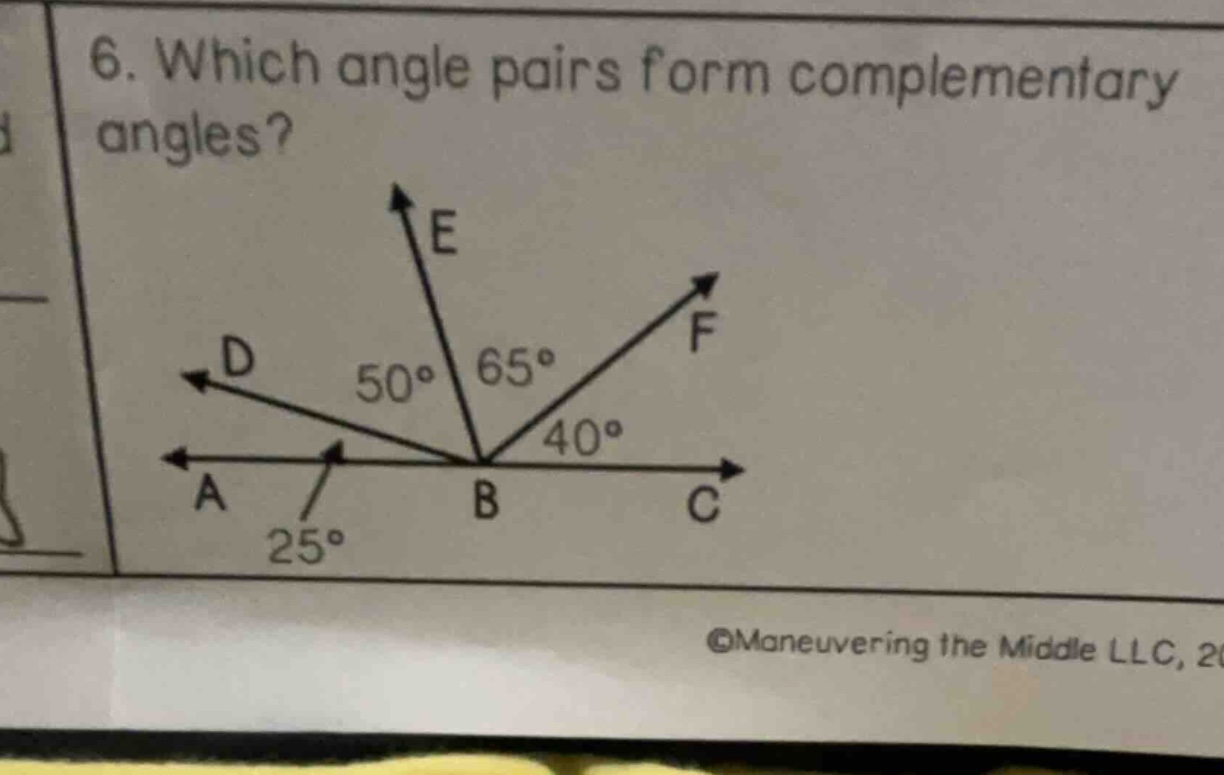
diagram with angles at point b: 25° between a and another ray, 50° between that ray (d) and e, 65° between e and f, 40° between f and c
Step1: Recall complementary angles
Complementary angles sum to \(90^\circ\). We check each angle pair.
Step2: Check \(\angle ABE\) (25°) and \(\angle EBF\) (65°)
\(25^\circ + 65^\circ = 90^\circ\), so they are complementary.
Step3: Check \(\angle DBE\) (50°) and \(\angle FBC\) (40°)
\(50^\circ + 40^\circ = 90^\circ\), so they are complementary.
Step4: Check \(\angle ABD\) (let's find it: total on left side. Wait, \(\angle ABC\) is straight, but for pairs: also, \(\angle ABE\) (25) + \(\angle EBF\) (65) = 90, \(\angle DBE\) (50) + \(\angle FBC\) (40)=90, and also \(\angle ABD\) (let's calculate: from A to D: total left of B: 25° (A to the small angle) + angle from small to D. Wait, maybe better to recheck. Wait, the angles at B:
- \(\angle ABE = 25^\circ\), \(\angle EBF = 65^\circ\): \(25 + 65 = 90\)
- \(\angle DBE = 50^\circ\), \(\angle FBC = 40^\circ\): \(50 + 40 = 90\)
- Also, \(\angle ABD\) (let's see: from A to D: the angle between A and D. Wait, the small angle from A to the middle is 25°, then from middle to D: let's see, total left of E: 25° + angle (A to D) + 50°? Wait, no, the straight line is A-B-C. So angles on left: 25° (A to the small arrow) + angle (small arrow to D) + 50° (D to E) = 180° - (65° + 40°) = 75°? Wait, maybe I overcomplicate. The key pairs are:
- \(25^\circ\) (e.g., \(\angle ABE\)) and \(65^\circ\) (\(\angle EBF\)): sum to 90.
- \(50^\circ\) (\(\angle DBE\)) and \(40^\circ\) (\(\angle FBC\)): sum to 90.

Snap & solve any problem in the app
Get step-by-step solutions on Sovi AI
Photo-based solutions with guided steps
Explore more problems and detailed explanations
The complementary angle pairs are \(\angle ABE\) (25°) and \(\angle EBF\) (65°), and \(\angle DBE\) (50°) and \(\angle FBC\) (40°). (Or in terms of angle labels: \(\angle ABE\) and \(\angle EBF\), \(\angle DBE\) and \(\angle FBC\))