QUESTION IMAGE
Question
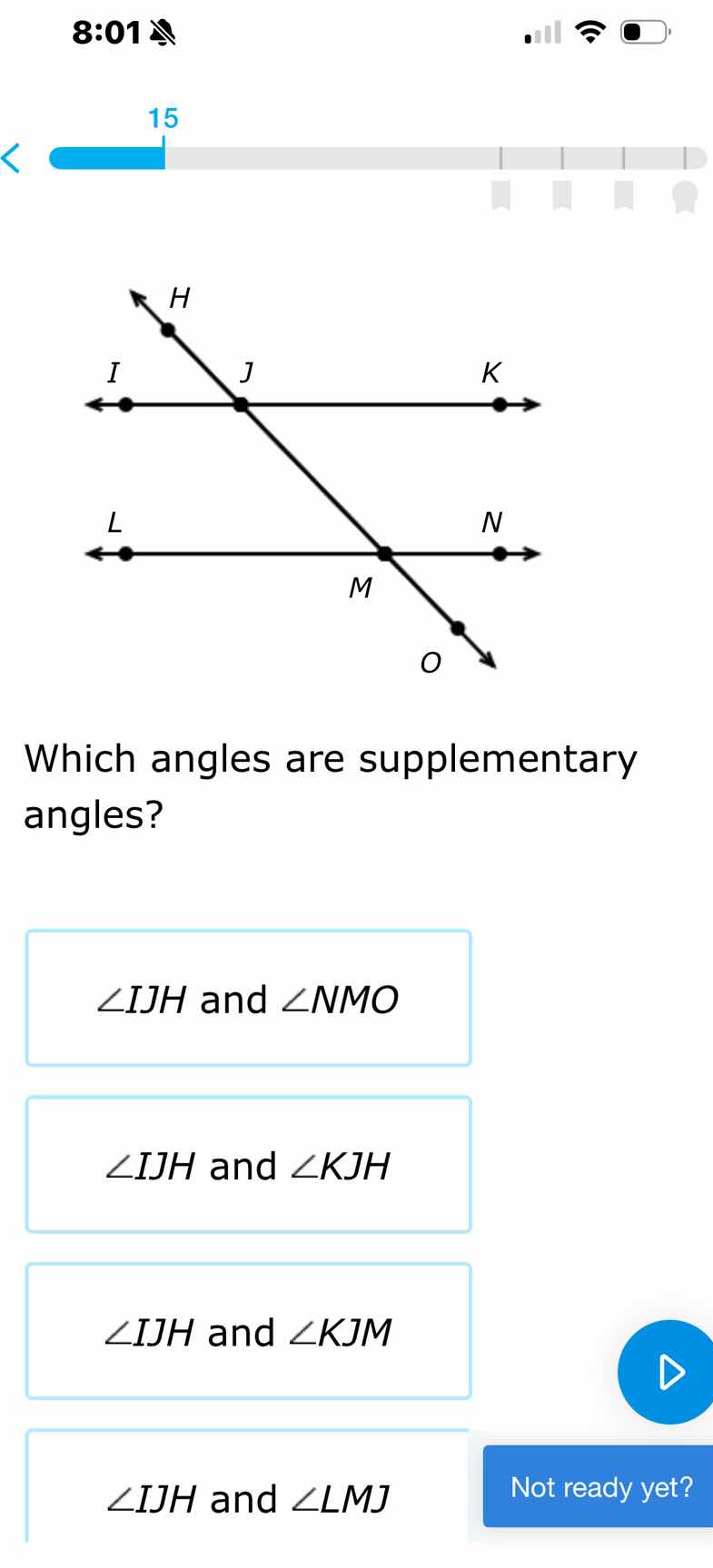
which angles are supplementary angles? ∠ijh and ∠nmo ∠ijh and ∠kjh ∠ijh and ∠kjm ∠ijh and ∠lmj
Brief Explanations
- Recall the definition of supplementary angles: two angles are supplementary if their sum is \(180^\circ\) (they form a linear pair or are adjacent angles on a straight line, or non - adjacent angles that add up to \(180^\circ\)).
- Analyze \(\angle IJH\) and \(\angle KJH\): \(\angle IJH\) and \(\angle KJH\) are adjacent angles that form a straight line (since \(IK\) is a straight line). So, \(\angle IJH+\angle KJH = 180^\circ\), which means they are supplementary.
- Analyze \(\angle IJH\) and \(\angle NMO\): \(\angle IJH\) and \(\angle NMO\) are corresponding angles (since \(IK\parallel LN\) and \(HO\) is a transversal), so they are equal, not supplementary.
- Analyze \(\angle IJH\) and \(\angle KJM\): \(\angle IJH\) and \(\angle KJM\) are alternate - interior angles (since \(IK\parallel LN\) and \(HO\) is a transversal), so they are equal, not supplementary.
- Analyze \(\angle IJH\) and \(\angle LMJ\): \(\angle IJH\) and \(\angle LMJ\) are not related in a way that their sum is \(180^\circ\). They are not a linear pair and do not satisfy the supplementary angle condition.

Snap & solve any problem in the app
Get step-by-step solutions on Sovi AI
Photo-based solutions with guided steps
Explore more problems and detailed explanations
\(\boldsymbol{\angle IJH}\) and \(\boldsymbol{\angle KJH}\) (the option: \(\angle IJH\) and \(\angle KJH\))