QUESTION IMAGE
Question
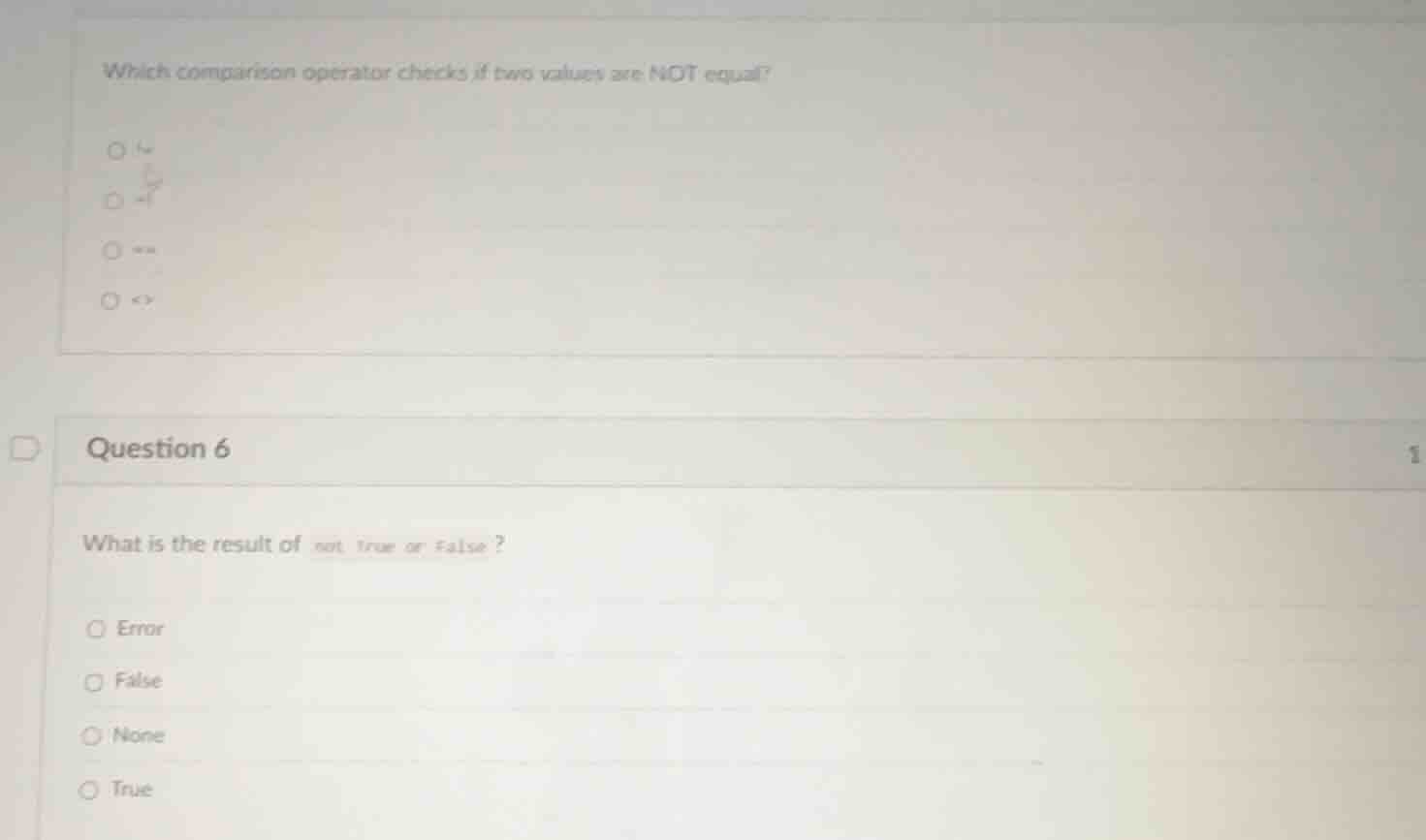
which comparison operator checks if two values are not equal?
○ <
○ =
○ ==
○ <>
question 6
what is the result of not true or false?
○ error
○ false
○ none
○ true
First Question (Comparison Operator for Not Equal)
In programming (often related to Computer Science, a subfield of Natural Science), the comparison operator to check if two values are NOT equal is typically != (or <> in some older syntax like SQL, but in many programming languages like Python, Java, etc., != is common). Let's analyze the options:
- The first option (assuming it's a typo or incorrect symbol) is not a standard not - equal operator.
- The second option (if it's
=) is an assignment operator, not a comparison operator for inequality. - The third option (if it's
==) is the equality comparison operator. - The fourth option (if it's
<>or!=- depending on the context, but in the context of this question, it's the operator for not equal).
Step 1: Evaluate not True
In boolean logic, not True is False because the not operator negates the boolean value.
Step 2: Evaluate False or False
The or operator in boolean logic returns True if at least one of the operands is True, and False if both operands are False. Here, both operands (not True which is False and False) are False, so False or False is False. Wait, no - wait, let's re - evaluate. Wait, the order of operations: not has higher precedence than or. So first, not True is False. Then we have False or False. Wait, no, wait: not True is False, then False or False is False? Wait, no, wait, maybe I made a mistake. Wait, not True is False, then False or False is False? But wait, let's check again. Wait, the expression is not True or False. Let's break it down:
not TrueisFalse.- Then we have
False or False. Theoroperation: in Python (for example),False or FalseisFalse. But wait, maybe the question is in a different context? Wait, no, boolean logic:A or BisTrueif either A or B isTrue. So if both areFalse, it'sFalse. Wait, but wait, maybe I messed up the precedence. Wait,notis evaluated first, sonot TrueisFalse, thenFalse or FalseisFalse. But wait, let's check with actual Python code:
In Python, print(not True or False) gives False? Wait, no, wait:
Wait, not True is False, then False or False is False? Wait, no, wait, or is a short - circuit operator. Wait, False or False is False. But wait, maybe the question has a typo? Wait, no, let's re - examine. Wait, not True is False, then False or False is False. But let's check again:
Wait, the expression is not True or False. Let's compute step by step:
not True→FalseFalse or False→False
Wait, but that seems wrong? Wait, no, maybe I made a mistake. Wait, or operator: if any of the operands is True, it returns True. If both are False, it returns False. So in this case, both are False, so the result is False.

Snap & solve any problem in the app
Get step-by-step solutions on Sovi AI
Photo-based solutions with guided steps
Explore more problems and detailed explanations
D. <> (or the option with the not - equal operator, assuming the fourth option is the not - equal operator)