QUESTION IMAGE
Question
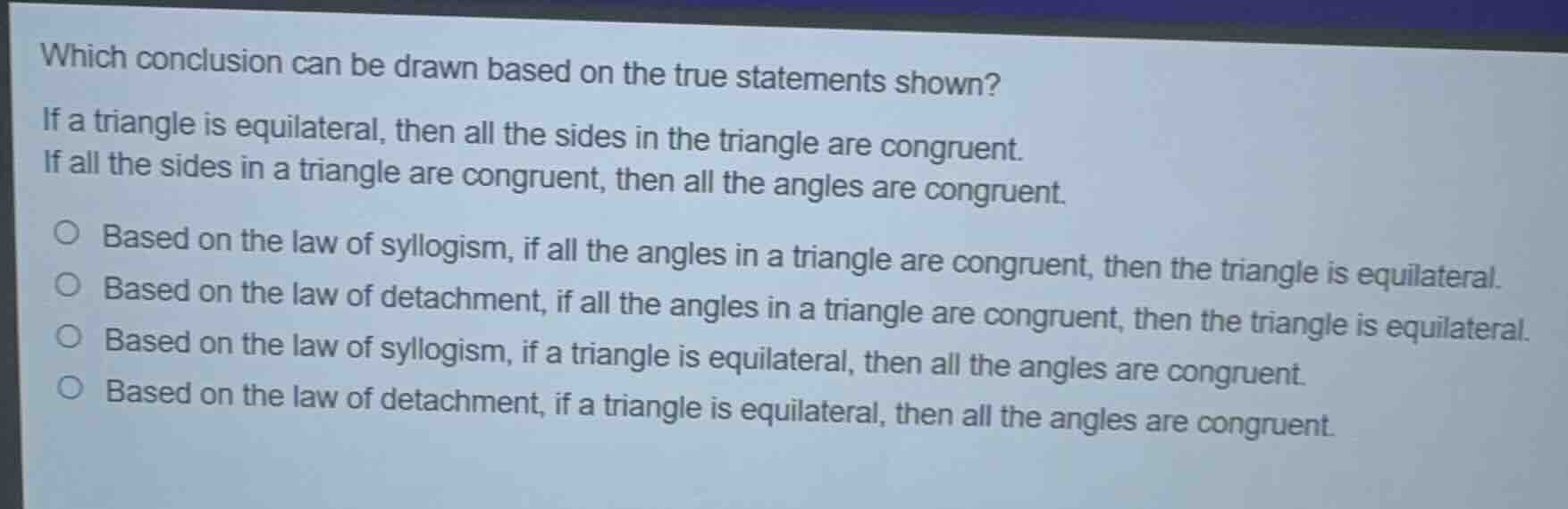
which conclusion can be drawn based on the true statements shown?
if a triangle is equilateral, then all the sides in the triangle are congruent.
if all the sides in a triangle are congruent, then all the angles are congruent.
based on the law of syllogism, if all the angles in a triangle are congruent, then the triangle is equilateral.
based on the law of detachment, if all the angles in a triangle are congruent, then the triangle is equilateral.
based on the law of syllogism, if a triangle is equilateral, then all the angles are congruent.
based on the law of detachment, if a triangle is equilateral, then all the angles are congruent.
The law of syllogism allows combining two conditional statements: If $P
ightarrow Q$ and $Q
ightarrow R$, then $P
ightarrow R$. Here, $P$ = "a triangle is equilateral", $Q$ = "all sides are congruent", $R$ = "all angles are congruent". The valid syllogism conclusion is $P
ightarrow R$. The law of detachment applies when we have a confirmed $P$ to conclude $Q$, which does not fit here. The reverse statements (starting with angle congruence) are not supported by the given conditionals.

Snap & solve any problem in the app
Get step-by-step solutions on Sovi AI
Photo-based solutions with guided steps
Explore more problems and detailed explanations
Based on the law of syllogism, if a triangle is equilateral, then all the angles are congruent.