QUESTION IMAGE
Question
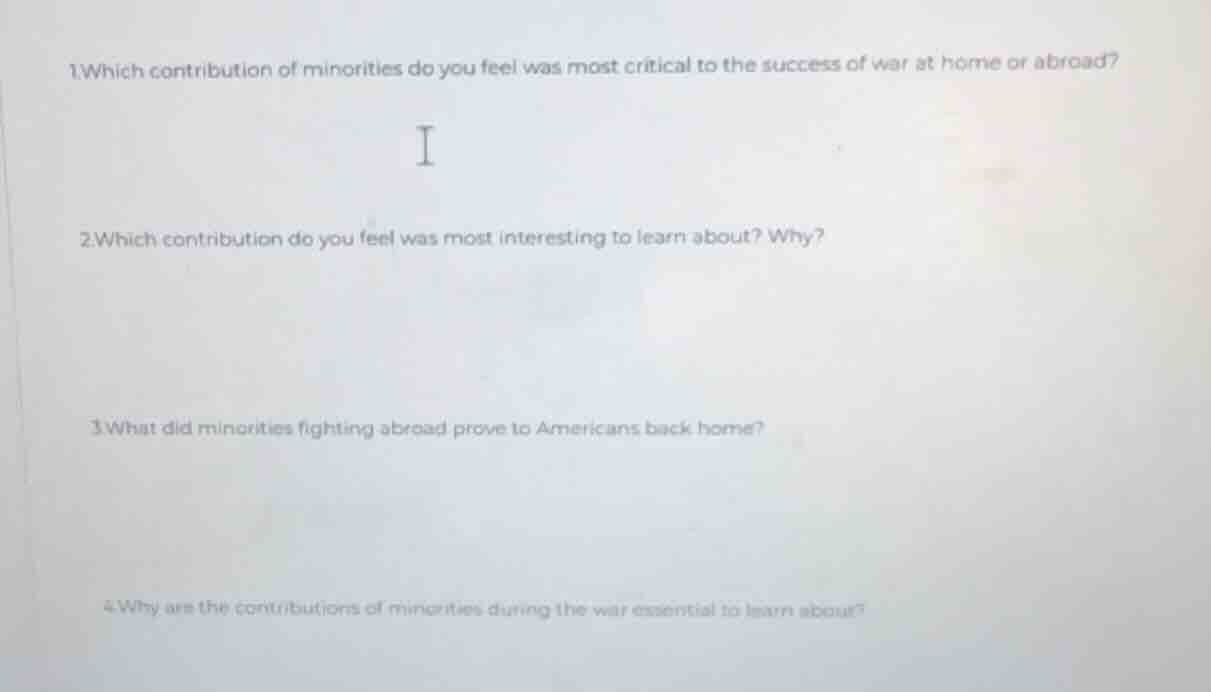
- which contribution of minorities do you feel was most critical to the success of war at home or abroad?
- which contribution do you feel was most interesting to learn about? why?
- what did minorities fighting abroad prove to americans back home?
- why are the contributions of minorities during the war essential to learn about?
These questions are related to the contributions of minorities during war, which falls under the Social Science discipline, specifically in the subfield of History (as it deals with historical events and contributions) or Sociology (as it deals with minority groups and their societal impact). Here are brief explanations and possible answers for each:
Question 1
To answer this, we consider the various contributions of minorities (e.g., African Americans, Hispanic Americans, Asian Americans, Native Americans) during wars (like World War I, World War II, etc.). For example, the labor contributions at home (working in factories, agriculture to support the war effort) or military contributions abroad (serving in segregated units, like the Tuskegee Airmen in WWII). A critical contribution could be the military service abroad, as minority soldiers fought bravely, helping secure victories, and also the labor at home that kept the economy and war production going. For instance, African American soldiers in combat units proved their valor, and their service, along with the home - front labor, was crucial.
The most interesting contribution could vary based on personal interest. For example, the code - talking of Native Americans (like the Navajo code talkers in WWII) is often interesting. They used their native language to create an unbreakable code, which was crucial for communication in the Pacific theater. The reason it's interesting is that it combined cultural heritage with a unique military strategy, and it showed how a minority group's cultural asset was leveraged for the war effort.
Minorities fighting abroad proved several things to Americans back home. Firstly, they proved that they were loyal Americans, willing to risk their lives for their country, despite facing discrimination at home. Secondly, their bravery and competence in combat proved that the racial and ethnic stereotypes about them were wrong. For example, African American soldiers in combat showed that they were just as capable and brave as white soldiers, challenging the idea of white superiority. This helped to plant the seeds for future civil rights movements, as it became harder to justify segregation and discrimination when minorities were proving their worth on the battlefield.

Snap & solve any problem in the app
Get step-by-step solutions on Sovi AI
Photo-based solutions with guided steps
Explore more problems and detailed explanations
One of the most critical contributions of minorities was their military service abroad. For example, the Tuskegee Airmen (African American pilots) in World War II flew numerous successful missions, protecting Allied bombers and helping to secure air superiority. Their skill and bravery were instrumental in the success of air campaigns. Additionally, minority workers at home, such as African Americans and Hispanic Americans, filled jobs in war - related industries (like aircraft manufacturing, shipbuilding), ensuring that the military had the necessary equipment and supplies. Without their labor, the war production effort would have been severely hampered, affecting the success of the war both at home and abroad.