QUESTION IMAGE
Question
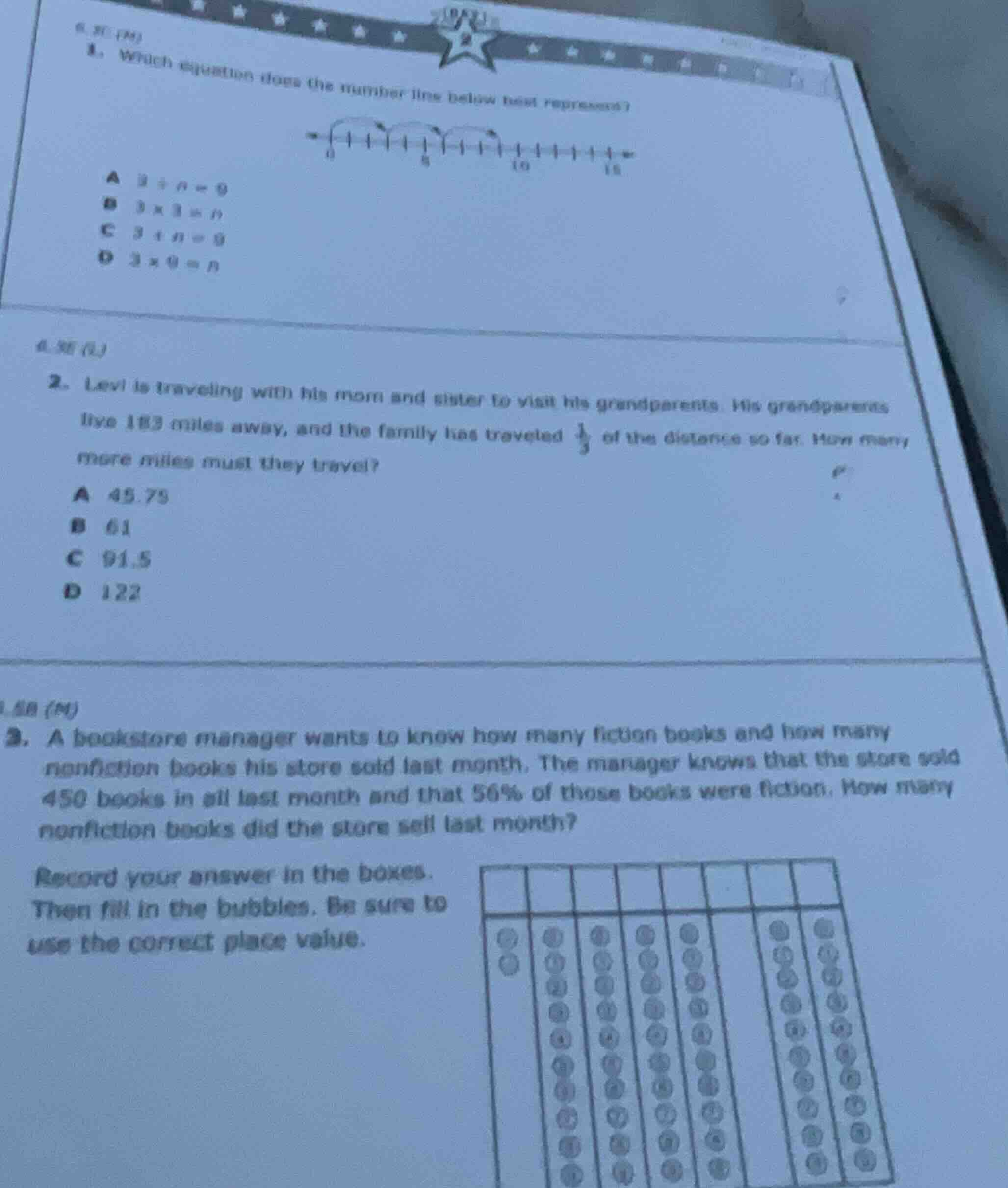
- which equation does the number line below best represent? number line image a 3 + 6 = 9 b 3 × 3 = 9 c 3 + 9 = 12 d 3 × 9 = 27 2. levi is traveling with his mom and sister to visit his grandparents. his grandparents live 183 miles away, and the family has traveled \\(\frac{1}{3}\\) of the distance so far. how many more miles must they travel? a 45.75 b 61 c 91.5 d 122 3. a bookstore manager wants to know how many fiction books and how many nonfiction books his store sold last month. the manager knows that the store sold 450 books in all last month and that 56% of those books were fiction. how many nonfiction books did the store sell last month? record your answer in the boxes. then fill in the bubbles. be sure to use the correct place value. answer grid image
Question 1
Step1: Analyze the number line
The number line has 3 jumps, each of length 3 (since from 0, first jump to 3, second to 6, third to 9? Wait, maybe each segment is 3? Wait, the options are about 3 and n. Let's check the options. Option B: \(3\times3 = n\) (wait, maybe the number line shows 3 groups of 3, so total is 9. So the equation is \(3\times3 = n\) or maybe \(3 + 3+ 3=9\) which is \(3\times3 = 9\), so the equation is \(3\times3 = n\) (if n=9) or \(3 + n=9\)? Wait, no. Wait the options: A: \(3\div n = 9\) (no), B: \(3\times3 = n\) (n=9), C: \(3 + n=9\) (n=6), D: \(3\times9 = n\) (n=27). Wait the number line: let's see, the first jump is from 0 to 3, second from 3 to 6, third from 6 to 9? Wait no, maybe each jump is 3 units, 3 jumps. So total is \(3\times3 = 9\), so the equation is \(3\times3 = n\) (n=9). So option B.
Step2: Check each option
- Option A: \(3\div n = 9\) → \(n = 3/9 = 1/3\), not matching.
- Option B: \(3\times3 = n\) → \(n = 9\), matches the number line (3 jumps of 3, total 9).
- Option C: \(3 + n = 9\) → \(n = 6\), not matching.
- Option D: \(3\times9 = n\) → \(n = 27\), not matching.
Step1: Find the remaining fraction
Total distance is 183 miles. They traveled \( \frac{1}{3} \) of the distance, so remaining fraction is \( 1 - \frac{1}{3} = \frac{2}{3} \).
Step2: Calculate remaining miles
Remaining miles = \( 183 \times \frac{2}{3} \). Let's compute: \( 183 \div 3 = 61 \), then \( 61 \times 2 = 122 \)? Wait no, wait \( \frac{1}{3} \) of 183 is \( 183 \times \frac{1}{3} = 61 \) miles traveled. So remaining is \( 183 - 61 = 122 \) miles. Wait but option D is 122. Wait but let's check again. Wait \( 1 - \frac{1}{3} = \frac{2}{3} \), so \( 183 \times \frac{2}{3} = (183 \div 3) \times 2 = 61 \times 2 = 122 \). So option D.
Step3: Check options
- Option A: 45.75 (no)
- Option B: 61 (traveled distance, not remaining)
- Option C: 91.5 (no)
- Option D: 122 (remaining distance)
Step1: Find the percentage of nonfiction books
Total books: 450. Fiction books: 56% of 450. So nonfiction books: \( (100\% - 56\%) \) of 450 = \( 44\% \) of 450.
Step2: Calculate 44% of 450
\( 44\% = 0.44 \), so \( 450 \times 0.44 = 450 \times \frac{44}{100} = 450 \times 0.44 \). Let's compute: \( 450 \times 0.4 = 180 \), \( 450 \times 0.04 = 18 \), so total \( 180 + 18 = 198 \). Wait, wait 56% of 450 is \( 450 \times 0.56 = 252 \), so nonfiction is \( 450 - 252 = 198 \).

Snap & solve any problem in the app
Get step-by-step solutions on Sovi AI
Photo-based solutions with guided steps
Explore more problems and detailed explanations
B. \(3\times3 = n\)