QUESTION IMAGE
Question
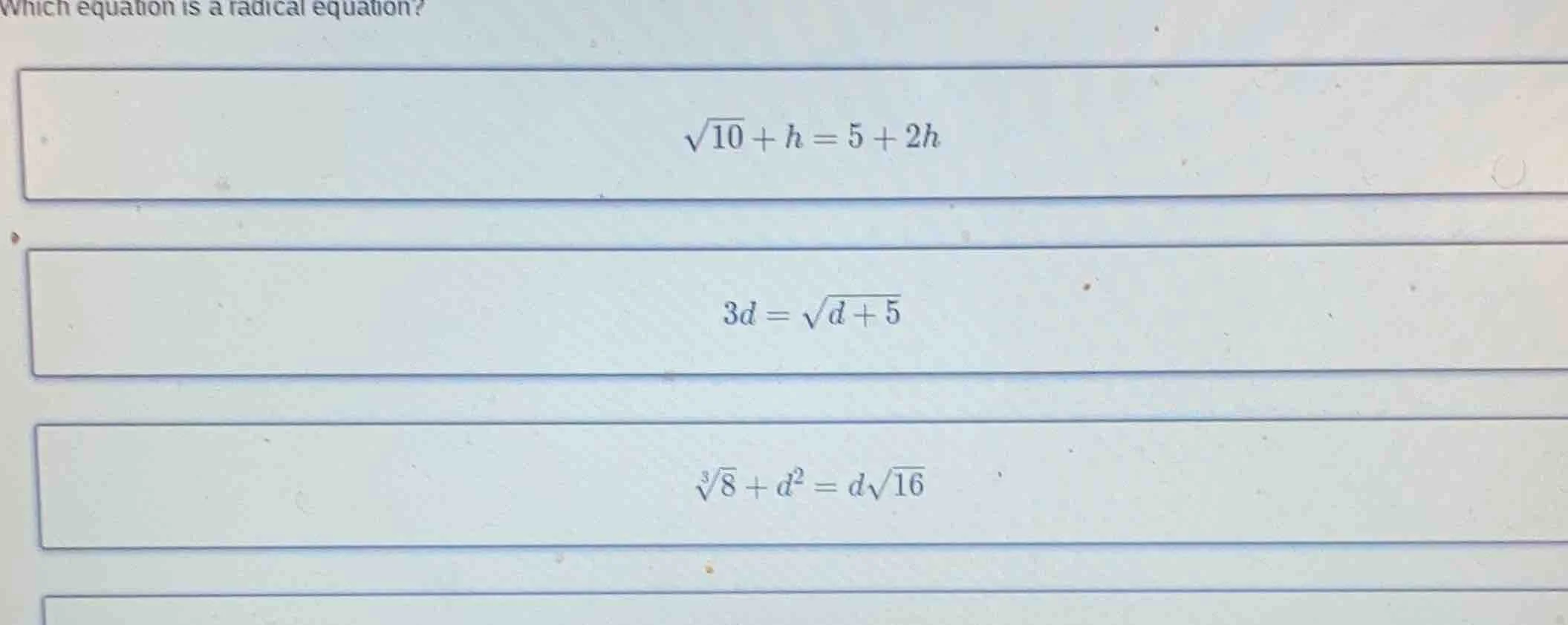
which equation is a radical equation?
\\(\sqrt{10} + h = 5 + 2h\\)
\\(3d = \sqrt{d + 5}\\)
\\(\sqrt3{8} + d^2 = d\sqrt{16}\\)
Step1: Define radical equation
A radical equation has a variable under a radical.
Step2: Analyze first equation
$\sqrt{10}+h=5+2h$: $\sqrt{10}$ is constant, no variable under radical.
Step3: Analyze second equation
$3d=\sqrt{d+5}$: Variable $d$ is under the square root.
Step4: Analyze third equation
$\sqrt[3]{8}+d^2=d\sqrt{16}$: $\sqrt[3]{8}=2$, $\sqrt{16}=4$, no variable under radical.

Snap & solve any problem in the app
Get step-by-step solutions on Sovi AI
Photo-based solutions with guided steps
Explore more problems and detailed explanations
$3d = \sqrt{d+5}$