QUESTION IMAGE
Question
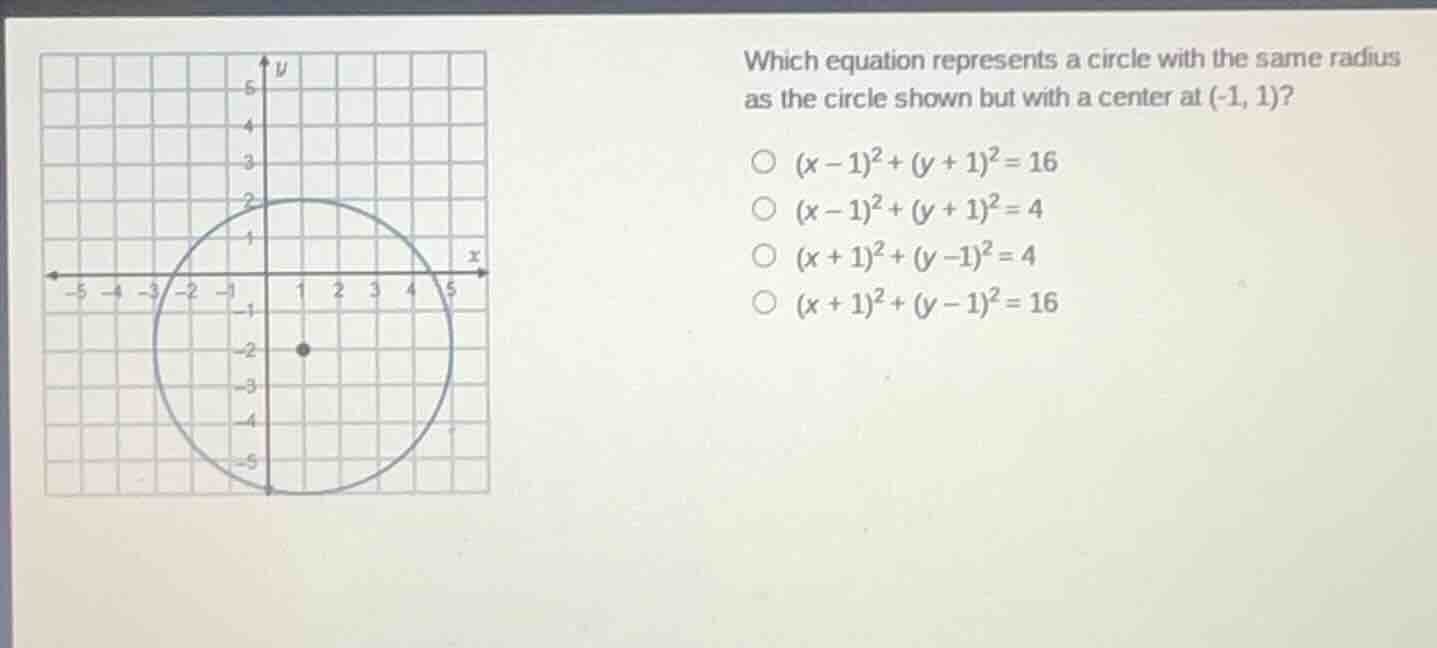
which equation represents a circle with the same radius as the circle shown but with a center at (-1,1)?$\bigcirc (x - 1)^2 + (y + 1)^2 = 16$$\bigcirc (x - 1)^2 + (y + 1)^2 = 4$$\bigcirc (x + 1)^2 + (y - 1)^2 = 4$$\bigcirc (x + 1)^2 + (y - 1)^2 = 16$
Step1: Find center of given circle
From the graph, the center is $(1, -2)$.
Step2: Calculate radius of given circle
Count horizontal distance from center to edge: $4 - 1 = 3$? No, wait, the circle reaches $x=4$ and $x=-2$, so radius $r = \frac{4 - (-2)}{2} = 3$? No, wait, the circle touches $y=2$ and $y=-5$? No, wait, the circle goes from $x=-2$ to $x=4$, so diameter is $4 - (-2) = 6$, radius $r=3$? No, wait, the standard circle equation is $(x-h)^2+(y-k)^2=r^2$. Wait, the center is $(1,-2)$, and the circle passes through $(4,0)$: distance is $\sqrt{(4-1)^2+(0+2)^2}=\sqrt{9+4}=\sqrt{13}$? No, wait, the circle touches $x=4$ and $x=-2$, so the horizontal distance from center $(1,-2)$ to $x=4$ is $3$, vertical distance from center to $y=2$ is $4$. Oh, wait, the circle's bottom is at $y=-5$, so vertical distance from $(1,-2)$ to $(1,-5)$ is $3$. Wait, no, the circle's rightmost point is $(4,0)$, leftmost $(-2,0)$, top $(1,2)$, bottom $(1,-5)$? No, that's not a circle. Wait, no, the circle is symmetric: center $(1,-2)$, radius is the distance from center to $(4,-2)$: $4-1=3$, yes, that's a horizontal point. So $r=3$, $r^2=9$? No, the options have 16 and 4. Wait, wait, the center is $(1,-2)$, and the circle goes to $(1,2)$: distance is $2 - (-2)=4$, so radius $r=4$, $r^2=16$. Oh right! The top of the circle is at $y=2$, center at $y=-2$, so $2 - (-2)=4$, that's the radius. So $r=4$, $r^2=16$.
Step3: Write new circle equation
New center is $(-1,1)$. The standard form is $(x-h)^2+(y-k)^2=r^2$, where $(h,k)$ is center. Substitute $h=-1$, $k=1$, $r^2=16$:
$(x - (-1))^2 + (y - 1)^2 = 16$
Simplify: $(x+1)^2+(y-1)^2=16$

Snap & solve any problem in the app
Get step-by-step solutions on Sovi AI
Photo-based solutions with guided steps
Explore more problems and detailed explanations
D. $(x + 1)^2 + (y - 1)^2 = 16$