QUESTION IMAGE
Question
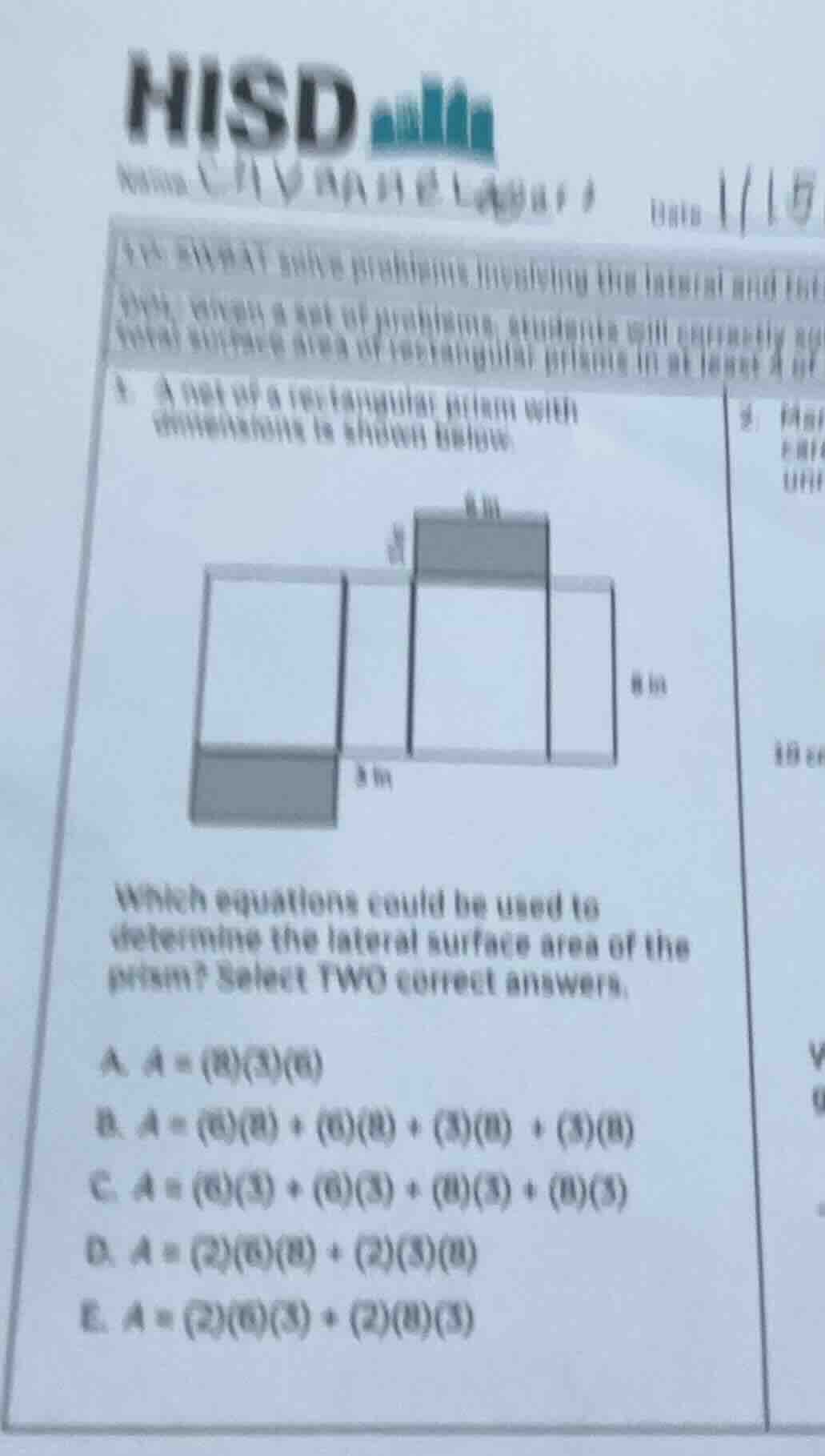
which equations could be used to determine the lateral surface area of the prism? select two correct answers. a. $a = (8)(3)(6)$ b. $a = (6)(8) + (6)(8) + (3)(8) + (3)(8)$ c. $a = (6)(3) + (6)(3) + (8)(3) + (8)(3)$ d. $a = (2)(6)(8) + (2)(3)(8)$ e. $a = (2)(6)(3) + (2)(8)(3)$
To determine the lateral surface area of a rectangular prism, we use the formula for the lateral surface area of a rectangular prism, which is the sum of the areas of the four lateral faces. The formula can also be written as \( A = 2(lh + wh) \), where \( l \) is the length, \( w \) is the width, and \( h \) is the height.
From the diagram, we can identify the dimensions: length \( l = 8 \) in, width \( w = 3 \) in, and height \( h = 6 \) in.
Step 1: Analyze Option B
The lateral surface area is the sum of the areas of the four rectangular faces. There are two pairs of congruent rectangles: two with dimensions \( 6 \times 8 \) and two with dimensions \( 3 \times 8 \). So the area would be:
\[
A = (6)(8) + (6)(8) + (3)(8) + (3)(8)
\]
This is a valid way to calculate the lateral surface area by adding the areas of each lateral face.
Step 2: Analyze Option D
We can factor out the common terms. The two \( 6 \times 8 \) faces can be written as \( 2(6)(8) \) and the two \( 3 \times 8 \) faces can be written as \( 2(3)(8) \). So the area is:
\[
A = (2)(6)(8) + (2)(3)(8)
\]
This is also a valid way to calculate the lateral surface area by grouping the congruent faces.
Now let's check the other options:
- Option A: \( A=(8)(3)(6) \) is the formula for the volume of the prism, not the lateral surface area.
- Option C: \( A=(6)(3)+(6)(3)+(8)(3)+(8)(3) \) uses the wrong height (it should be 8 instead of 3 for the lateral faces).
- Option E: \( A=(2)(6)(3)+(2)(8)(3) \) is the formula for the surface area including the top and bottom faces (total surface area), not the lateral surface area.

Snap & solve any problem in the app
Get step-by-step solutions on Sovi AI
Photo-based solutions with guided steps
Explore more problems and detailed explanations
B. \( A = (6)(8) + (6)(8) + (3)(8) + (3)(8) \)
D. \( A = (2)(6)(8) + (2)(3)(8) \)