QUESTION IMAGE
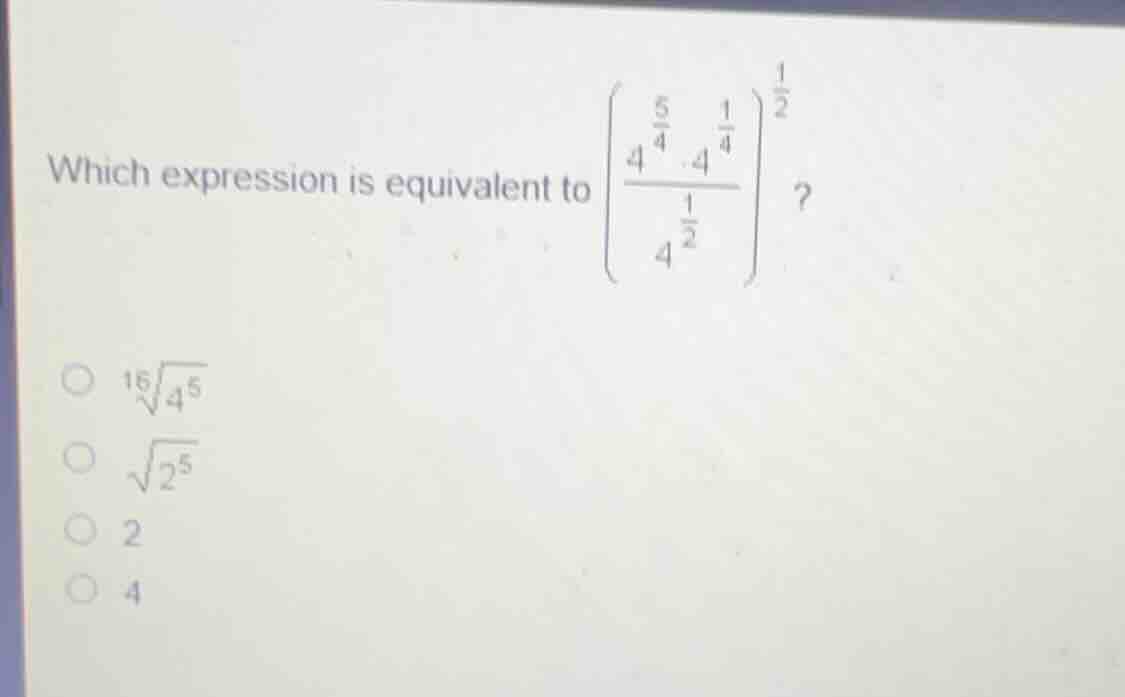
Question
which expression is equivalent to \\(\left(\frac{4^{\frac{5}{4}} \cdot 4^{\frac{1}{4}}}{4^{\frac{1}{2}}}\
ight)^{\frac{1}{2}}\\)? \\(\sqrt16{4^5}\\) \\(\sqrt{2^5}\\) 2 4
Step1: Simplify numerator using exponent rule \(a^m \cdot a^n = a^{m + n}\)
For \(4^{\frac{5}{4}} \cdot 4^{\frac{1}{4}}\), we add the exponents: \(\frac{5}{4}+\frac{1}{4}=\frac{6}{4}=\frac{3}{2}\). So the numerator becomes \(4^{\frac{3}{2}}\).
Step2: Simplify the fraction inside the parentheses
Now we have \(\frac{4^{\frac{3}{2}}}{4^{\frac{1}{2}}}\). Using the exponent rule \(\frac{a^m}{a^n}=a^{m - n}\), we subtract the exponents: \(\frac{3}{2}-\frac{1}{2}=\frac{2}{2} = 1\). So the fraction simplifies to \(4^{1}\).
Step3: Apply the outer exponent \(\frac{1}{2}\)
We now have \((4^{1})^{\frac{1}{2}}\). Using the exponent rule \((a^m)^n=a^{m\cdot n}\), we multiply the exponents: \(1\times\frac{1}{2}=\frac{1}{2}\)? Wait, no, wait. Wait, in step 2, we had \(\frac{4^{\frac{3}{2}}}{4^{\frac{1}{2}}}=4^{\frac{3}{2}-\frac{1}{2}} = 4^{1}\)? Wait, no, \(\frac{3}{2}-\frac{1}{2}=1\), so \(4^{1}\). Then raising to the \(\frac{1}{2}\) power: \((4^{1})^{\frac{1}{2}}=4^{\frac{1}{2}}\). But \(4^{\frac{1}{2}}=\sqrt{4}=2\)? Wait, no, wait, maybe I made a mistake in step 2. Wait, let's re - do step 2.
Wait, original numerator: \(4^{\frac{5}{4}}\cdot4^{\frac{1}{4}}=4^{\frac{5 + 1}{4}}=4^{\frac{6}{4}}=4^{\frac{3}{2}}\). Denominator: \(4^{\frac{1}{2}}\). So \(\frac{4^{\frac{3}{2}}}{4^{\frac{1}{2}}}=4^{\frac{3}{2}-\frac{1}{2}}=4^{\frac{2}{2}} = 4^{1}\). Then the expression inside the parentheses is \(4^{1}\), and we raise it to the \(\frac{1}{2}\) power: \((4^{1})^{\frac{1}{2}}=4^{\frac{1}{2}}\). But \(4^{\frac{1}{2}}=\sqrt{4} = 2\)? Wait, no, wait, maybe I messed up the exponent addition. Wait, \(\frac{5}{4}+\frac{1}{4}=\frac{6}{4}=\frac{3}{2}\), correct. Then \(\frac{3}{2}-\frac{1}{2}=1\), correct. Then \((4^{1})^{\frac{1}{2}}=4^{\frac{1}{2}} = 2\)? Wait, but let's check the answer options. One of the options is 2. Wait, but let's check again.
Wait, another way: \(4 = 2^{2}\). Let's rewrite everything in terms of base 2.
\(4^{\frac{5}{4}}=(2^{2})^{\frac{5}{4}}=2^{\frac{10}{4}}=2^{\frac{5}{2}}\)
\(4^{\frac{1}{4}}=(2^{2})^{\frac{1}{4}}=2^{\frac{2}{4}}=2^{\frac{1}{2}}\)
\(4^{\frac{1}{2}}=(2^{2})^{\frac{1}{2}}=2^{1}\)
Now, numerator: \(2^{\frac{5}{2}}\cdot2^{\frac{1}{2}}=2^{\frac{5 + 1}{2}}=2^{\frac{6}{2}}=2^{3}\)
Denominator: \(2^{1}\)
So the fraction inside the parentheses: \(\frac{2^{3}}{2^{1}}=2^{3 - 1}=2^{2}\)
Now, raise to the \(\frac{1}{2}\) power: \((2^{2})^{\frac{1}{2}}=2^{2\times\frac{1}{2}}=2^{1}=2\)

Snap & solve any problem in the app
Get step-by-step solutions on Sovi AI
Photo-based solutions with guided steps
Explore more problems and detailed explanations
2 (the option with "2")