QUESTION IMAGE
Question
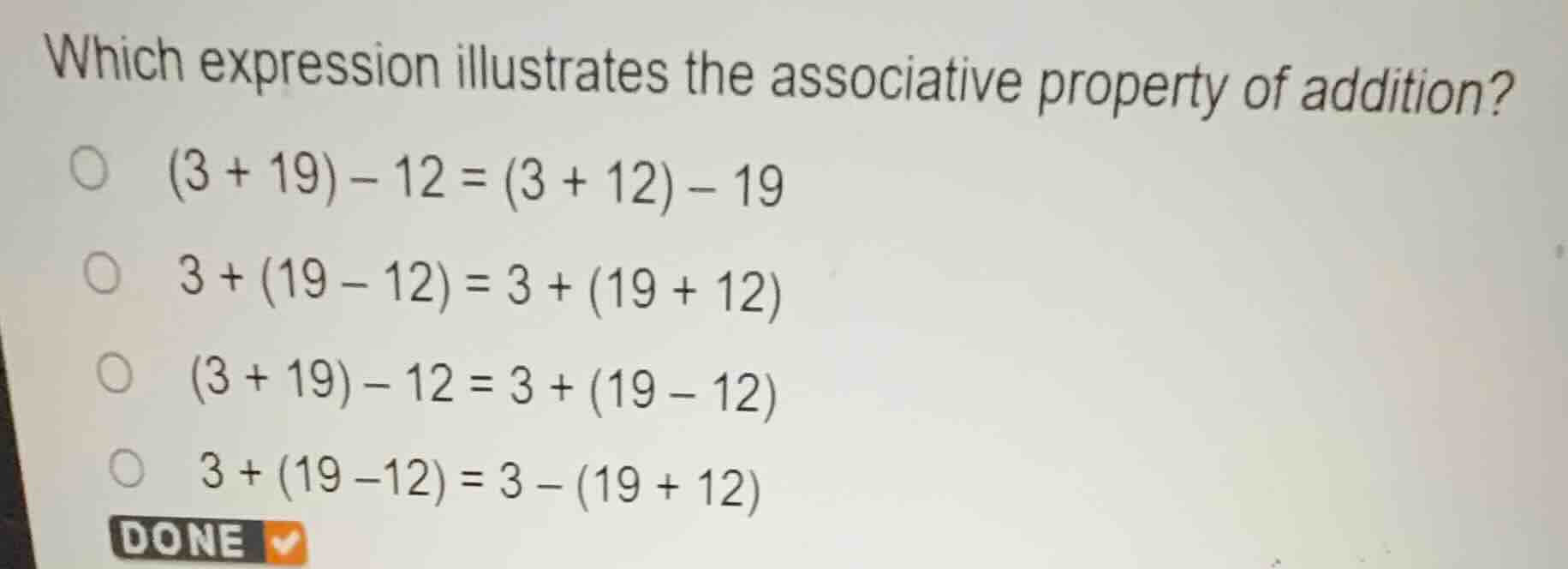
which expression illustrates the associative property of addition? (3 + 19) − 12 = (3 + 12) − 19 3 + (19 − 12) = 3 + (19 + 12) (3 + 19) − 12 = 3 + (19 − 12) 3 + (19 −12) = 3 − (19 + 12)
Step1: Recall Associative Property
The associative property of addition (or subtraction, in the context of grouped operations) states that the way in which numbers are grouped in an addition or subtraction expression does not change the result. Mathematically, for operations like \((a + b) - c\) and \(a + (b - c)\), if the grouping changes but the order of numbers and operations (with sign considerations) remains consistent, it follows the associative property.
Step2: Analyze Each Option
- Option 1: \((3 + 19) - 12 = (3 + 12) - 19\)
The right - hand side has \(12\) and \(19\) swapped in the grouped part, and the operation signs are not consistent (left has \(+19 - 12\), right has \(+12-19\)), so this is not associative.
- Option 2: \(3+(19 - 12)=3+(19 + 12)\)
The operation inside the parentheses changes from subtraction to addition (\(19 - 12\) vs \(19+12\)), so this does not follow the associative property.
- Option 3: \((3 + 19)-12 = 3+(19 - 12)\)
Here, we are changing the grouping of the numbers. On the left - hand side, we first add \(3\) and \(19\) and then subtract \(12\). On the right - hand side, we first subtract \(12\) from \(19\) and then add \(3\). The order of the numbers and the operations (with their signs) are preserved, just the grouping is changed, which matches the associative property.
- Option 4: \(3+(19 - 12)=3-(19 + 12)\)
The operation on the right - hand side changes from addition of \(3\) to subtraction of \(3\) and the operation inside the parentheses changes from subtraction to addition, so this does not follow the associative property.

Snap & solve any problem in the app
Get step-by-step solutions on Sovi AI
Photo-based solutions with guided steps
Explore more problems and detailed explanations
\((3 + 19)-12 = 3+(19 - 12)\) (the third option)