QUESTION IMAGE
Question
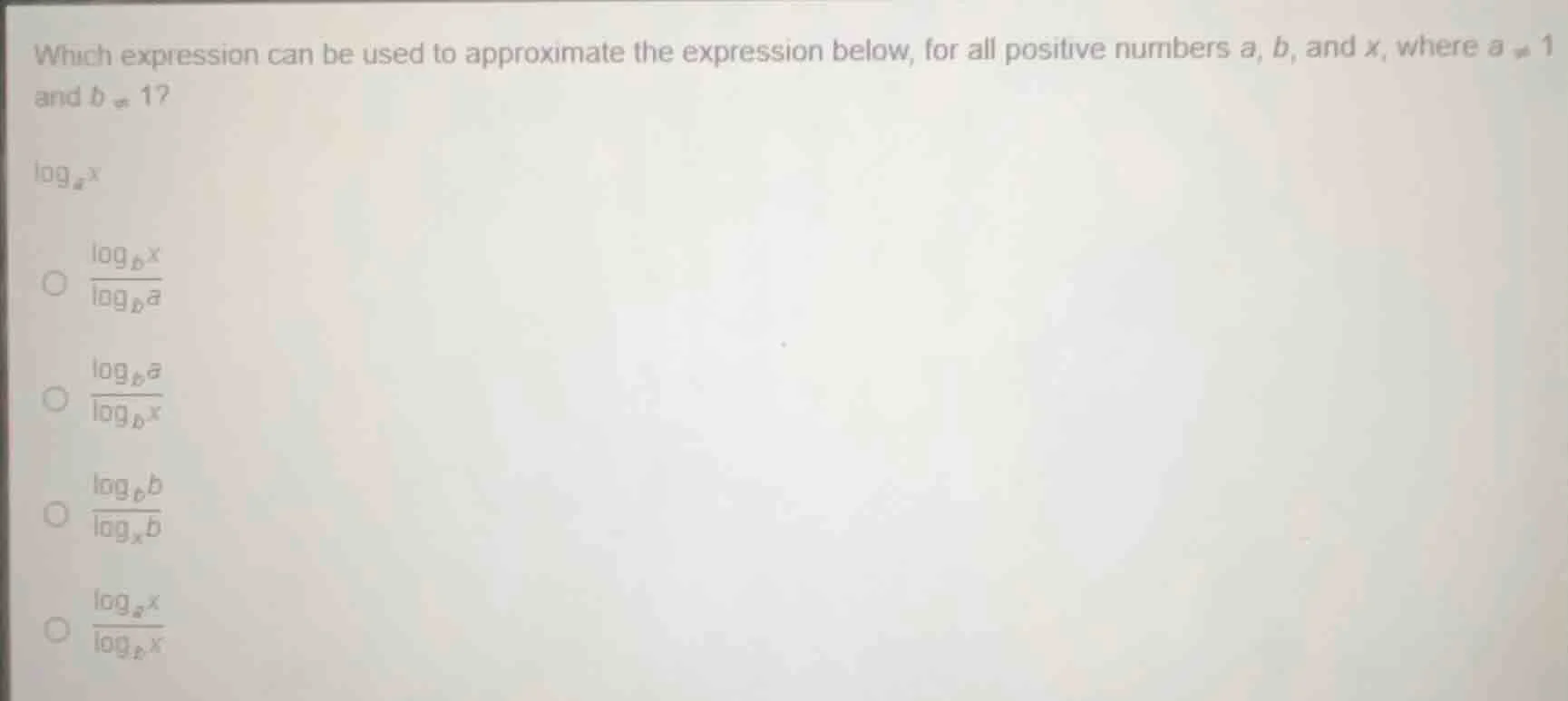
which expression can be used to approximate the expression below, for all positive numbers a, b, and x, where a ≠ 1 and b ≠ 1?\\(\log_{a}x\\)\\(\frac{\log_{b}x}{\log_{b}a}\\)\\(\frac{\log_{b}a}{\log_{b}x}\\)\\(\frac{\log_{b}b}{\log_{x}b}\\)\\(\frac{\log_{a}x}{\log_{b}x}\\)
Step1: Recall Change of Base Formula
The change of base formula for logarithms states that for any positive numbers \(a\), \(b\) (where \(a
eq1\), \(b
eq1\)) and positive number \(x\), \(\log_{a}x=\frac{\log_{b}x}{\log_{b}a}\). This formula allows us to convert a logarithm with base \(a\) to a logarithm with base \(b\) by taking the ratio of the logarithm of \(x\) with base \(b\) to the logarithm of \(a\) with base \(b\).
Step2: Analyze Each Option
- Option 1: \(\frac{\log_{b}x}{\log_{b}a}\) matches the change of base formula, so this is a valid approximation for \(\log_{a}x\).
- Option 2: \(\frac{\log_{b}a}{\log_{b}x}\) is the reciprocal of the correct change of base formula, so it is incorrect.
- Option 3: \(\frac{\log_{b}b}{\log_{x}b}=\frac{1}{\log_{x}b}=\log_{b}x\) (by the reciprocal property of logarithms \(\frac{1}{\log_{x}b}=\log_{b}x\)), which is not equal to \(\log_{a}x\) in general, so it is incorrect.
- Option 4: \(\frac{\log_{a}x}{\log_{b}x}\) does not match the change of base formula and is not equal to \(\log_{a}x\) in general, so it is incorrect.

Snap & solve any problem in the app
Get step-by-step solutions on Sovi AI
Photo-based solutions with guided steps
Explore more problems and detailed explanations
\(\boldsymbol{\frac{\log_{b}x}{\log_{b}a}}\) (the first option)