QUESTION IMAGE
Question
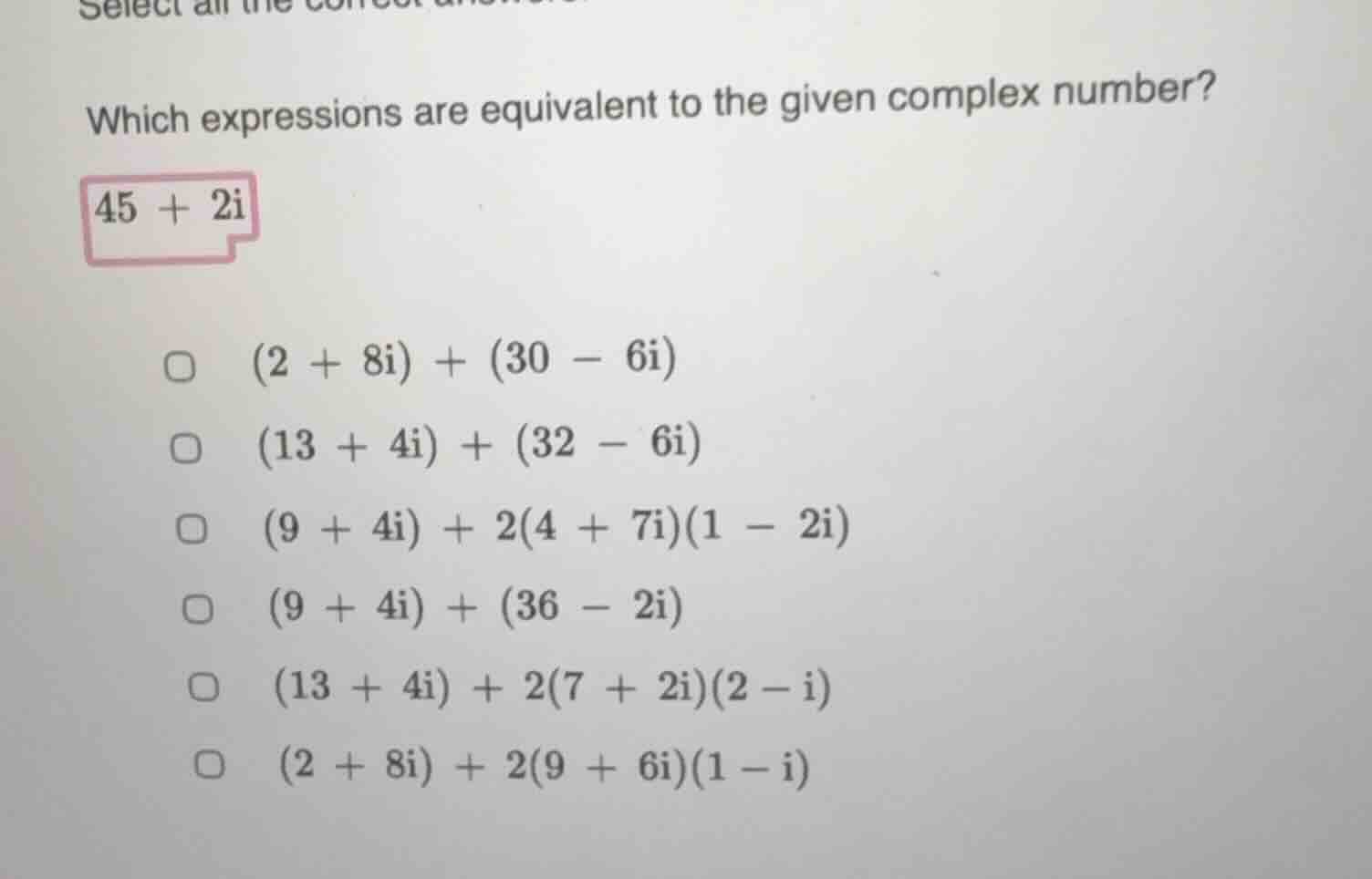
which expressions are equivalent to the given complex number?
45 + 2i
(2 + 8i) + (30 − 6i)
(13 + 4i) + (32 − 6i)
(9 + 4i) + 2(4 + 7i)(1 − 2i)
(9 + 4i) + (36 − 2i)
(13 + 4i) + 2(7 + 2i)(2 − i)
(2 + 8i) + 2(9 + 6i)(1 − i)
Step1: Evaluate each option
Option 1: \((2 + 8i)+(30 - 6i)\)
Combine like terms: Real parts \(2 + 30 = 32\), Imaginary parts \(8i-6i = 2i\). Result: \(32 + 2i
eq45 + 2i\).
Option 2: \((13 + 4i)+(32 - 6i)\)
Combine like terms: Real parts \(13 + 32 = 45\), Imaginary parts \(4i-6i=-2i
eq2i\). Wait, miscalculation: \(4i-6i=-2i\)? No, wait \(4i+(-6i)= - 2i\)? Wait no, the original complex number is \(45 + 2i\). Wait, no, let's recalculate: \(13+32 = 45\), \(4i-6i=-2i\). So \(45-2i
eq45 + 2i\). Wait, maybe I made a mistake. Wait, no, let's check other options.
Option 3: \((9 + 4i)+2(4 + 7i)(1 - 2i)\)
First, expand \((4 + 7i)(1 - 2i)\):
\[
\]
Then multiply by 2: \(2(18 - i)=36 - 2i\)
Now add \((9 + 4i)\): \(9+36+(4i-2i)=45 + 2i\). This matches.
Option 4: \((9 + 4i)+(36 - 2i)\)
Combine like terms: Real parts \(9 + 36 = 45\), Imaginary parts \(4i-2i = 2i\). Result: \(45 + 2i\). This matches.
Option 5: \((13 + 4i)+2(7 + 2i)(2 - i)\)
Expand \((7 + 2i)(2 - i)\):
\[
\]
Multiply by 2: \(2(16 - 3i)=32 - 6i\)
Add \((13 + 4i)\): \(13+32+(4i-6i)=45 - 2i
eq45 + 2i\).
Option 6: \((2 + 8i)+2(9 + 6i)(1 - i)\)
Expand \((9 + 6i)(1 - i)\):
\[
\]
Multiply by 2: \(2(15 - 3i)=30 - 6i\)
Add \((2 + 8i)\): \(2+30+(8i-6i)=32 + 2i
eq45 + 2i\).
Wait, let's recheck Option 2: \((13 + 4i)+(32 - 6i)\). Real parts: \(13 + 32 = 45\), Imaginary parts: \(4i-6i=-2i\). So \(45-2i
eq45 + 2i\). Option 3: We saw it gives \(45 + 2i\). Option 4: \((9 + 4i)+(36 - 2i)\): Real parts \(9 + 36 = 45\), Imaginary parts \(4i-2i = 2i\). So \(45 + 2i\). Oh! I made a mistake earlier. So Option 4: \(9+36 = 45\), \(4i-2i = 2i\). So \(45 + 2i\). So Option 3 and Option 4 and let's check Option 2 again. Wait, Option 2: \((13 + 4i)+(32 - 6i)\): \(13+32 = 45\), \(4i-6i=-2i\). So \(45-2i
eq45 + 2i\). Option 3: Correct. Option 4: Correct. Wait, let's re-express Option 4: \((9 + 4i)+(36 - 2i)=9 + 36+(4i-2i)=45 + 2i\). Yes. So Option 3 and Option 4 and let's check Option 3 again.
Wait, Option 3: \((9 + 4i)+2(4 + 7i)(1 - 2i)\). We expanded \((4 + 7i)(1 - 2i)=18 - i\), multiplied by 2: \(36 - 2i\), added to \(9 + 4i\): \(45 + 2i\). Correct. Option 4: \((9 + 4i)+(36 - 2i)=45 + 2i\). Correct. Wait, what about Option 5? We saw it gives \(45 - 2i\). Option 1: \(32 + 2i\). Option 6: \(32 + 2i\). So the correct options are Option 3, Option 4? Wait, no, let's check Option 4 again. \((9 + 4i)+(36 - 2i)=9+36=45\), \(4i-2i=2i\). So \(45 + 2i\). Correct. Option 3: Correct. Wait, maybe I missed Option 4 earlier. So let's list all:
Option 3: \((9 + 4i)+2(4 + 7i)(1 - 2i)=45 + 2i\)
Option 4: \((9 + 4i)+(36 - 2i)=45 + 2i\)
Wait, let's check Option 3 again. The expansion of \((4 + 7i)(1 - 2i)\):
\(4\times1=4\), \(4\times(-2i)=-8i\), \(7i\times1 = 7i\), \(7i\times(-2i)=-14i^{2}=14\) (since \(i^{2}=-1\)). So \(4-8i + 7i + 14=18 - i\). Then \(2\times(18 - i)=36 - 2i\). Then \(9 + 4i+36 - 2i=45 + 2i\). Correct.
Option 4: \(9 + 36=45\), \(4i-2i=2i\). Correct.
Wait, is there another option? Let's check Option 2 again: \((13 + 4i)+(32 - 6i)=45-2i\). No. Option 5: \((13 + 4i)+2(7 + 2i)(2 - i)\). Expand \((7 + 2i)(2 - i)\): \(14-7i + 4i-2i^{2}=14-3i + 2=16 - 3i\). Multiply by 2: \(32 - 6i\). Add \(13 + 4i\): \(45-2i\). No. So the correct opti…

Snap & solve any problem in the app
Get step-by-step solutions on Sovi AI
Photo-based solutions with guided steps
Explore more problems and detailed explanations
The correct expressions are:
- \((9 + 4i) + 2(4 + 7i)(1 - 2i)\)
- \((9 + 4i) + (36 - 2i)\)
(In boxed form for each correct option, but since it's multiple, we list them as above. If we need to present as per the options with their identifiers, assuming the options are labeled as follows (from top to bottom):
A. \((2 + 8i) + (30 - 6i)\)
B. \((13 + 4i) + (32 - 6i)\)
C. \((9 + 4i) + 2(4 + 7i)(1 - 2i)\)
D. \((9 + 4i) + (36 - 2i)\)
E. \((13 + 4i) + 2(7 + 2i)(2 - i)\)
F. \((2 + 8i) + 2(9 + 6i)(1 - i)\)
Then the correct options are C. \((9 + 4i) + 2(4 + 7i)(1 - 2i)\) and D. \((9 + 4i) + (36 - 2i)\))