QUESTION IMAGE
Question
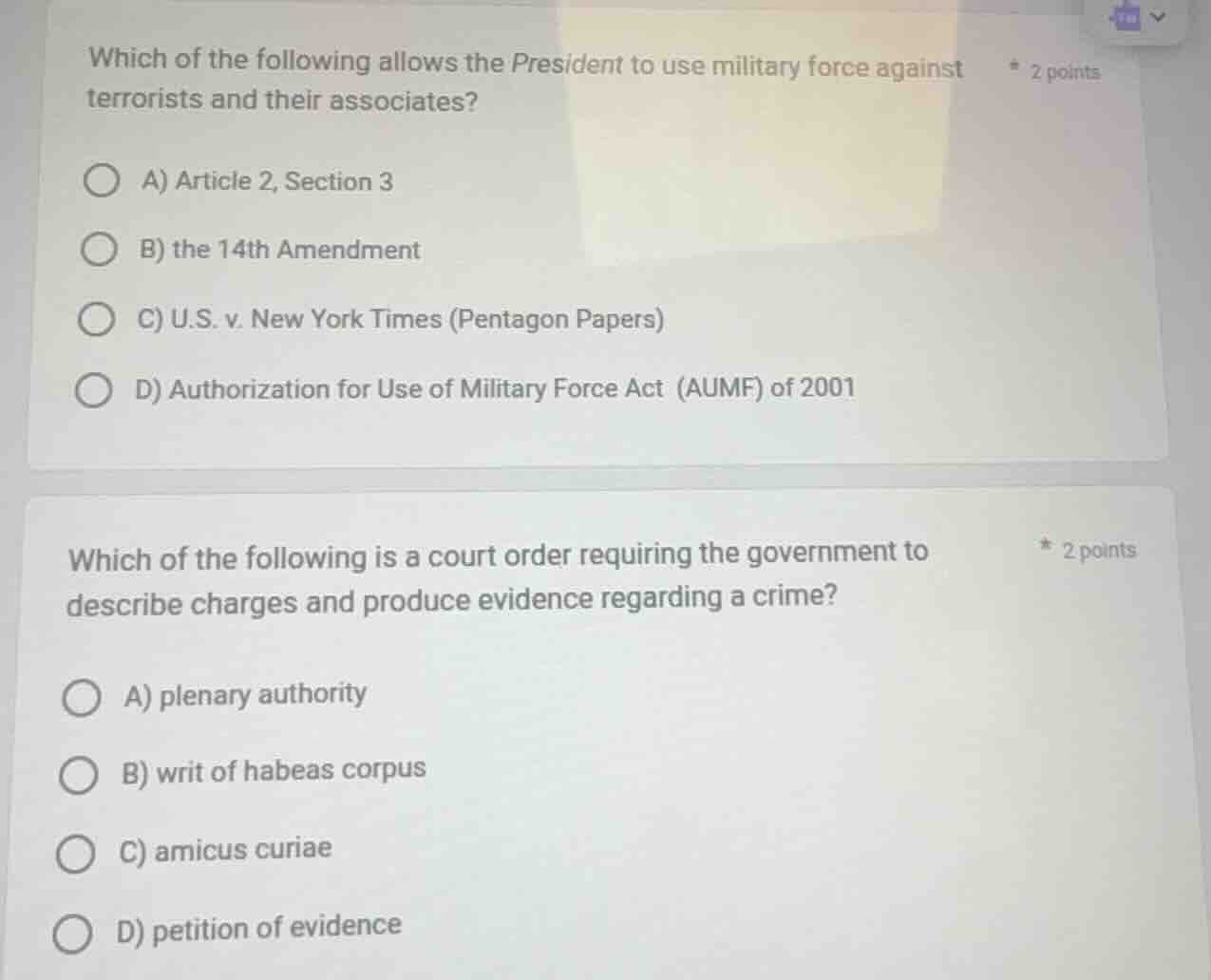
which of the following allows the president to use military force against terrorists and their associates?
a) article 2, section 3
b) the 14th amendment
c) u.s. v. new york times (pentagon papers)
d) authorization for use of military force act (aumf) of 2001
which of the following is a court order requiring the government to describe charges and produce evidence regarding a crime?
a) plenary authority
b) writ of habeas corpus
c) amicus curiae
d) petition of evidence
Brief Explanations
For the first question:
- Option A outlines presidential duties like ensuring laws are executed, not military force against terrorists.
- Option B deals with civil rights, not military authority.
- Option C is a free press case, unrelated to military force.
- Option D is the specific law authorizing the president to use military force against those responsible for the 9/11 attacks, including terrorists and their associates.
For the second question:
- Option A refers to full administrative authority, not a court order for charges/evidence.
- Option B is a legal writ that compels the government to present a detained person and explain the legal basis for their detention, including charges and evidence.
- Option C refers to a "friend of the court" brief, not a court order for evidence.
- Option D is not a standard legal term for this specific court order.

Snap & solve any problem in the app
Get step-by-step solutions on Sovi AI
Photo-based solutions with guided steps
Explore more problems and detailed explanations
- D) Authorization for Use of Military Force Act (AUMF) of 2001
- B) writ of habeas corpus