QUESTION IMAGE
Question
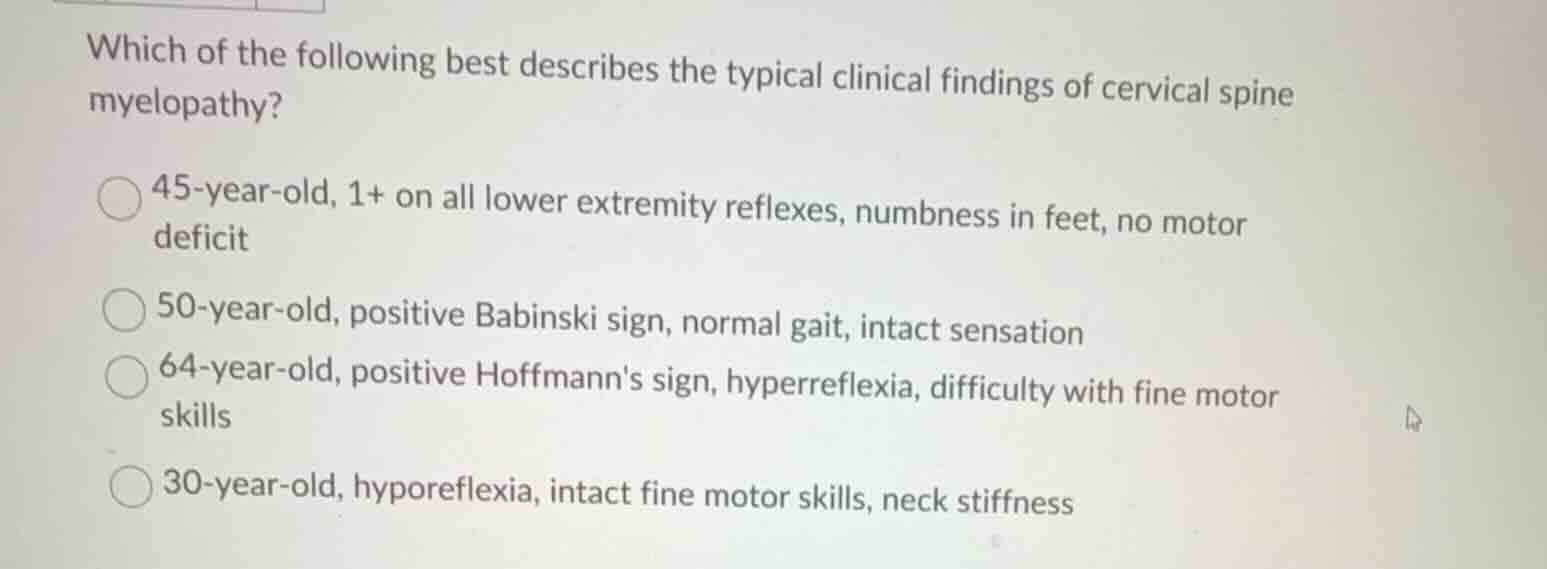
which of the following best describes the typical clinical findings of cervical spine myelopathy? 45 - year - old, 1+ on all lower extremity reflexes, numbness in feet, no motor deficit 50 - year - old, positive babinski sign, normal gait, intact sensation 64 - year - old, positive hoffmanns sign, hyperreflexia, difficulty with fine motor skills 30 - year - old, hyporeflexia, intact fine motor skills, neck stiffness
Cervical spine myelopathy typically affects older adults (usually 50+ years) due to spinal cord compression from degenerative changes. Key findings include upper motor neuron signs: hyperreflexia, positive Hoffmann's sign (a reflex indicating upper motor neuron dysfunction), and fine motor skill impairment (from cervical cord affecting upper extremity control).
- The first option has no motor deficit and only 1+ reflexes (not hyperreflexia), inconsistent with myelopathy.
- The second option has normal gait and intact sensation, which does not match the typical multi-system involvement of myelopathy.
- The fourth option affects a young patient, has hyporeflexia (lower motor neuron sign) and no upper motor neuron deficits, which is not characteristic of cervical myelopathy.

Snap & solve any problem in the app
Get step-by-step solutions on Sovi AI
Photo-based solutions with guided steps
Explore more problems and detailed explanations
64-year-old, positive Hoffmann's sign, hyperreflexia, difficulty with fine motor skills