QUESTION IMAGE
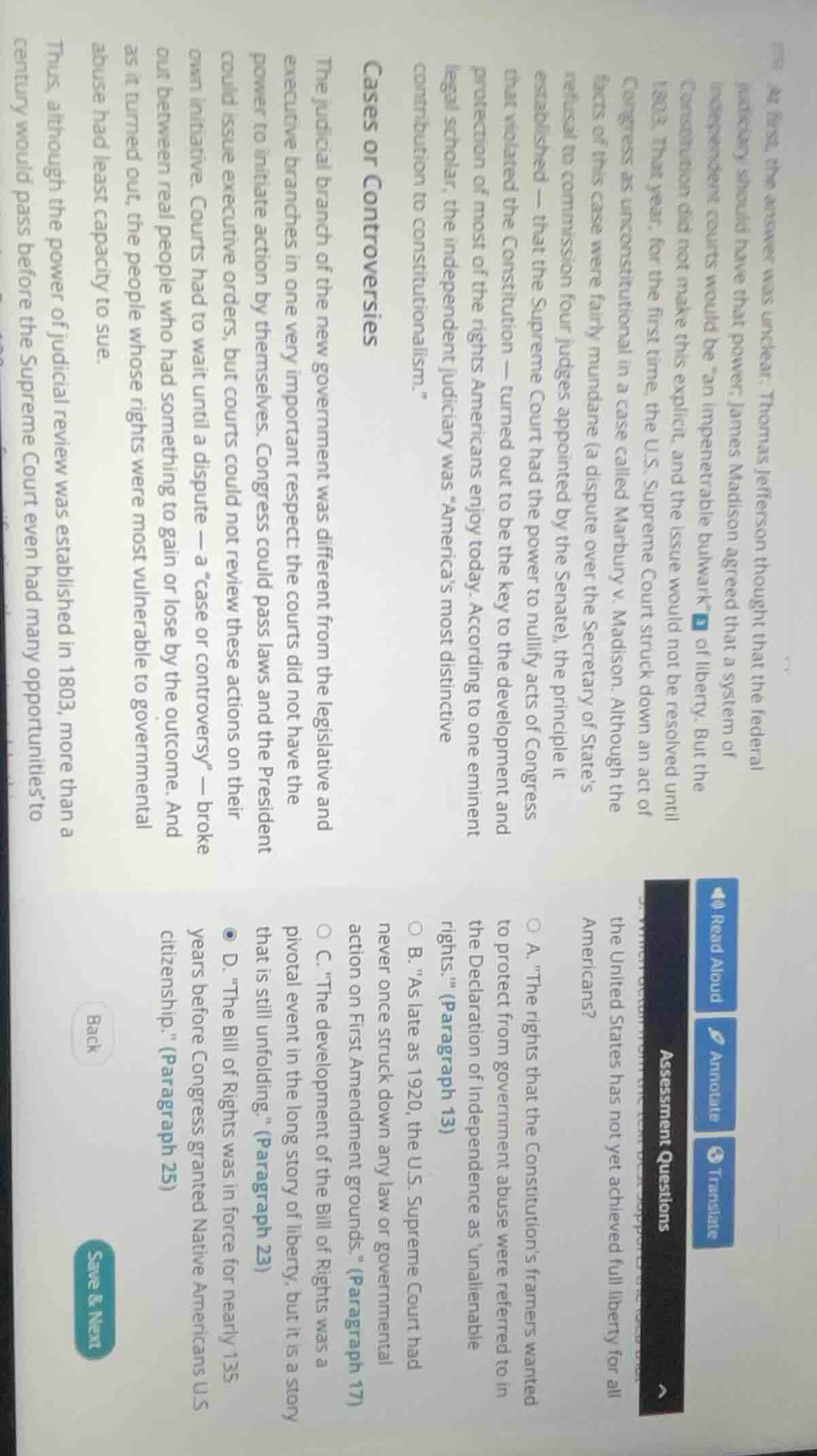
Question
which of the following best supports the idea that the united states has not yet achieved full liberty for all americans? a. \the rights that the constitution’s framers wanted to protect from government abuse were referred to in the declaration of independence as unalienable rights. (paragraph 13) b. \as late as 1920, the u.s. supreme court had never once struck down any law or governmental action on first amendment grounds.\ (paragraph 17) c. \the development of the bill of rights was a pivotal event in the long story of liberty, but it is a story that is still unfolding.\ (paragraph 23) d. \the bill of rights was in force for nearly 135 years before congress granted native americans u.s citizenship.\ (paragraph 25)
To solve this, we analyze each option:
- Option A: The passage focuses on judicial review, constitutional rights development, and the judiciary's role. The Declaration of Independence's "unalienable rights" aren’t the main focus here, so A is incorrect.
- Option B: The passage states judicial review was established in 1803, but “more than a century would pass” before the Court had many opportunities to use it. This contradicts “never once struck down any law” by 1920, so B is incorrect.
- Option C: The passage discusses the judiciary’s role in protecting liberty, noting that the story of liberty “is still unfolding.” This aligns with the idea that the Bill of Rights’ development was pivotal and ongoing, making C a strong match.
- Option D: The passage does not discuss Native American citizenship or the Bill of Rights’ timeline in relation to Native Americans, so D is irrelevant.

Snap & solve any problem in the app
Get step-by-step solutions on Sovi AI
Photo-based solutions with guided steps
Explore more problems and detailed explanations
C. "The development of the Bill of Rights was a pivotal event in the long story of liberty, but it is a story that is still unfolding." (Paragraph 23)