QUESTION IMAGE
Question
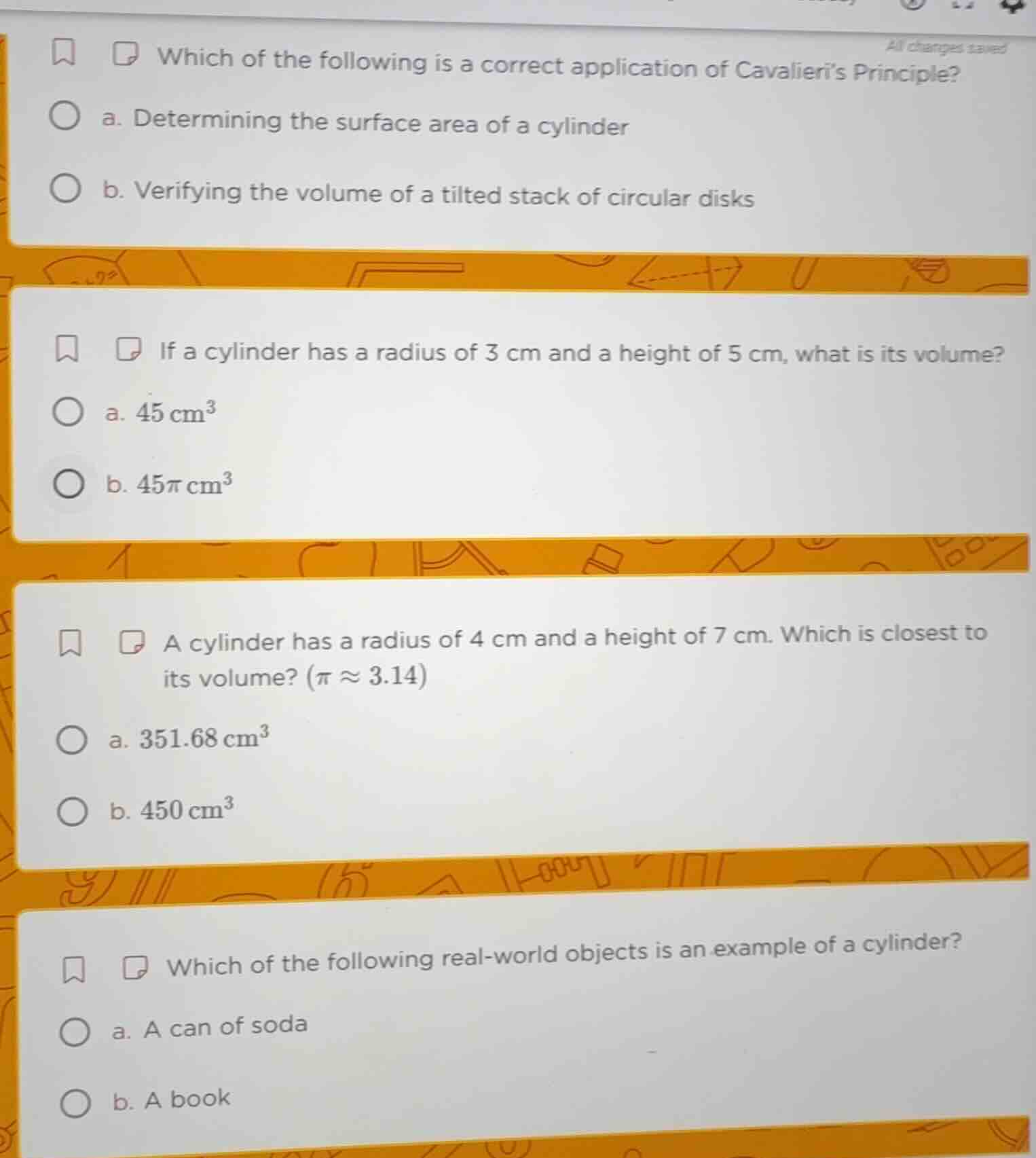
which of the following is a correct application of cavalieri’s principle?
a. determining the surface area of a cylinder
b. verifying the volume of a tilted stack of circular disks
if a cylinder has a radius of 3 cm and a height of 5 cm, what is its volume?
a. 45 cm³
b. 45π cm³
a cylinder has a radius of 4 cm and a height of 7 cm. which is closest to its volume? (π ≈ 3.14)
a. 351.68 cm³
b. 450 cm³
which of the following real - world objects is an example of a cylinder?
a. a can of soda
b. a book
First Question: Which of the following is a correct application of Cavalieri’s Principle?
Cavalieri’s Principle states that if two solids have the same height and the same cross - sectional area at every level, they have the same volume. A tilted stack of circular disks (like a slanted cylinder) and a right - circular cylinder with the same base area and height will have the same volume by Cavalieri’s Principle. Determining the surface area of a cylinder does not involve Cavalieri’s Principle as it is about surface area, not volume comparison. So option b is correct.
Step1: Recall the formula for the volume of a cylinder
The formula for the volume \(V\) of a cylinder is \(V=\pi r^{2}h\), where \(r\) is the radius and \(h\) is the height.
Step2: Substitute the given values
Given \(r = 3\space\text{cm}\) and \(h=5\space\text{cm}\). Substitute these values into the formula: \(V=\pi\times(3)^{2}\times5\).
First, calculate \((3)^{2}=9\). Then, \(V = \pi\times9\times5=45\pi\space\text{cm}^3\).
Step1: Recall the volume formula for a cylinder
The volume formula of a cylinder is \(V = \pi r^{2}h\).
Step2: Substitute the values
Given \(r = 4\space\text{cm}\) and \(h = 7\space\text{cm}\), and \(\pi\approx3.14\). Substitute into the formula: \(V=3.14\times(4)^{2}\times7\).
First, calculate \((4)^{2}=16\). Then, \(3.14\times16 = 50.24\). Then, \(50.24\times7=351.68\space\text{cm}^3\).

Snap & solve any problem in the app
Get step-by-step solutions on Sovi AI
Photo-based solutions with guided steps
Explore more problems and detailed explanations
b. Verifying the volume of a tilted stack of circular disks