QUESTION IMAGE
Question
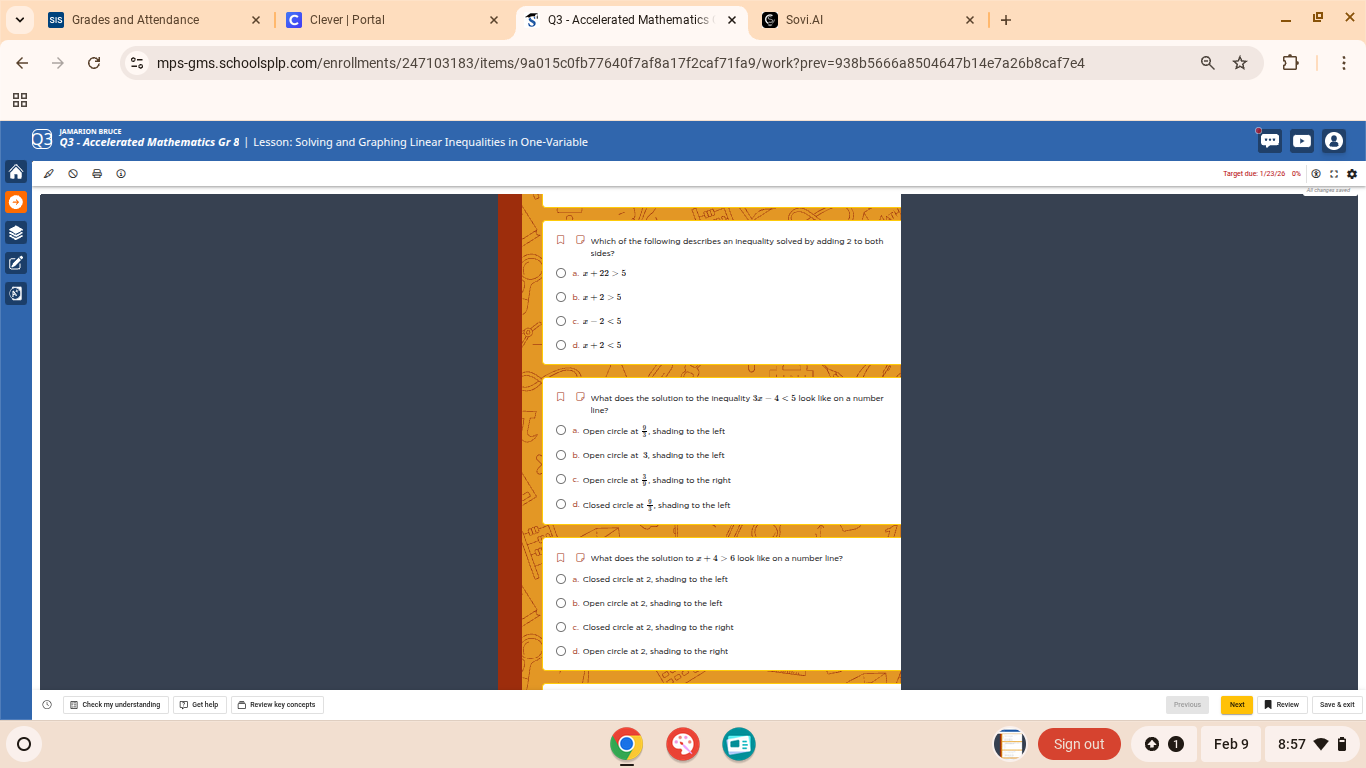
- which of the following describes an inequality solved by adding 2 to both sides?
a. $x + 22 > 5$
b. $x + 2 > 5$
c. $x - 2 < 5$
d. $x + 2 < 5$
- what does the solution to the inequality $3x - 4 < 5$ look like on a number line?
a. open circle at $\frac{9}{3}$, shading to the left
b. open circle at 3, shading to the left
c. open circle at $\frac{9}{3}$, shading to the right
d. closed circle at $\frac{9}{3}$, shading to the left
- what does the solution to $x + 4 > 6$ look like on a number line?
a. closed circle at 2, shading to the left
b. open circle at 2, shading to the left
c. closed circle at 2, shading to the right
d. open circle at 2, shading to the right
Step1: Solve first inequality question
We need an inequality where adding 2 to both sides isolates $x$. For option c: $x - 2 < 5$, adding 2 to both sides gives $x < 7$, which matches the described operation.
Step2: Solve second inequality
Start with $3x - 4 < 5$. Add 4 to both sides: $3x < 5 + 4 = 9$. Divide by 3: $x < \frac{9}{3} = 3$. Since the inequality is $<$ (not $\leq$), we use an open circle at 3, and shade left (for values less than 3).
Step3: Solve third inequality
Start with $x + 4 > 6$. Subtract 4 from both sides: $x > 6 - 4 = 2$. Since the inequality is $>$ (not $\geq$), we use an open circle at 2, and shade right (for values greater than 2).

Snap & solve any problem in the app
Get step-by-step solutions on Sovi AI
Photo-based solutions with guided steps
Explore more problems and detailed explanations
- c. $x - 2 < 5$
- b. Open circle at 3, shading to the left
- d. Open circle at 2, shading to the right