QUESTION IMAGE
Question
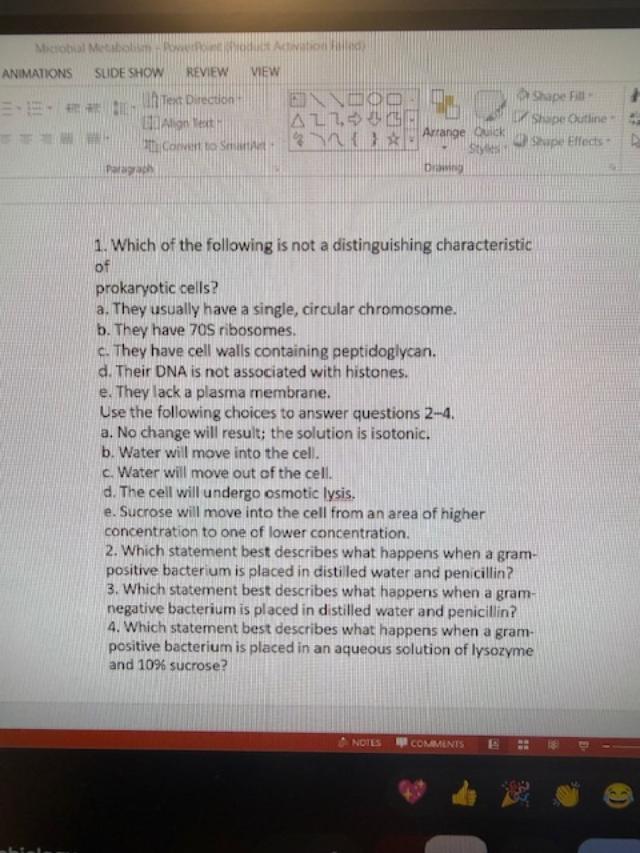
- which of the following is not a distinguishing characteristic of prokaryotic cells? a. they usually have a single, circular chromosome. b. they have 70s ribosomes. c. they have cell walls containing peptidoglycan. d. their dna is not associated with histones. e. they lack a plasma membrane. use the following choices to answer questions 2--4. a. no change will result; the solution is isotonic. b. water will move into the cell. c. water will move out of the cell. d. the cell will undergo osmotic lysis. e. sucrose will move into the cell from an area of higher concentration to one of lower concentration 2. which statement best describes what happens when a gram-positive bacterium is placed in distilled water and penicillin? 3. which statement best describes what happens when a gram-negative bacterium is placed in distilled water and penicillin? 4. which statement best describes what happens when a gram-positive bacterium is placed in an aqueous solution of lysozyme and 10% sucrose?
Response
Question 1
Brief Explanations
To determine the non - distinguishing characteristic of prokaryotic cells:
- Option a: Prokaryotes usually have a single, circular chromosome. This is a characteristic of prokaryotes.
- Option b: Prokaryotes have 70S ribosomes. This is a distinguishing feature from eukaryotes (which have 80S ribosomes in the cytoplasm).
- Option c: Most prokaryotic cell walls (especially bacteria) contain peptidoglycan.
- Option d: Prokaryotic DNA is not associated with histones (eukaryotic DNA is).
- Option e: All cells (prokaryotic and eukaryotic) have a plasma membrane. So the statement that prokaryotes lack a plasma membrane is false and not a distinguishing characteristic.
Brief Explanations
- Gram - positive bacteria have a thick peptidoglycan cell wall. Penicillin inhibits peptidoglycan synthesis. Distilled water is a hypotonic solution (lower solute concentration than the bacterial cytoplasm).
- When placed in distilled water, water will move into the cell (osmosis) because the cell has a higher solute concentration. Penicillin weakens the cell wall. With the influx of water from the hypotonic distilled water and a weakened cell wall due to penicillin, the cell will undergo osmotic lysis.
Brief Explanations
- Gram - negative bacteria have a thin peptidoglycan cell wall surrounded by an outer membrane. Penicillin can enter the periplasmic space (between the outer membrane and the cell wall) and inhibit peptidoglycan synthesis. Distilled water is hypotonic.
- Water will move into the cell (osmosis) as the cell has a higher solute concentration. But the outer membrane of gram - negative bacteria is relatively more resistant to lysis compared to gram - positive bacteria's cell wall when weakened. However, penicillin weakens the peptidoglycan layer. The influx of water from the hypotonic distilled water and the weakened peptidoglycan layer (due to penicillin) will lead to the cell undergoing osmotic lysis. Wait, actually, for gram - negative bacteria, the outer membrane can limit the effect of penicillin to some extent, but in distilled water (hypotonic), water moves in. But the main thing is that with penicillin inhibiting peptidoglycan synthesis, the cell wall is weakened. So the cell will undergo osmotic lysis.

Snap & solve any problem in the app
Get step-by-step solutions on Sovi AI
Photo-based solutions with guided steps
Explore more problems and detailed explanations
e. They lack a plasma membrane.