QUESTION IMAGE
Question
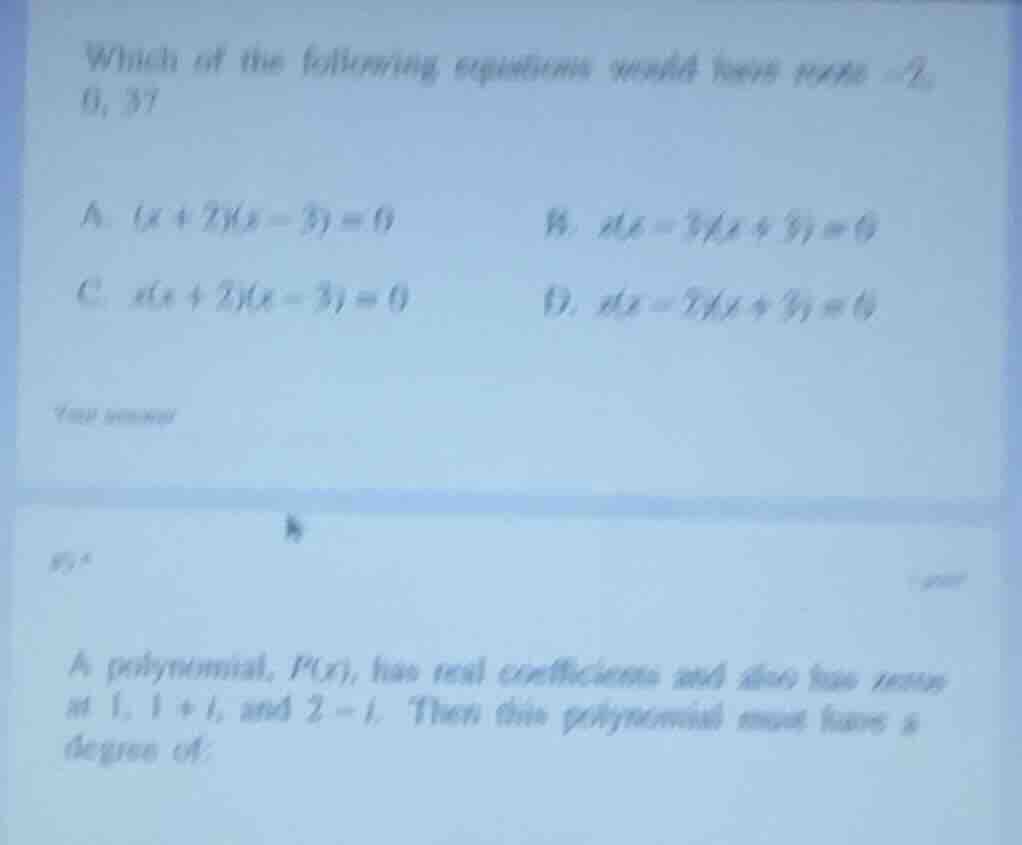
which of the following equations would have roots -2, 0, 3?
a. $(x + 2)(x - 3) = 0$ b. $x(x - 3)(x + 3) = 0$
c. $x(x + 2)(x - 3) = 0$ d. $x(x - 2)(x + 3) = 0$
your answer
a polynomial, $p(x)$, has real coefficients and also has zeros at 1, $1 + i$, and $2 - i$. then this polynomial must have a degree of:
Step1: Find roots for Option A
Set each factor to 0:
$x+2=0 \implies x=-2$; $x-3=0 \implies x=3$
Roots: $-2, 3$
Step2: Find roots for Option B
Set each factor to 0:
$x=0$; $x-3=0 \implies x=3$; $x+3=0 \implies x=-3$
Roots: $0, 3, -3$
Step3: Find roots for Option C
Set each factor to 0:
$x=0$; $x+2=0 \implies x=-2$; $x-3=0 \implies x=3$
Roots: $0, -2, 3$
Step4: Find roots for Option D
Set each factor to 0:
$x=0$; $x-2=0 \implies x=2$; $x+3=0 \implies x=-3$
Roots: $0, 2, -3$
Step5: Apply Complex Conjugate Root Theorem
For polynomials with real coefficients, non-real roots come in conjugate pairs. Given roots $1+i$ and $2-i$, their conjugates $1-i$ and $2+i$ must also be roots. Count all distinct roots: $1, 1+i, 1-i, 2-i, 2+i$.

Snap & solve any problem in the app
Get step-by-step solutions on Sovi AI
Photo-based solutions with guided steps
Explore more problems and detailed explanations
First question: C. $x(x + 2)(x - 3) = 0$
Second question: 5