QUESTION IMAGE
Question
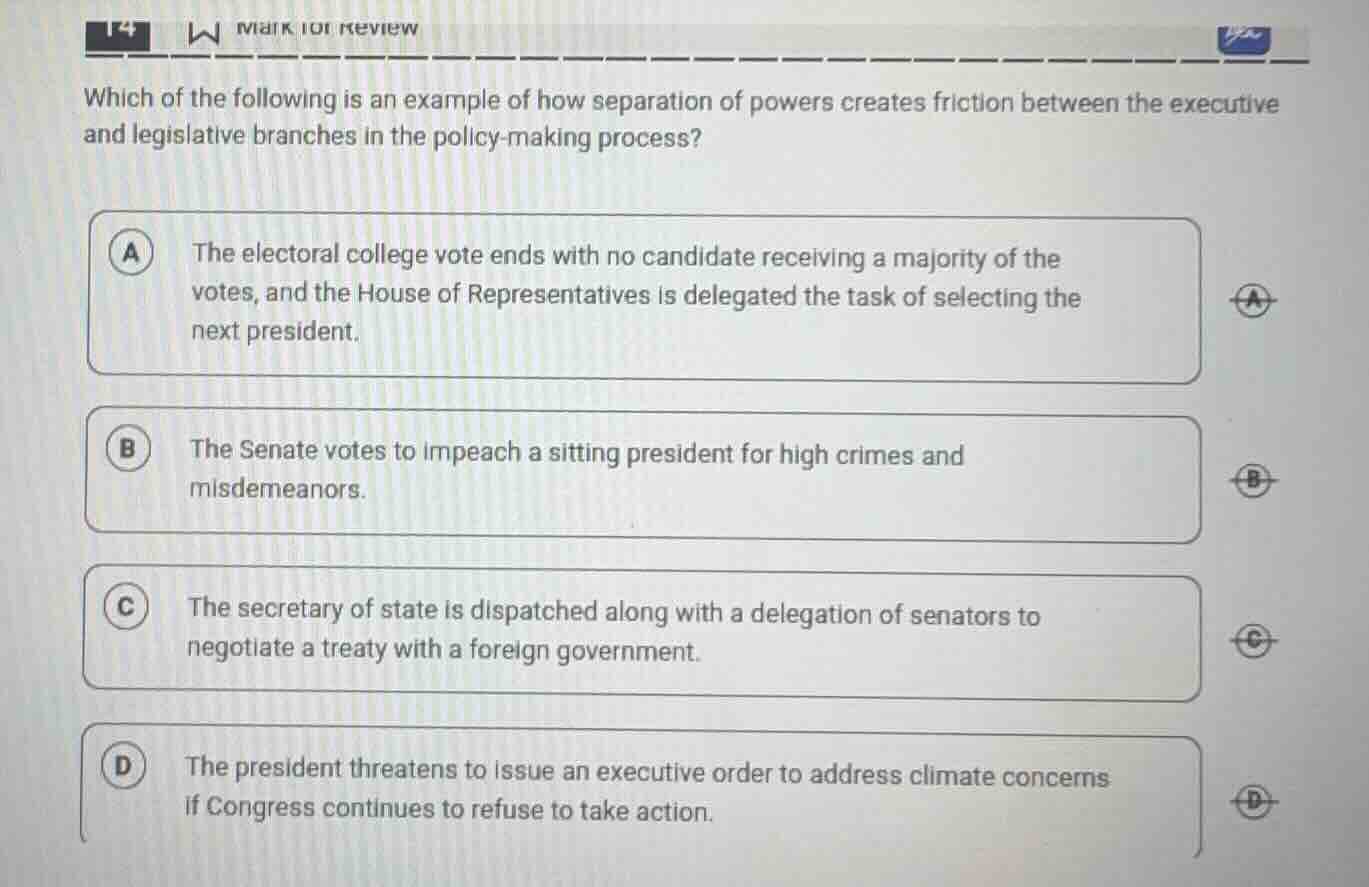
which of the following is an example of how separation of powers creates friction between the executive and legislative branches in the policy - making process?
a the electoral college vote ends with no candidate receiving a majority of the votes, and the house of representatives is delegated the task of selecting the next president.
b the senate votes to impeach a sitting president for high crimes and misdemeanors.
c the secretary of state is dispatched along with a delegation of senators to negotiate a treaty with a foreign government.
d the president threatens to issue an executive order to address climate concerns if congress continues to refuse to take action.
- Option A describes a presidential election contingency, not policy-making friction between branches.
- Option B involves impeachment, a check on executive power but not routine policy-making friction.
- Option C shows inter-branch cooperation on treaty negotiations, not friction.
- Option D illustrates friction: the executive (president) uses the threat of an executive order to push the legislative (Congress) to act on climate policy, a direct conflict in the policy-making process due to separated powers.

Snap & solve any problem in the app
Get step-by-step solutions on Sovi AI
Photo-based solutions with guided steps
Explore more problems and detailed explanations
D. The president threatens to issue an executive order to address climate concerns if Congress continues to refuse to take action.