QUESTION IMAGE
Question
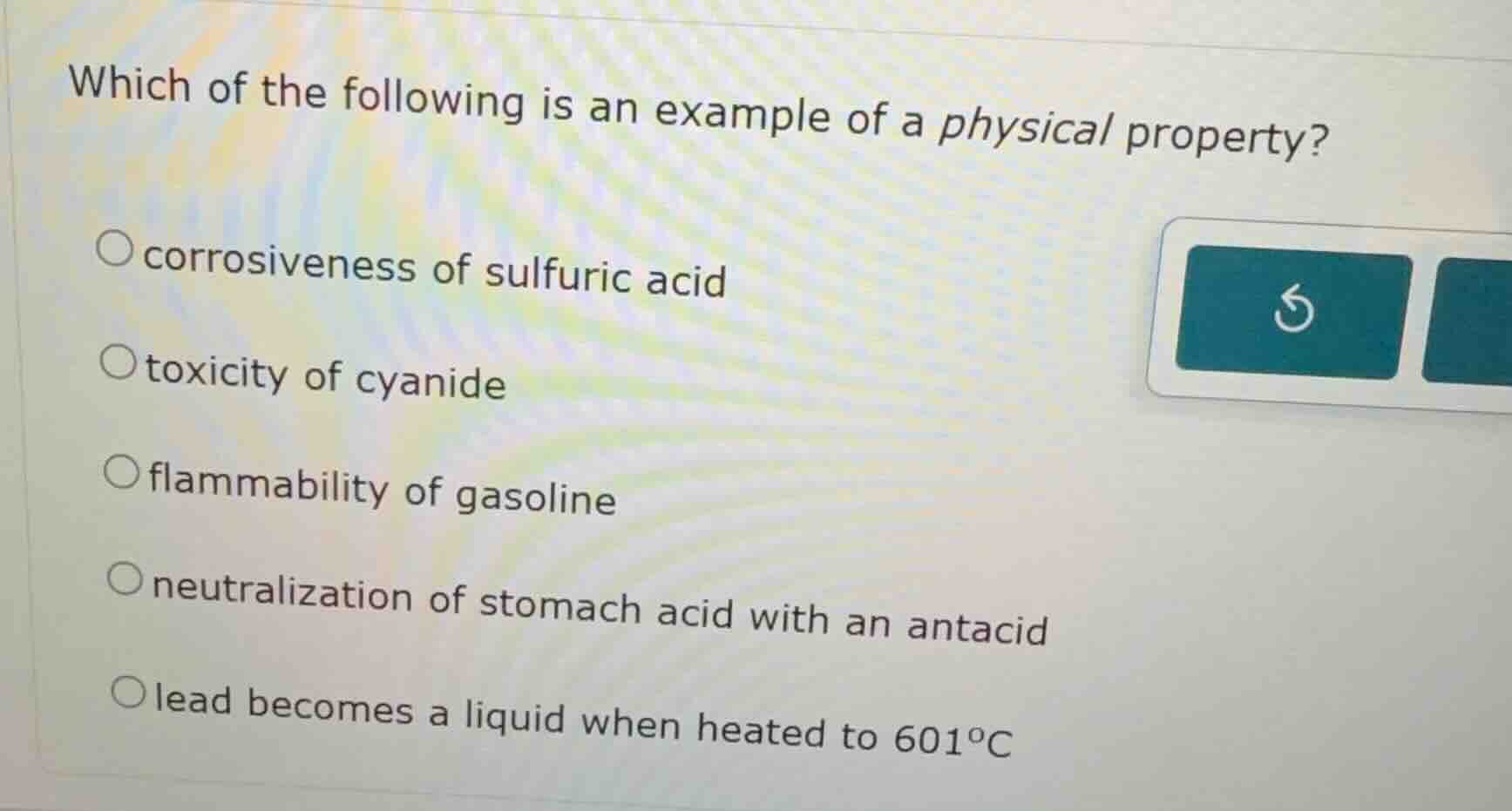
which of the following is an example of a physical property? corrosiveness of sulfuric acid toxicity of cyanide flammability of gasoline neutralization of stomach acid with an antacid lead becomes a liquid when heated to 601°c
To determine a physical property, we recall that physical properties are characteristics that can be observed or measured without changing the substance's chemical identity. Chemical properties involve chemical reactions (like corrosiveness, toxicity, flammability, or neutralization, which involve chemical changes). The melting of lead (changing state from solid to liquid) is a physical change, and the melting point (the temperature at which this occurs) is a physical property.

Snap & solve any problem in the app
Get step-by-step solutions on Sovi AI
Photo-based solutions with guided steps
Explore more problems and detailed explanations
lead becomes a liquid when heated to \( 601^\circ\text{C} \)