QUESTION IMAGE
Question
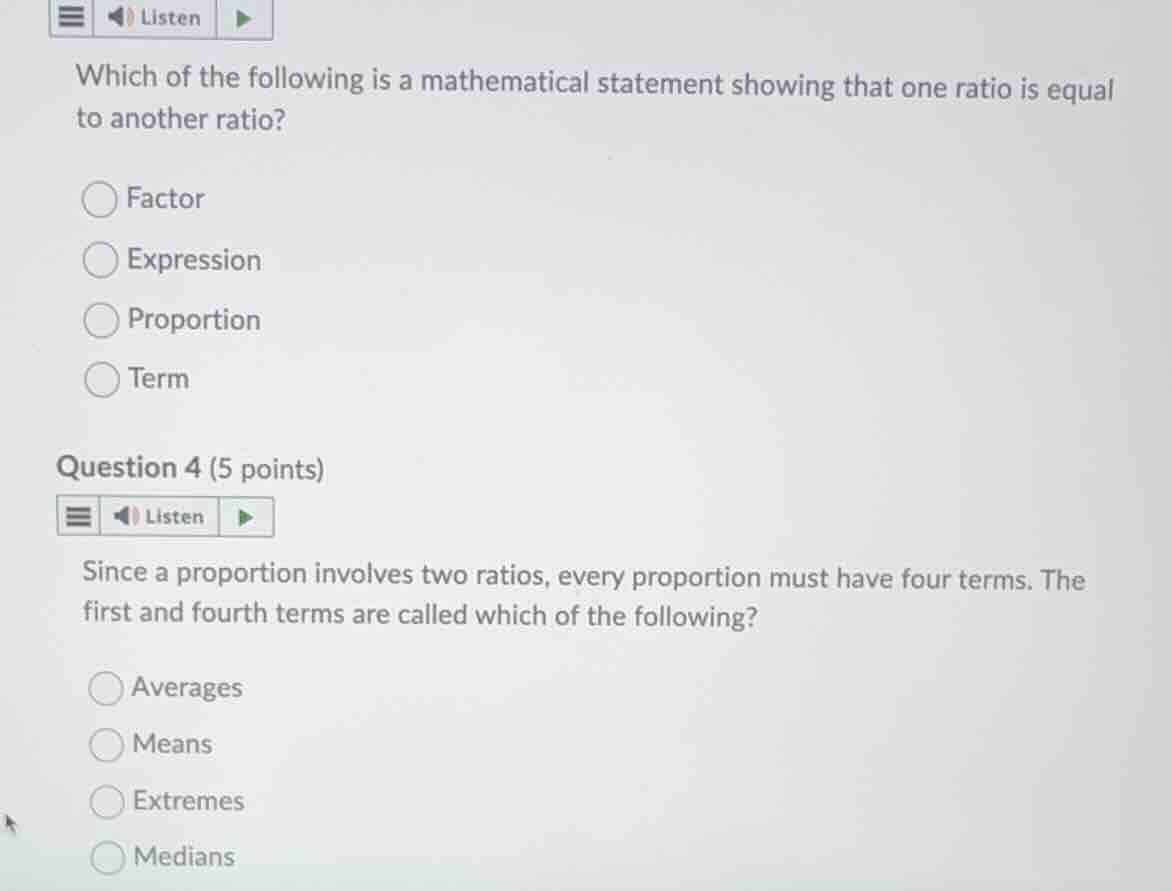
which of the following is a mathematical statement showing that one ratio is equal to another ratio?
factor
expression
proportion
term
question 4 (5 points)
since a proportion involves two ratios, every proportion must have four terms. the first and fourth terms are called which of the following?
averages
means
extremes
medians
Response
First Question (Which of the following is a mathematical statement showing that one ratio is equal to another ratio?)
Brief Explanations
- A "Factor" is a number that divides another number without leaving a remainder, not related to equal ratios.
- An "Expression" is a combination of numbers, variables, and operations, not a statement of equal ratios.
- A "Proportion" is defined as a mathematical statement that two ratios are equal (e.g., \(\frac{a}{b}=\frac{c}{d}\)).
- A "Term" is a single number, variable, or product/quotient of numbers and variables, not related to equal ratios.
Brief Explanations
- In a proportion \(\frac{a}{b}=\frac{c}{d}\) (or \(a:b = c:d\)), the terms are \(a\), \(b\), \(c\), \(d\). The first (\(a\)) and fourth (\(d\)) terms are called "Extremes", while the second (\(b\)) and third (\(c\)) terms are called "Means". "Averages" are measures of central tendency, and "Medians" are the middle value in a data set, neither related to proportion terms.

Snap & solve any problem in the app
Get step-by-step solutions on Sovi AI
Photo-based solutions with guided steps
Explore more problems and detailed explanations
C. Proportion