QUESTION IMAGE
Question
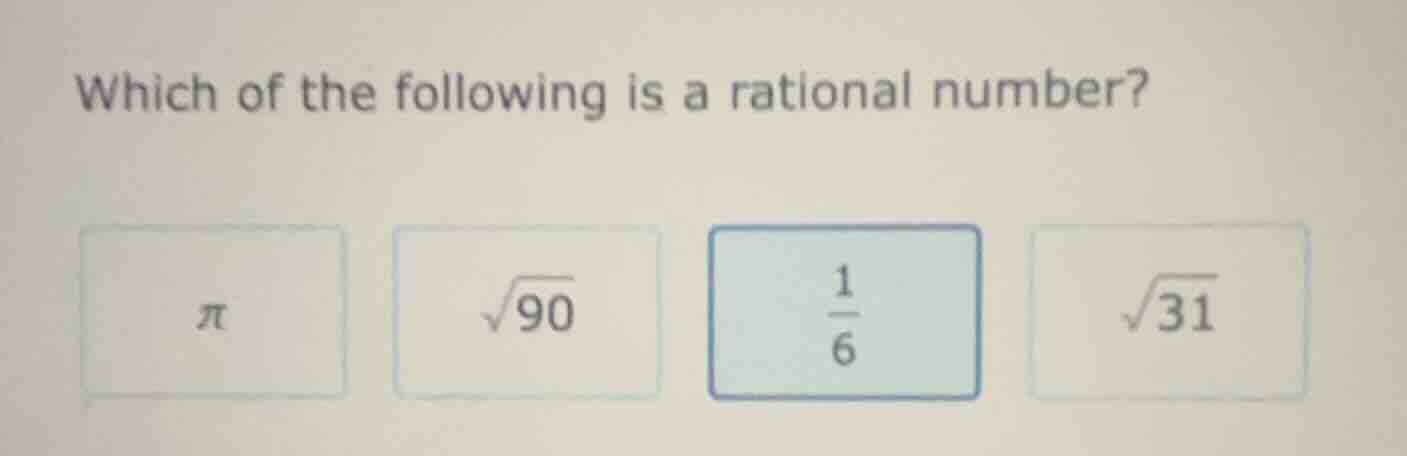
which of the following is a rational number? π, √90, \\(\frac{1}{6}\\), √31
Step1: Recall rational number definition
A rational number is a number that can be expressed as $\frac{p}{q}$, where $p$ and $q$ are integers and $q
eq0$.
Step2: Analyze each option
- $\pi$: It is an irrational number (non - repeating, non - terminating decimal, can't be expressed as $\frac{p}{q}$ with integers $p,q$).
- $\sqrt{90}$: Simplify $\sqrt{90}=\sqrt{9\times10} = 3\sqrt{10}$. Since $\sqrt{10}$ is irrational, $3\sqrt{10}$ is irrational.
- $\frac{1}{6}$: Here $p = 1$ and $q = 6$ (both integers, $q
eq0$), so it is a rational number.
- $\sqrt{31}$: 31 is a prime number, and $\sqrt{31}$ is an irrational number (can't be expressed as $\frac{p}{q}$ with integers $p,q$).

Snap & solve any problem in the app
Get step-by-step solutions on Sovi AI
Photo-based solutions with guided steps
Explore more problems and detailed explanations
$\frac{1}{6}$ (the option with $\frac{1}{6}$)