QUESTION IMAGE
Question
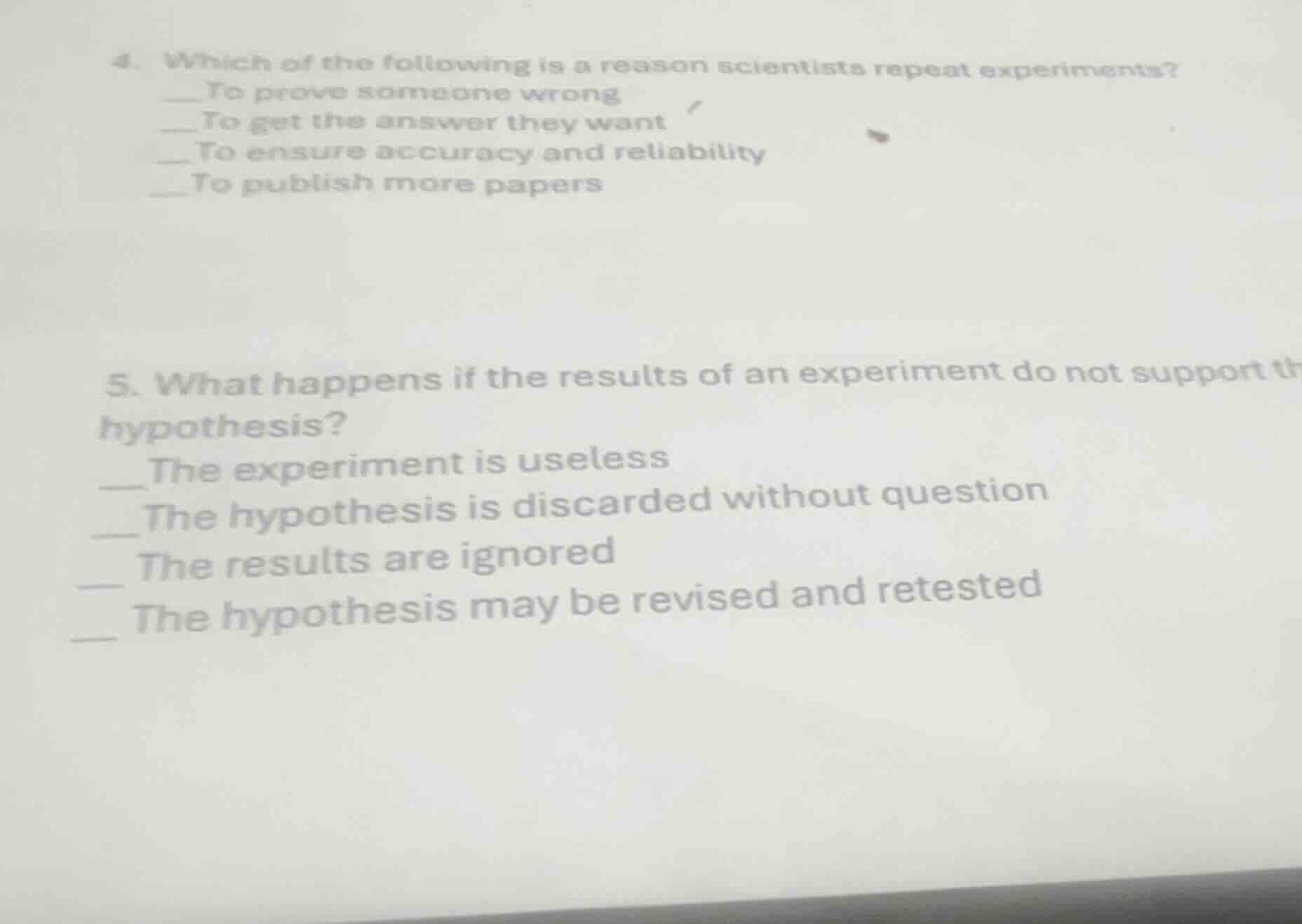
- which of the following is a reason scientists repeat experiments?
__to prove someone wrong
__to get the answer they want
__to ensure accuracy and reliability
__to publish more papers
- what happens if the results of an experiment do not support the hypothesis?
__the experiment is useless
__the hypothesis is discarded without question
__the results are ignored
__the hypothesis may be revised and retested
Question 4
Scientists repeat experiments to check if results are consistent (accuracy) and can be trusted (reliability). Proving someone wrong, getting a desired answer, or publishing more papers are not scientific reasons.
If experiment results don't support the hypothesis, the scientific process involves revising the hypothesis and retesting. Discarding the hypothesis, ignoring results, or calling the experiment useless go against scientific method.

Snap & solve any problem in the app
Get step-by-step solutions on Sovi AI
Photo-based solutions with guided steps
Explore more problems and detailed explanations
To ensure accuracy and reliability