QUESTION IMAGE
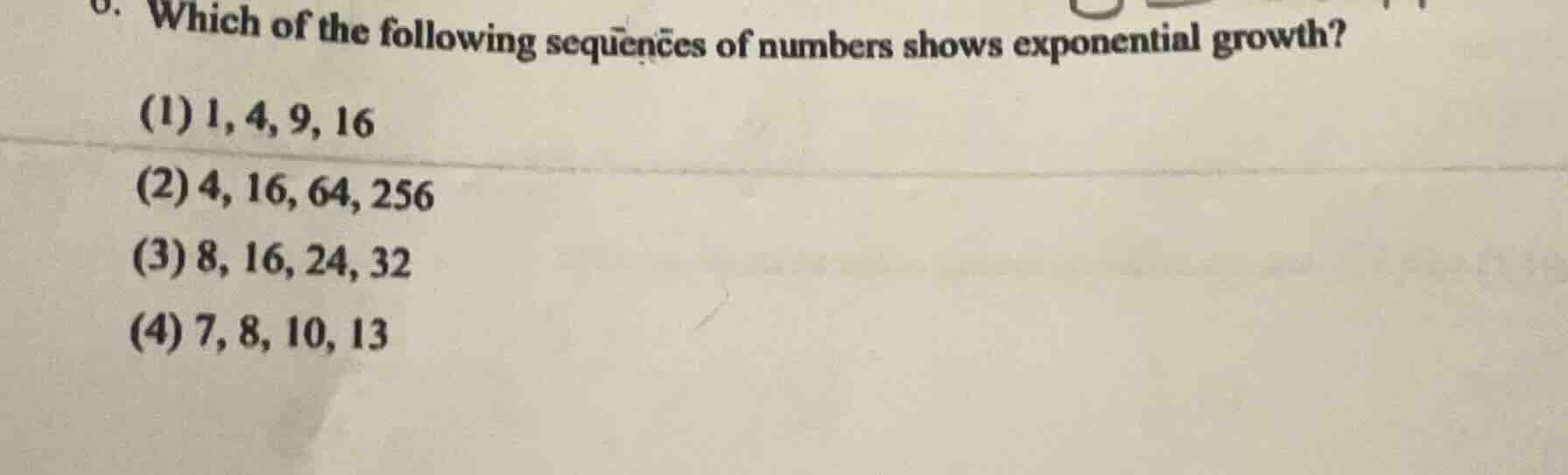
Question
- which of the following sequences of numbers shows exponential growth? (1) 1, 4, 9, 16 (2) 4, 16, 64, 256 (3) 8, 16, 24, 32 (4) 7, 8, 10, 13
Step1: Recall exponential growth definition
Exponential growth sequence has a common ratio \( r \) (each term multiplied by \( r \) to get next term), \( r>1 \).
Step2: Analyze sequence (1)
\( 1, 4, 9, 16 \): \( \frac{4}{1}=4 \), \( \frac{9}{4}=2.25 \) – not constant ratio (these are squares: \( 1^2, 2^2, 3^2, 4^2 \), quadratic growth).
Step3: Analyze sequence (2)
\( 4, 16, 64, 256 \): \( \frac{16}{4}=4 \), \( \frac{64}{16}=4 \), \( \frac{256}{64}=4 \) – common ratio \( r = 4>1 \), so exponential growth.
Step4: Analyze sequence (3)
\( 8, 16, 24, 32 \): \( 16 - 8 = 8 \), \( 24 - 16 = 8 \), \( 32 - 24 = 8 \) – common difference (arithmetic sequence, linear growth).
Step5: Analyze sequence (4)
\( 7, 8, 10, 13 \): Differences: \( 8 - 7 = 1 \), \( 10 - 8 = 2 \), \( 13 - 10 = 3 \) – increasing differences (not linear or exponential with constant ratio).

Snap & solve any problem in the app
Get step-by-step solutions on Sovi AI
Photo-based solutions with guided steps
Explore more problems and detailed explanations
(2) 4, 16, 64, 256