QUESTION IMAGE
Question
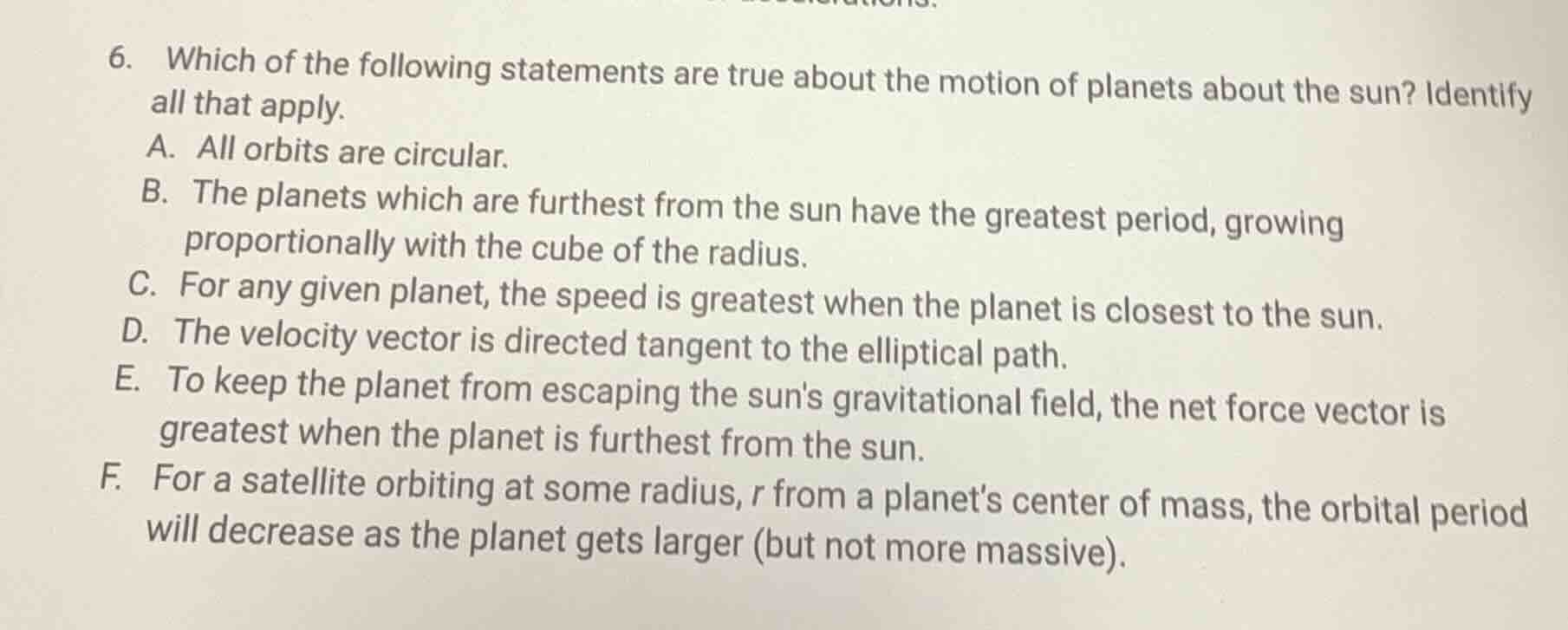
- which of the following statements are true about the motion of planets about the sun? identify all that apply.
a. all orbits are circular.
b. the planets which are furthest from the sun have the greatest period, growing proportionally with the cube of the radius.
c. for any given planet, the speed is greatest when the planet is closest to the sun.
d. the velocity vector is directed tangent to the elliptical path.
e. to keep the planet from escaping the suns gravitational field, the net force vector is greatest when the planet is furthest from the sun.
f. for a satellite orbiting at some radius, $r$ from a planets center of mass, the orbital period will decrease as the planet gets larger (but not more massive).
- A: Planetary orbits are elliptical (Kepler's 1st Law), not circular. False.
- B: From Kepler's 3rd Law, $T^2 \propto r^3$, so $T \propto r^{3/2}$, not proportional to $r^3$. False.
- C: Kepler's 2nd Law (equal area law) states planets move fastest at perihelion (closest to sun). True.
- D: Orbital velocity is always tangent to the path, which is elliptical for planets. True.
- Gravitational force follows $F = G\frac{Mm}{r^2}$, so force is greatest when $r$ is smallest (closest to sun). E is false.
- F: Orbital period depends on the planet's mass and orbital radius ($T = 2\pi\sqrt{\frac{r^3}{GM}}$), not the planet's size (if mass is constant). False.

Snap & solve any problem in the app
Get step-by-step solutions on Sovi AI
Photo-based solutions with guided steps
Explore more problems and detailed explanations
C. For any given planet, the speed is greatest when the planet is closest to the sun.
D. The velocity vector is directed tangent to the elliptical path.