QUESTION IMAGE
Question
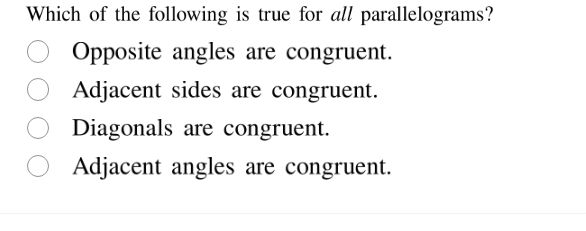
which of the following is true for all parallelograms? opposite angles are congruent. adjacent sides are congruent. diagonals are congruent. adjacent angles are congruent.
Brief Explanations
To determine which statement is true for all parallelograms, we analyze each option:
- Opposite angles are congruent: By the definition and properties of a parallelogram, in a parallelogram, opposite angles are equal (congruent). This is a fundamental property of parallelograms.
- Adjacent sides are congruent: In a general parallelogram, adjacent sides are not necessarily congruent. For example, a rectangle is a parallelogram, but adjacent sides (length and width) are congruent only if it is a square. So this is not true for all parallelograms.
- Diagonals are congruent: The diagonals of a parallelogram are congruent only in special cases like rectangles (and squares, which are special rectangles). In a rhombus (a type of parallelogram), diagonals are not congruent (they are perpendicular bisectors of each other). So this is not true for all parallelograms.
- Adjacent angles are congruent: In a parallelogram, adjacent angles are supplementary (their sum is \(180^\circ\)), not necessarily congruent. For example, in a non - rectangular parallelogram (like a rhombus that is not a square), adjacent angles are supplementary but not congruent.

Snap & solve any problem in the app
Get step-by-step solutions on Sovi AI
Photo-based solutions with guided steps
Explore more problems and detailed explanations
Opposite angles are congruent.