QUESTION IMAGE
Question
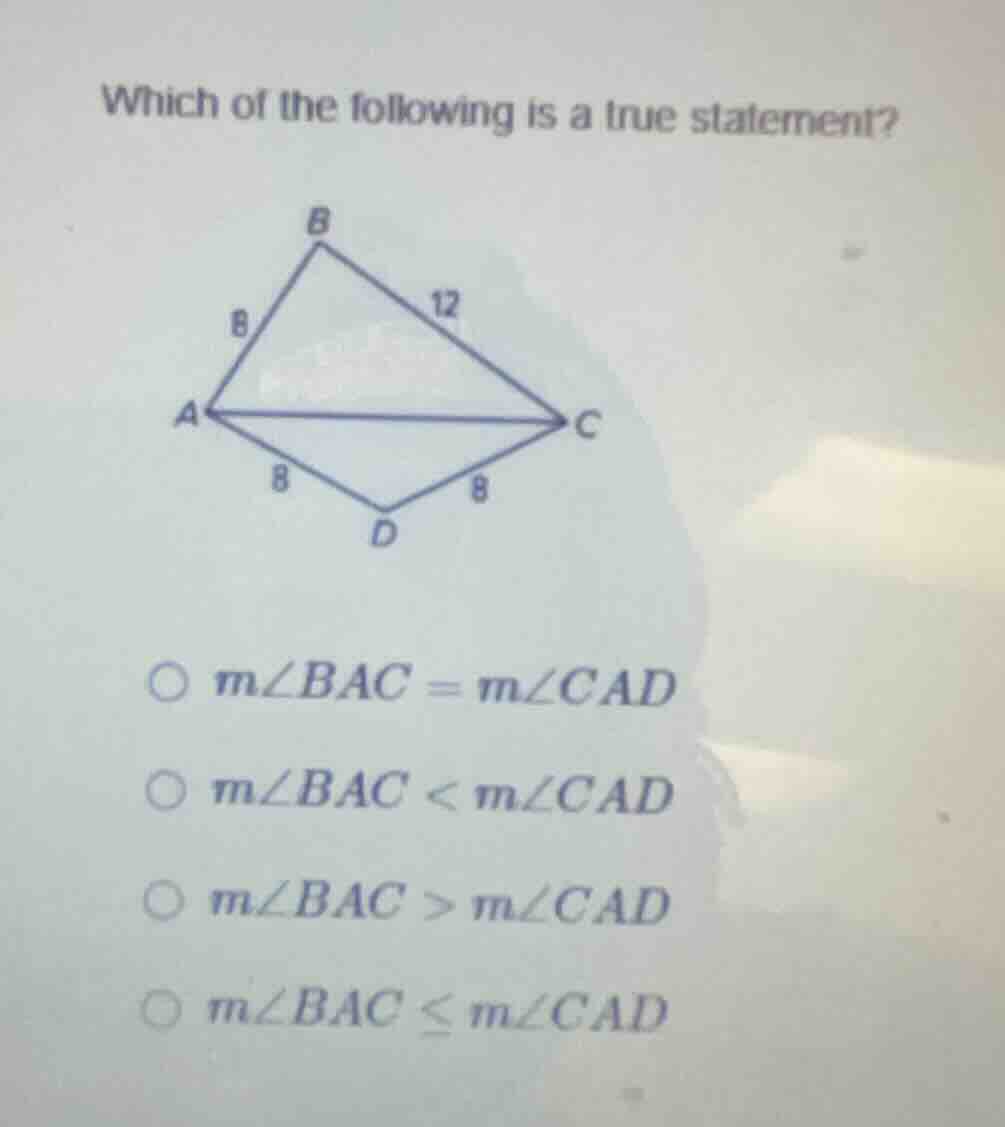
which of the following is a true statement? image of a quadrilateral with triangles abc and adc, where ab=8, bc=12, ad=8, dc=8, and ac is a common side options: - ( mangle bac = mangle cad ) - ( mangle bac < mangle cad ) - ( mangle bac > mangle cad ) - ( mangle bac leq mangle cad )
Step1: Analyze Triangle \( \triangle ABC \) and \( \triangle ADC \)
In \( \triangle ABC \), we have \( AB = 8 \), \( BC = 12 \), and \( AC \) is a common side. In \( \triangle ADC \), we have \( AD = 8 \), \( DC = 8 \), so \( \triangle ADC \) is isosceles with \( AD = DC \).
Step2: Apply the Hinge Theorem (SAS Inequality Theorem)
The Hinge Theorem states that if two sides of one triangle are congruent to two sides of another triangle, but the third side of the first triangle is longer than the third side of the second triangle, then the included angle of the first triangle is larger than the included angle of the second triangle.
In \( \triangle ABC \) and \( \triangle ADC \):
- \( AB = AD = 8 \) (two sides congruent)
- \( AC \) is common to both triangles (the second pair of congruent sides)
- The third side: \( BC = 12 \) and \( DC = 8 \). Since \( BC > DC \) (12 > 8), the included angle \( \angle BAC \) (included between \( AB \) and \( AC \)) must be larger than the included angle \( \angle CAD \) (included between \( AD \) and \( AC \)). So \( m\angle BAC > m\angle CAD \).

Snap & solve any problem in the app
Get step-by-step solutions on Sovi AI
Photo-based solutions with guided steps
Explore more problems and detailed explanations
\( m\angle BAC > m\angle CAD \) (the option with this statement)