QUESTION IMAGE
Question
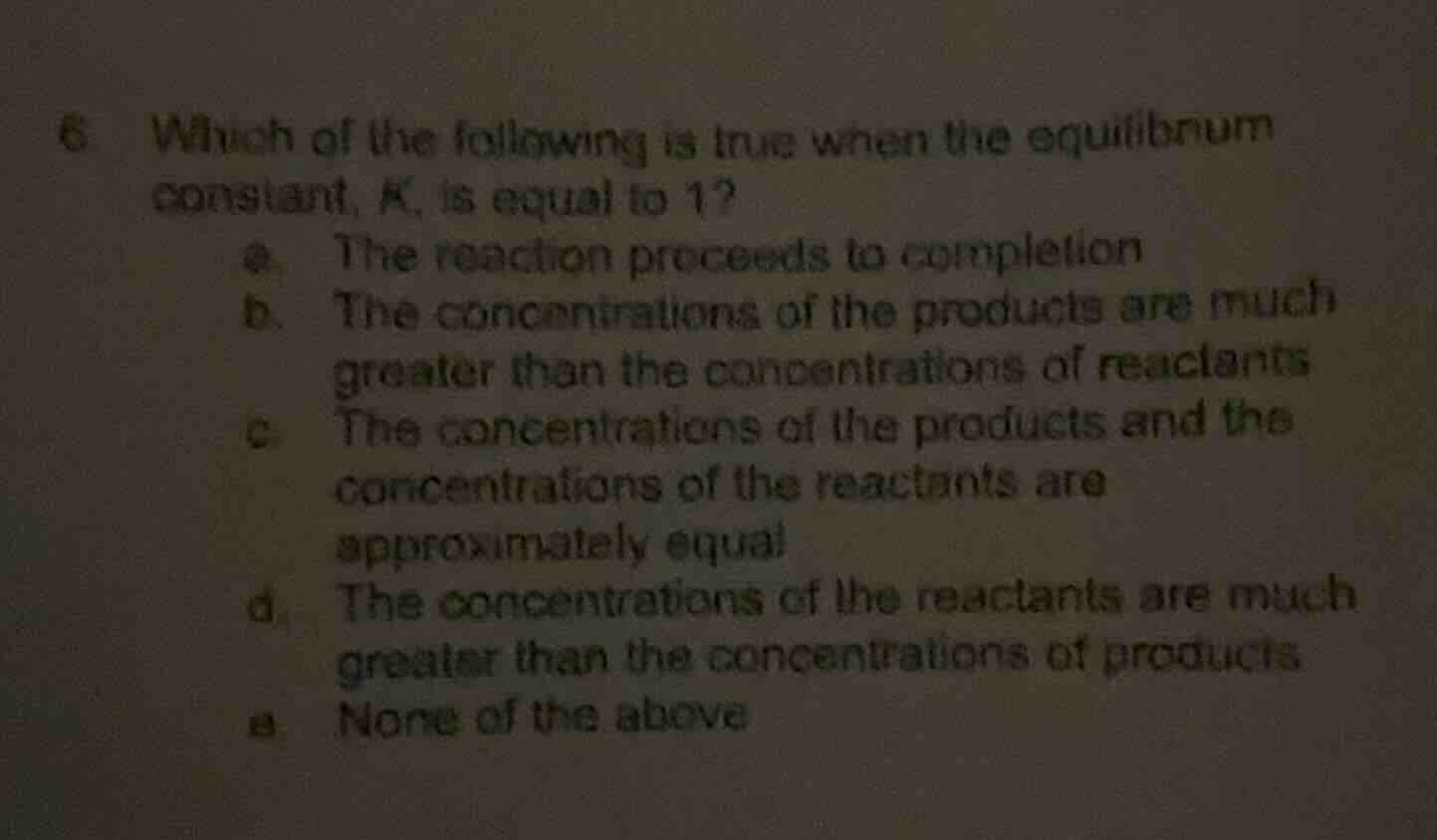
6 which of the following is true when the equilibrium constant, k, is equal to 1?
a. the reaction proceeds to completion
b. the concentrations of the products are much greater than the concentrations of reactants
c. the concentrations of the products and the concentrations of the reactants are approximately equal
d. the concentrations of the reactants are much greater than the concentrations of products
e. none of the above
The equilibrium constant \( K \) is defined as the ratio of the concentrations (or partial pressures) of products to reactants, each raised to their stoichiometric coefficients. Mathematically, for a reaction \( aA + bB
ightleftharpoons cC + dD \), \( K=\frac{[C]^c[D]^d}{[A]^a[B]^b} \).
- Option a: A reaction proceeds to completion when \( K \) is very large (approaching infinity), not when \( K = 1 \).
- Option b: If product concentrations were much greater than reactant concentrations, \( K \) would be much larger than 1 (since \( K \) is product/reactant ratio).
- Option c: When \( K = 1 \), the ratio of product concentrations to reactant concentrations (adjusted for stoichiometry) is 1. This means the concentrations of products and reactants (accounting for their stoichiometric coefficients) are approximately equal.
- Option d: If reactant concentrations were much greater than product concentrations, \( K \) would be much less than 1.

Snap & solve any problem in the app
Get step-by-step solutions on Sovi AI
Photo-based solutions with guided steps
Explore more problems and detailed explanations
c. The concentrations of the products and the concentrations of the reactants are approximately equal