QUESTION IMAGE
Question
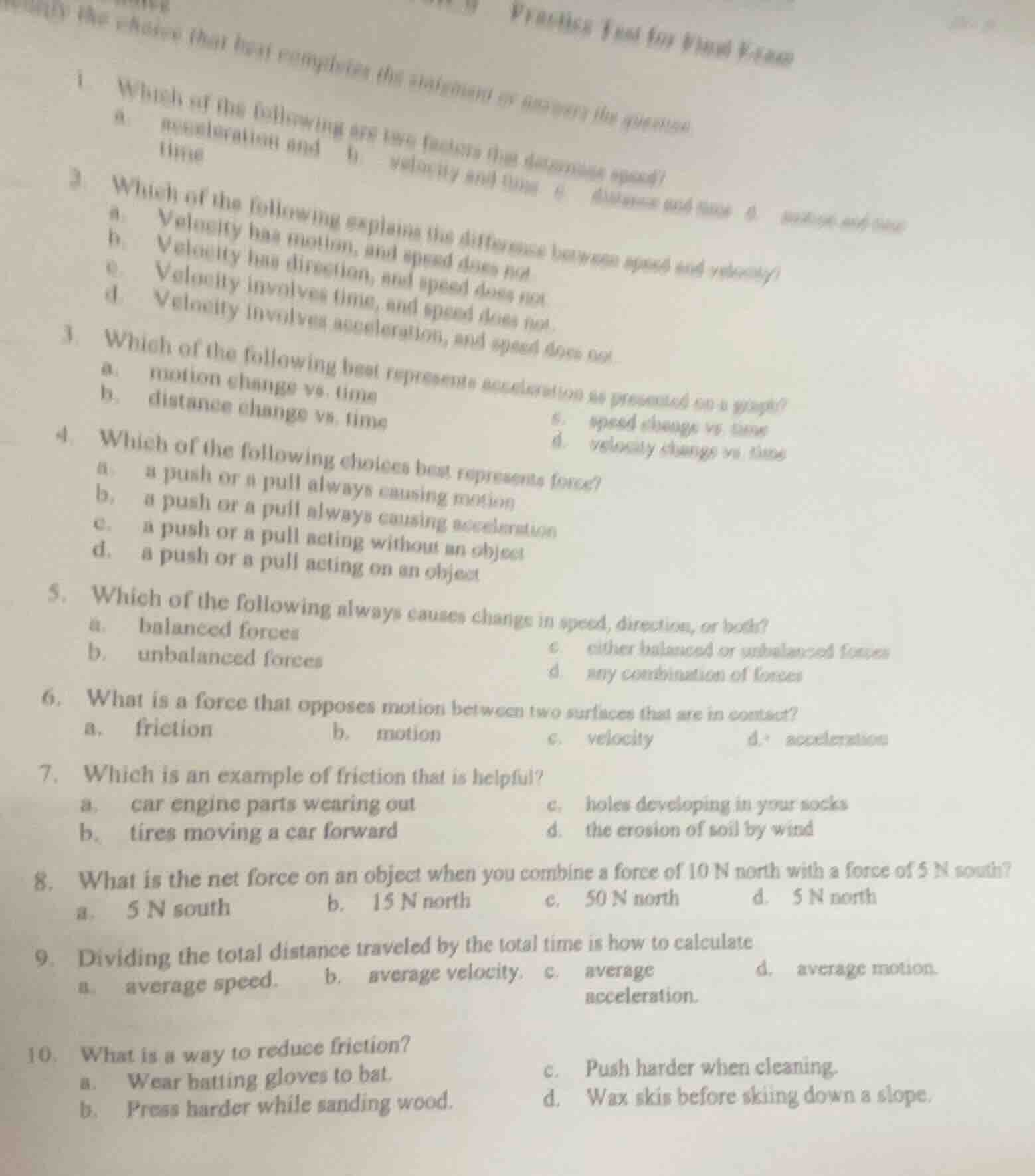
1 which of the following are two factors that determine speed?
a. acceleration and time
b. velocity and time
c. distance and time
d. motion and time
2 which of the following explains the difference between speed and velocity?
a. velocity has motion, and speed does not.
b. velocity has direction, and speed does not.
c. velocity involves time, and speed does not.
d. velocity involves acceleration, and speed does not.
3 which of the following best represents acceleration as presented on a graph?
a. motion change vs. time
b. distance change vs. time
c. speed change vs. time
d. velocity change vs. time
4 which of the following choices best represents force?
a. a push or a pull always causing motion
b. a push or a pull always causing acceleration
c. a push or a pull acting without an object
d. a push or a pull acting on an object
5 which of the following always causes change in speed, direction, or both?
a. balanced forces
b. unbalanced forces
c. either balanced or unbalanced forces
d. any combination of forces
6 what is a force that opposes motion between two surfaces that are in contact?
a. friction
b. motion
c. velocity
d. acceleration
7 which is an example of friction that is helpful?
a. car engine parts wearing out
b. tires moving a car forward
c. holes developing in your socks
d. the erosion of soil by wind
8 what is the net force on an object when you combine a force of 10 n north with a force of 5 n south?
a. 5 n south
b. 15 n north
c. 50 n north
d. 5 n north
9 dividing the total distance traveled by the total time is how to calculate
a. average speed.
b. average velocity.
c. average acceleration.
d. average motion.
10 what is a way to reduce friction?
a. wear batting gloves to bat.
b. press harder while sanding wood.
c. push harder when cleaning.
d. wax skis before skiing down a slope.
- Speed is defined as distance traveled over time, so the two factors are distance and time.
- Speed is a scalar quantity (only magnitude), while velocity is a vector quantity (has magnitude and direction).
- Acceleration is the rate of change of velocity over time, so a graph of velocity change vs. time represents acceleration.
- Force is formally defined as a push or pull acting on an object; it does not always cause motion or acceleration (e.g., balanced forces), and cannot act without an object.
- Unbalanced forces result in a net force, which causes a change in an object's speed, direction, or both. Balanced forces produce no change in motion.
- Friction is the force that opposes motion between two contacting surfaces.
- Tire friction with the road allows a car to move forward, which is a helpful use of friction; the other options are harmful effects of friction.
- Forces in opposite directions subtract. 10 N north minus 5 N south results in a net force of 5 N north.
- Average speed is calculated by dividing total distance traveled by total time taken.
- Waxing skis creates a smooth surface that reduces friction between the skis and snow; the other options increase friction.

Snap & solve any problem in the app
Get step-by-step solutions on Sovi AI
Photo-based solutions with guided steps
Explore more problems and detailed explanations
- c. distance and time
- b. Velocity has direction, and speed does not.
- d. velocity change vs. time
- d. a push or a pull acting on an object
- b. unbalanced forces
- a. friction
- b. tires moving a car forward
- d. 5 N north
- a. average speed.
- d. Wax skis before skiing down a slope.