QUESTION IMAGE
Question
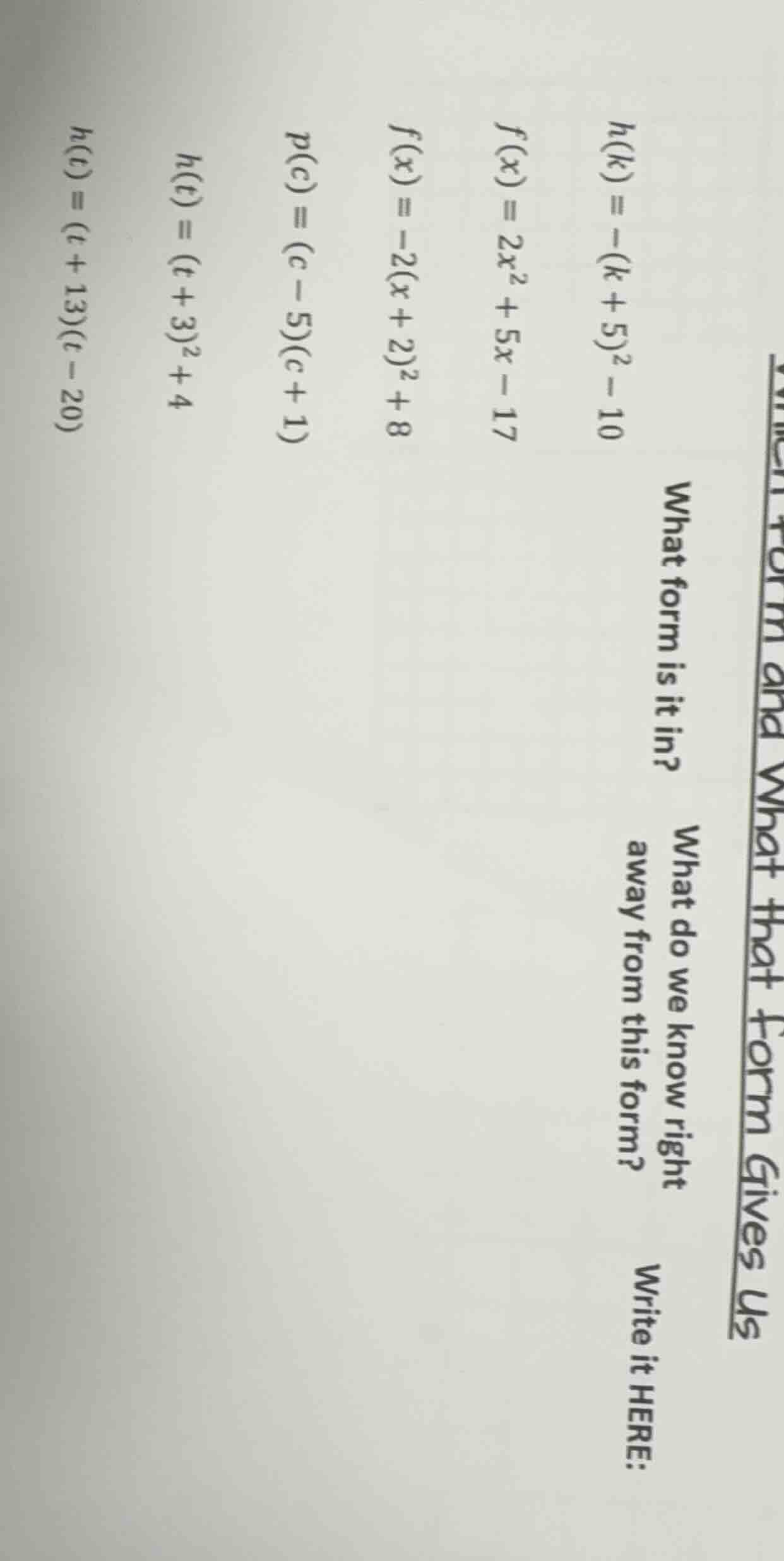
which form and what that form gives us
for each function:
what form is it in?
what do we know right away from this form?
write it here:
$h(k) = -(k + 5)^2 - 10$
$f(x) = 2x^2 + 5x - 17$
$f(x) = -2(x + 2)^2 + 8$
$p(c) = (c - 5)(c + 1)$
$h(t) = (t + 3)^2 + 4$
$h(t) = (t + 13)(t - 20)$
Response
To solve this, we analyze each function:
1. \( h(k) = -(k + 5)^2 - 10 \)
- Form: Vertex form of a quadratic function. The vertex form is \( y = a(x - h)^2 + k \) (here variable is \( k \), so \( y = a(k - h)^2 + k' \)). Here \( a = -1 \), \( h = -5 \) (since \( k - (-5)=k + 5 \)), \( k' = -10 \).
- What we know: The vertex of the parabola is at \( (h, k') = (-5, -10) \), and since \( a=-1<0 \), the parabola opens downwards.
- Write it HERE: Vertex form; Vertex at \((-5, -10)\), opens down.
2. \( f(x) = 2x^2 + 5x - 17 \)
- Form: Standard form of a quadratic function, which is \( y = ax^2 + bx + c \) with \( a = 2 \), \( b = 5 \), \( c = -17 \).
- What we know: We can find the vertex using \( x=-\frac{b}{2a}=-\frac{5}{4} \), and the parabola opens upwards (\( a = 2>0 \)).
- Write it HERE: Standard form; \( a = 2 \), \( b = 5 \), \( c = -17 \), opens up.
3. \( f(x) = -2(x + 2)^2 + 8 \)
- Form: Vertex form of a quadratic function. Here \( a=-2 \), \( h=-2 \) (since \( x - (-2)=x + 2 \)), \( k = 8 \).
- What we know: Vertex at \((-2, 8)\), and since \( a=-2<0 \), the parabola opens downwards.
- Write it HERE: Vertex form; Vertex at \((-2, 8)\), opens down.
4. \( p(c) = (c - 5)(c + 1) \)
- Form: Factored form of a quadratic function. It is \( y = a(x - r_1)(x - r_2) \), here \( a = 1 \), \( r_1 = 5 \), \( r_2=-1 \) (since \( c + 1=c - (-1) \)).
- What we know: The roots of the quadratic equation \( p(c)=0 \) are \( c = 5 \) and \( c=-1 \), and since \( a = 1>0 \), the parabola opens upwards.
- Write it HERE: Factored form; Roots at \( c = 5 \) and \( c=-1 \), opens up.
5. \( h(t) = (t + 3)^2 + 4 \)
- Form: Vertex form of a quadratic function. Here \( a = 1 \), \( h=-3 \) (since \( t - (-3)=t + 3 \)), \( k = 4 \).
- What we know: Vertex at \((-3, 4)\), and since \( a = 1>0 \), the parabola opens upwards.
- Write it HERE: Vertex form; Vertex at \((-3, 4)\), opens up.
6. \( h(t) = (t + 13)(t - 20) \)
- Form: Factored form of a quadratic function. Here \( a = 1 \), \( r_1=-13 \) (since \( t - (-13)=t + 13 \)), \( r_2 = 20 \).
- What we know: The roots of the quadratic equation \( h(t)=0 \) are \( t=-13 \) and \( t = 20 \), and since \( a = 1>0 \), the parabola opens upwards.
- Write it HERE: Factored form; Roots at \( t=-13 \) and \( t = 20 \), opens up.

Snap & solve any problem in the app
Get step-by-step solutions on Sovi AI
Photo-based solutions with guided steps
Explore more problems and detailed explanations
To solve this, we analyze each function:
1. \( h(k) = -(k + 5)^2 - 10 \)
- Form: Vertex form of a quadratic function. The vertex form is \( y = a(x - h)^2 + k \) (here variable is \( k \), so \( y = a(k - h)^2 + k' \)). Here \( a = -1 \), \( h = -5 \) (since \( k - (-5)=k + 5 \)), \( k' = -10 \).
- What we know: The vertex of the parabola is at \( (h, k') = (-5, -10) \), and since \( a=-1<0 \), the parabola opens downwards.
- Write it HERE: Vertex form; Vertex at \((-5, -10)\), opens down.
2. \( f(x) = 2x^2 + 5x - 17 \)
- Form: Standard form of a quadratic function, which is \( y = ax^2 + bx + c \) with \( a = 2 \), \( b = 5 \), \( c = -17 \).
- What we know: We can find the vertex using \( x=-\frac{b}{2a}=-\frac{5}{4} \), and the parabola opens upwards (\( a = 2>0 \)).
- Write it HERE: Standard form; \( a = 2 \), \( b = 5 \), \( c = -17 \), opens up.
3. \( f(x) = -2(x + 2)^2 + 8 \)
- Form: Vertex form of a quadratic function. Here \( a=-2 \), \( h=-2 \) (since \( x - (-2)=x + 2 \)), \( k = 8 \).
- What we know: Vertex at \((-2, 8)\), and since \( a=-2<0 \), the parabola opens downwards.
- Write it HERE: Vertex form; Vertex at \((-2, 8)\), opens down.
4. \( p(c) = (c - 5)(c + 1) \)
- Form: Factored form of a quadratic function. It is \( y = a(x - r_1)(x - r_2) \), here \( a = 1 \), \( r_1 = 5 \), \( r_2=-1 \) (since \( c + 1=c - (-1) \)).
- What we know: The roots of the quadratic equation \( p(c)=0 \) are \( c = 5 \) and \( c=-1 \), and since \( a = 1>0 \), the parabola opens upwards.
- Write it HERE: Factored form; Roots at \( c = 5 \) and \( c=-1 \), opens up.
5. \( h(t) = (t + 3)^2 + 4 \)
- Form: Vertex form of a quadratic function. Here \( a = 1 \), \( h=-3 \) (since \( t - (-3)=t + 3 \)), \( k = 4 \).
- What we know: Vertex at \((-3, 4)\), and since \( a = 1>0 \), the parabola opens upwards.
- Write it HERE: Vertex form; Vertex at \((-3, 4)\), opens up.
6. \( h(t) = (t + 13)(t - 20) \)
- Form: Factored form of a quadratic function. Here \( a = 1 \), \( r_1=-13 \) (since \( t - (-13)=t + 13 \)), \( r_2 = 20 \).
- What we know: The roots of the quadratic equation \( h(t)=0 \) are \( t=-13 \) and \( t = 20 \), and since \( a = 1>0 \), the parabola opens upwards.
- Write it HERE: Factored form; Roots at \( t=-13 \) and \( t = 20 \), opens up.