QUESTION IMAGE
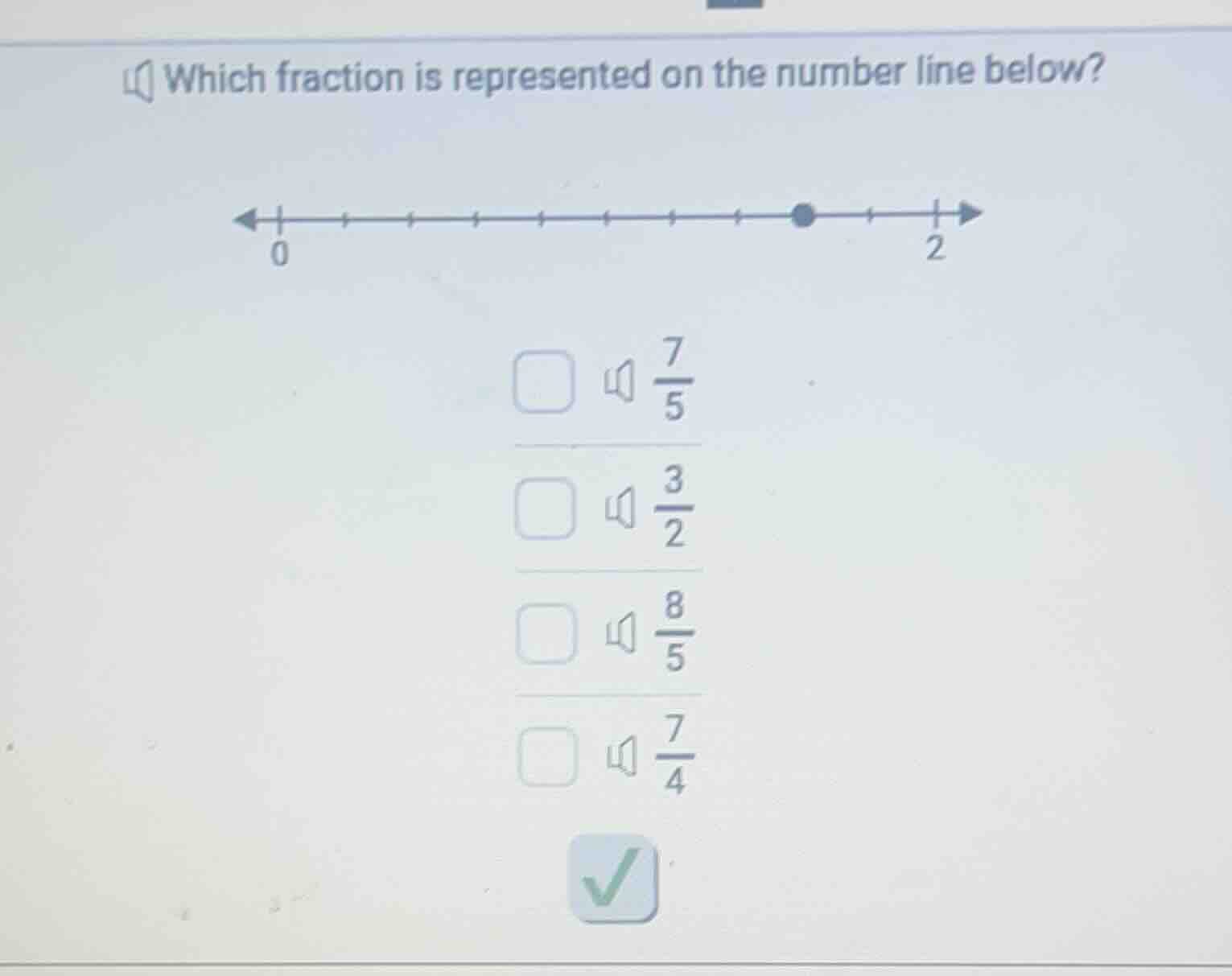
Question
which fraction is represented on the number line below?
0 2
\\(\frac{7}{5}\\)
\\(\frac{3}{2}\\)
\\(\frac{8}{5}\\)
\\(\frac{7}{4}\\)
Step1: Determine the number of intervals
The number line is from 0 to 2. Let's find the number of equal intervals between 0 and 2. From the number line, we can see that between 0 and 2, there are 10 small intervals (since from 0 to 2, if we count the ticks, we can see that the distance from 0 to 2 is divided into 10 parts? Wait, no, wait. Wait, the number line has 0, then some ticks, and then 2. Wait, let's re - examine. Wait, the dot is at the 8th tick (if we start counting from 0 as the first tick). Wait, actually, the distance from 0 to 2 is 2 units. Let's find the length of each interval. Let the length of each interval be \(x\). The total number of intervals between 0 and 2: let's see, from 0 to 2, how many intervals? Let's count the number of spaces between the ticks. From 0 to 2, there are 10 spaces? Wait, no, maybe I made a mistake. Wait, another approach: 2 can be written as \(\frac{10}{5}\) or \(\frac{8}{4}\) or other fractions. Wait, let's look at the options. The options are \(\frac{7}{5}\), \(\frac{3}{2}\) (which is \(\frac{7.5}{5}\) or \(\frac{6}{4}\)), \(\frac{8}{5}\), \(\frac{7}{4}\).
Wait, let's count the number of intervals between 0 and 2. Let's assume that between 0 and 2, there are 10 intervals (since 2 divided by 10 is 0.2 per interval). Wait, no, maybe the number of intervals between 0 and 2 is 10? Wait, no, the dot is at the 8th interval from 0? Wait, no, let's think again. Let's convert 2 to a fraction with denominator 5: \(2=\frac{10}{5}\). So if we divide the interval from 0 to 2 (which is length 2) into 10 equal parts (since \(\frac{10}{5}\) has denominator 5, and 2 is \(\frac{10}{5}\)), then each part is \(\frac{2}{10}=\frac{1}{5}\) in length. Wait, no, if we have the number line from 0 to 2, and we want to represent fractions with denominator 5 or 4. Let's check the position of the dot.
Wait, the dot is at a position that is 8 fifths? Wait, \(\frac{8}{5}=1.6\), \(\frac{7}{5} = 1.4\), \(\frac{3}{2}=1.5\), \(\frac{7}{4}=1.75\). Wait, let's count the number of intervals. Let's see, from 0 to 2, the total length is 2. Let's say there are 10 intervals (since 2 divided by 10 is 0.2). So each interval is 0.2 or \(\frac{1}{5}\). So the position of the dot: if we start at 0, and move 8 intervals (each of length \(\frac{1}{5}\)), then the position is \(8\times\frac{1}{5}=\frac{8}{5}\). Let's check the value of \(\frac{8}{5}=1.6\), \(\frac{7}{5} = 1.4\), \(\frac{3}{2}=1.5\), \(\frac{7}{4}=1.75\). So \(\frac{8}{5}\) is the correct fraction.
Step2: Verify with the number line
We know that \(2=\frac{10}{5}\). The number of intervals between 0 and 2 is 10 (since \(\frac{10}{5}\) implies 10 parts of \(\frac{1}{5}\) each). The dot is at the 8th interval (counting from 0), so the value is \(8\times\frac{1}{5}=\frac{8}{5}\).

Snap & solve any problem in the app
Get step-by-step solutions on Sovi AI
Photo-based solutions with guided steps
Explore more problems and detailed explanations
\(\frac{8}{5}\) (the option corresponding to \(\frac{8}{5}\))