QUESTION IMAGE
Question
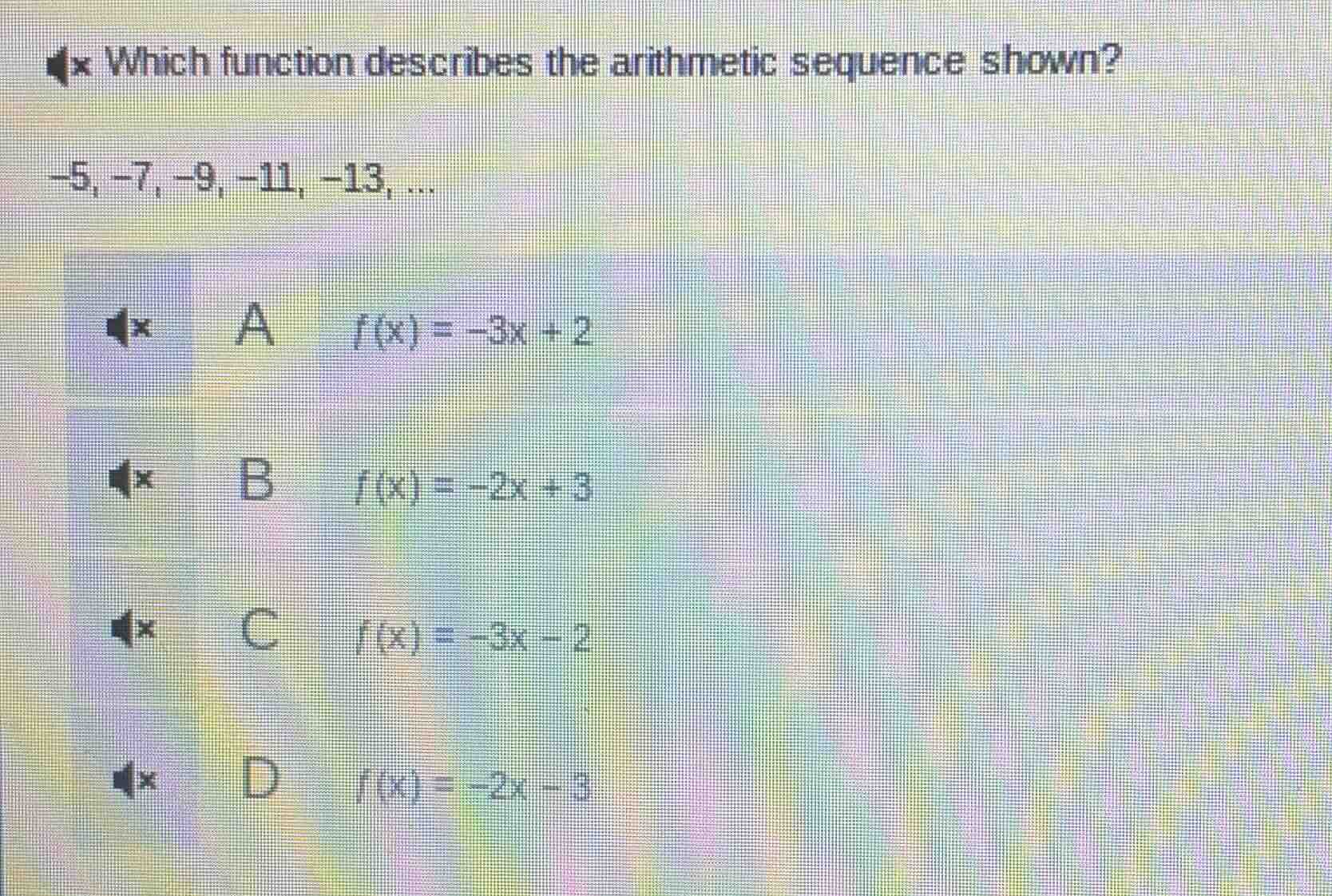
which function describes the arithmetic sequence shown? -5, -7, -9, -11, -13, ... a ( f(x) = -3x + 2 ) b ( f(x) = -2x + 3 ) c ( f(x) = -3x - 2 ) d ( f(x) = -2x - 3 )
Step1: Find the common difference (d)
In an arithmetic sequence, the common difference \( d \) is the difference between consecutive terms. For the sequence \(-5, -7, -9, -11, -13, \dots\), we calculate \( d = -7 - (-5) = -7 + 5 = -2 \).
Step2: Recall the formula for the nth term of an arithmetic sequence
The formula for the nth term of an arithmetic sequence is \( f(x)=a_1+(x - 1)d \), where \( a_1 \) is the first term and \( d \) is the common difference. Here, \( a_1=-5 \) and \( d = -2 \).
Substitute these values into the formula:
\[
\]
We can also verify by plugging in values of \( x \). For \( x = 1 \), \( f(1)=-2(1)-3=-5 \) (matches the first term). For \( x = 2 \), \( f(2)=-2(2)-3=-7 \) (matches the second term), and so on.

Snap & solve any problem in the app
Get step-by-step solutions on Sovi AI
Photo-based solutions with guided steps
Explore more problems and detailed explanations
D. \( f(x)=-2x - 3 \)