QUESTION IMAGE
Question
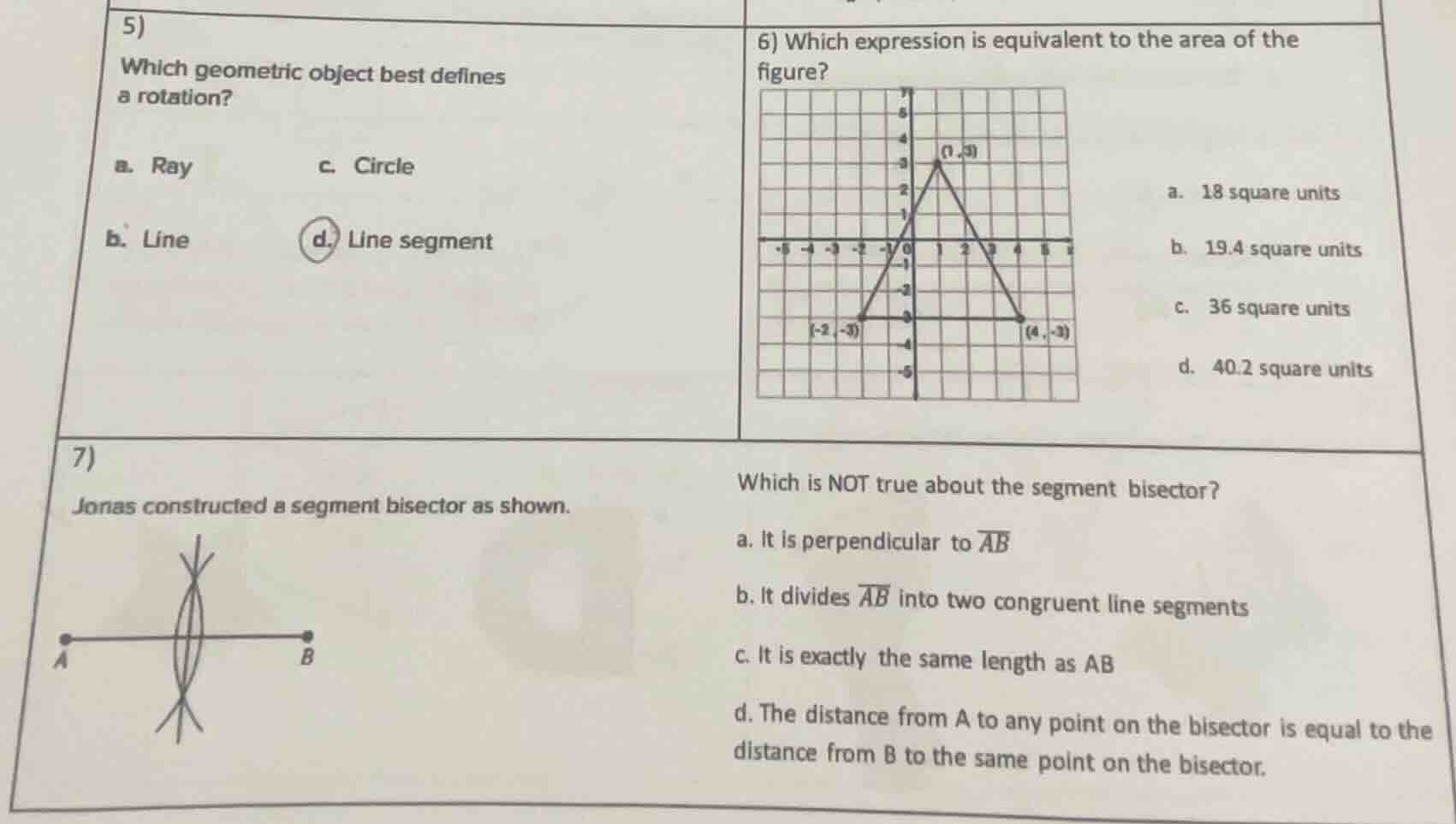
- which geometric object best defines a rotation? a. ray c. circle b. line d. line segment 6) which expression is equivalent to the area of the figure? a. 18 square units b. 19.4 square units c. 36 square units d. 40.2 square units 7) jonas constructed a segment bisector as shown. which is not true about the segment bisector? a. it is perpendicular to \\(\overline{ab}\\) b. it divides \\(\overline{ab}\\) into two congruent line segments c. it is exactly the same length as ab d. the distance from a to any point on the bisector is equal to the distance from b to the same point on the bisector.
Question 5
A rotation in geometry is often associated with a circle because a circle is defined by all points equidistant from a center, and rotating a point around a center traces a circular path. A ray, line, or line segment do not represent the set of points involved in a rotation as well as a circle does.
Step1: Identify the base and height of the triangle
The base of the triangle can be found by calculating the distance between the points \((-2, -3)\) and \((4, -3)\). Since the y - coordinates are the same, the distance is \(|4 - (-2)|=6\) units. The height of the triangle is the vertical distance from the point \((0, 3)\) to the line \(y=-3\), which is \(|3 - (-3)| = 6\) units.
Step2: Calculate the area of the triangle
The formula for the area of a triangle is \(A=\frac{1}{2}\times base\times height\). Substituting the values of base \(b = 6\) and height \(h=6\) into the formula, we get \(A=\frac{1}{2}\times6\times6 = 18\) square units.
- Option a: A segment bisector (specifically a perpendicular bisector, which is what is constructed here) is perpendicular to the segment \(\overline{AB}\), so this is true.
- Option b: A segment bisector divides the segment into two congruent (equal - length) line segments, so this is true.
- Option c: The segment bisector is a line (or part of a line) that intersects \(\overline{AB}\) at its midpoint. There is no reason for the bisector to be the same length as \(\overline{AB}\), so this is not true.
- Option d: By the definition of a perpendicular bisector, any point on the bisector is equidistant from \(A\) and \(B\), so the distance from \(A\) to a point on the bisector is equal to the distance from \(B\) to that point, so this is true.

Snap & solve any problem in the app
Get step-by-step solutions on Sovi AI
Photo-based solutions with guided steps
Explore more problems and detailed explanations
c. Circle