QUESTION IMAGE
Question
which graph shows the solution to the equation \\(\log_{2}(3x - 1) = 2\\)?
Step1: Solve the logarithmic equation
To solve \(\log_{2}(3x - 1)=2\), we use the definition of a logarithm. If \(\log_{b}(a)=c\), then \(a = b^{c}\). So, applying this to our equation, we get:
\(3x - 1=2^{2}\)
Step2: Simplify the right - hand side
Calculate \(2^{2}\), which is equal to 4. So the equation becomes:
\(3x - 1 = 4\)
Step3: Solve for x
Add 1 to both sides of the equation:
\(3x=4 + 1\)
\(3x=5\)
Then divide both sides by 3:
\(x=\frac{5}{3}\approx1.67\)
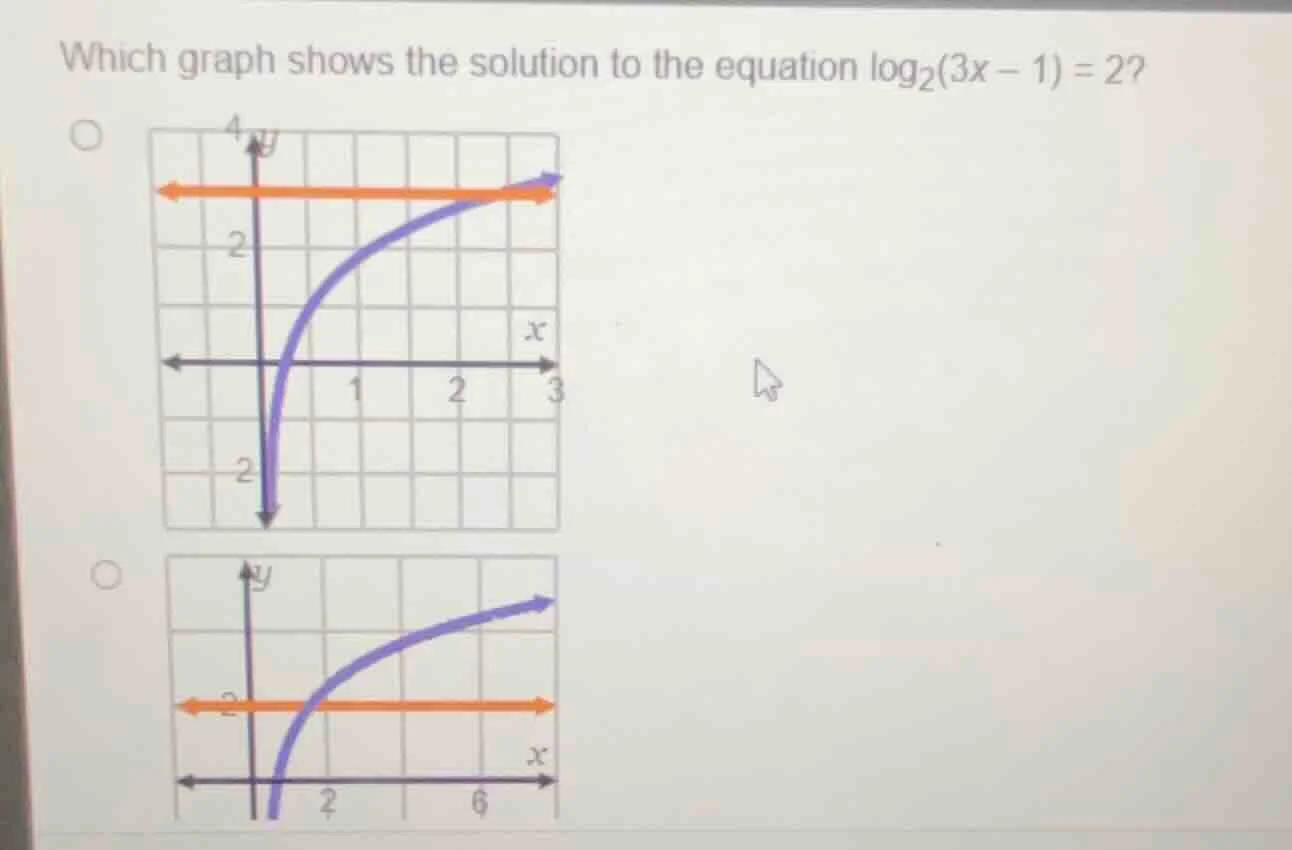
Now, we also know that the equation \(\log_{2}(3x - 1)=2\) can be thought of as finding the intersection of the function \(y = \log_{2}(3x - 1)\) and the horizontal line \(y = 2\).
First, let's analyze the domain of the logarithmic function \(y=\log_{2}(3x - 1)\). For a logarithmic function \(\log_{b}(u)\), \(u>0\). So \(3x-1>0\), which gives \(x>\frac{1}{3}\).
Now, let's find the value of \(x\) when \(y = 2\) (from the line \(y = 2\)) and see which graph has the intersection at \(x=\frac{5}{3}\approx1.67\).
Looking at the first graph, the x - axis has markings up to 3, and the second graph has x - axis markings up to 6. But when we solve \(x=\frac{5}{3}\approx1.67\), we can check the horizontal line \(y = 2\) (since the equation is \(\log_{2}(3x - 1)=2\), so \(y = 2\) for the horizontal line) and the logarithmic curve \(y=\log_{2}(3x - 1)\).
The key is that when \(y = 2\), we found \(x=\frac{5}{3}\approx1.67\). Now, let's check the horizontal line: the equation is \(\log_{2}(3x - 1)=2\), so the horizontal line should be \(y = 2\).
In the first graph, the horizontal line is \(y = 3\) (wait, no, looking back, the first graph's horizontal line is at \(y = 3\)? Wait, no, the first graph's orange line: looking at the y - axis, the first graph has y - axis with 2, 4? Wait, no, let's re - examine.
Wait, the equation is \(\log_{2}(3x - 1)=2\), so we are looking for the intersection of \(y=\log_{2}(3x - 1)\) and \(y = 2\).
Let's recast the function \(y=\log_{2}(3x - 1)\). Let's find the x - intercept: set \(y = 0\), then \(\log_{2}(3x - 1)=0\), so \(3x - 1=1\), \(3x=2\), \(x=\frac{2}{3}\approx0.67\).
Now, when \(y = 2\), \(x=\frac{5}{3}\approx1.67\).
Looking at the two graphs:
The first graph: the horizontal line (orange) is at \(y = 3\)? No, wait the first graph's y - axis: the top orange line is at \(y = 3\)? Wait, no, the first graph's y - axis has 2, 4? Wait, the first graph's orange line is horizontal, let's check the y - coordinate. The equation is \(\log_{2}(3x - 1)=2\), so the horizontal line should be \(y = 2\).
Wait, maybe I misread the graphs. Let's start over.
The equation is \(\log_{2}(3x - 1)=2\). To solve it:
- Convert logarithmic to exponential: \(3x-1 = 2^{2}=4\)
- Then \(3x=5\), \(x=\frac{5}{3}\approx1.67\)
Now, the function \(y = \log_{2}(3x - 1)\) is a logarithmic function. The domain is \(3x-1>0\Rightarrow x>\frac{1}{3}\approx0.33\).
The horizontal line is \(y = 2\) (since the equation is \(\log_{2}(3x - 1)=2\), so we set \(y = 2\)).
Now, let's look at the two graphs:
- First graph: The horizontal line (orange) is at \(y = 3\)? No, the first graph's y - axis: the orange line is at \(y = 3\)? Wait, no, the first graph's y - axis has markings: the first graph's y - axis, the orange line is at \(y = 3\)? Wait, no, the user's graph: first graph, y - axis: 2, 4? Wait, the first graph: the orange line is horizontal, and the blue curve is a log curve.
Wait, the second graph: the horizontal line is at \(y = 2\), and the blue curve. Let's check the x - value when \(y = 2\).
For the second graph, when \(y = 2\), the x - value of intersection:…

Snap & solve any problem in the app
Get step-by-step solutions on Sovi AI
Photo-based solutions with guided steps
Explore more problems and detailed explanations
The graph (the second one, with the horizontal line \(y = 2\) and the x - axis marked with 2, 6) shows the solution. (Assuming the second graph in the options has the horizontal line \(y = 2\) and the logarithmic curve intersecting it at \(x=\frac{5}{3}\approx1.67\))