QUESTION IMAGE
Question
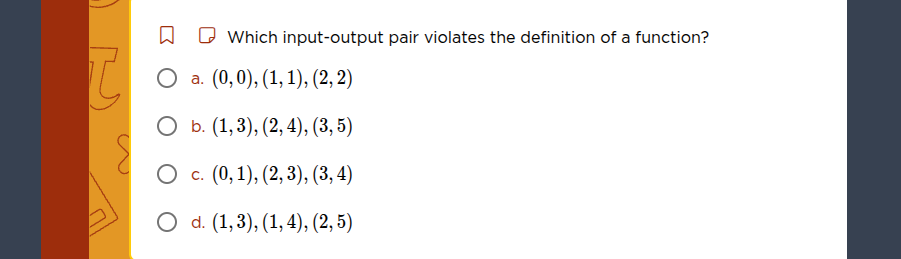
which input-output pair violates the definition of a function?
a. (0,0),(1,1),(2,2)
b. (1,3),(2,4),(3,5)
c. (0,1),(2,3),(3,4)
d. (1,3),(1,4),(2,5)
Step1: Recall the definition of a function
A function is a relation where each input (x - value) has exactly one output (y - value).
Step2: Analyze each option
- Option a: For \(x = 0\), \(y=0\); \(x = 1\), \(y = 1\); \(x=2\), \(y = 2\). Each \(x\) has one \(y\).
- Option b: For \(x = 1\), \(y = 3\); \(x=2\), \(y = 4\); \(x = 3\), \(y=5\). Each \(x\) has one \(y\).
- Option c: For \(x = 0\), \(y = 1\); \(x=2\), \(y = 3\); \(x = 3\), \(y=4\). Each \(x\) has one \(y\).
- Option d: For \(x = 1\), we have two \(y\) - values, \(y = 3\) and \(y=4\). This violates the definition of a function.

Snap & solve any problem in the app
Get step-by-step solutions on Sovi AI
Photo-based solutions with guided steps
Explore more problems and detailed explanations
d. \((1,3),(1,4),(2,5)\)