QUESTION IMAGE
Question
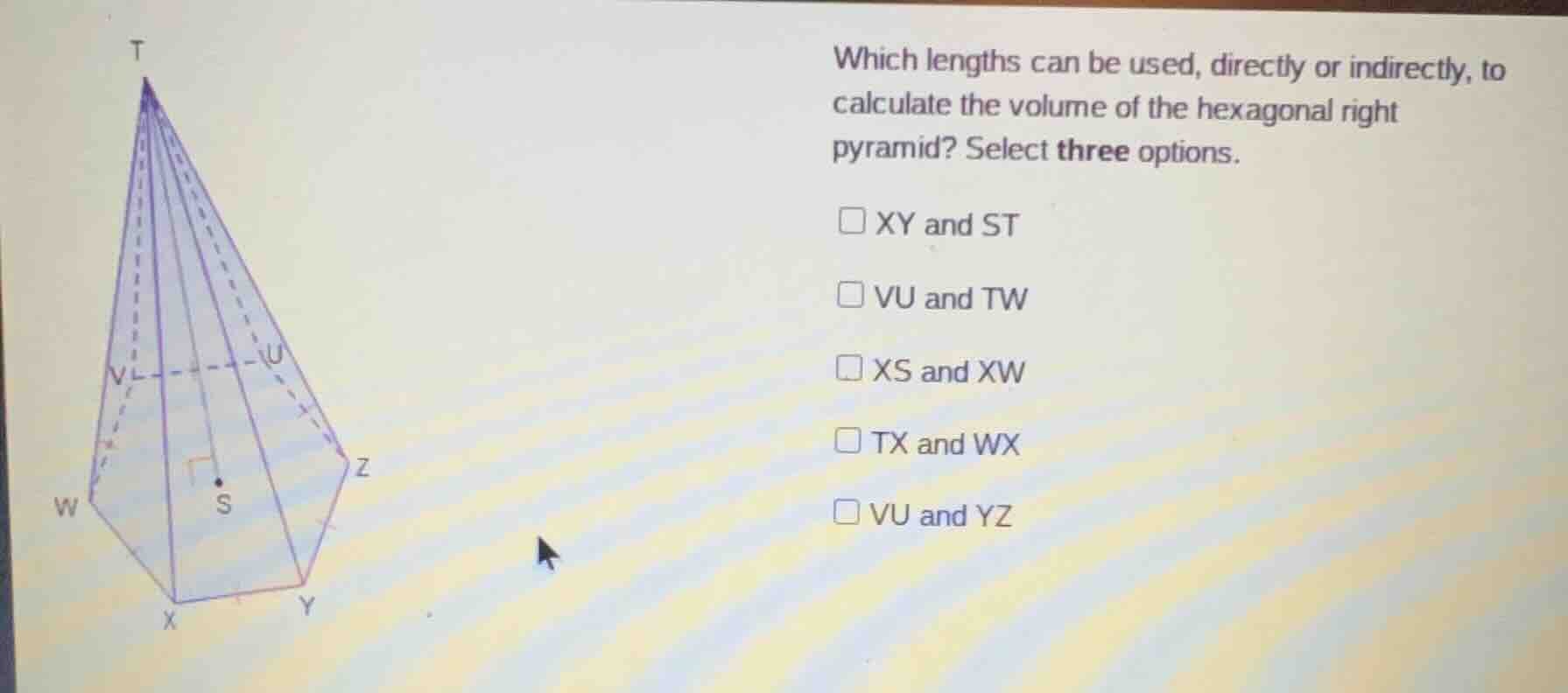
which lengths can be used, directly or indirectly, to calculate the volume of the hexagonal right pyramid? select three options. xy and st vu and tw xs and xw tx and wx vu and yz
Brief Explanations
To calculate the volume of a hexagonal right pyramid, the formula is \( V=\frac{1}{3}Bh \), where \( B \) is the area of the hexagonal base and \( h \) is the height of the pyramid.
- For "XY and ST":
- XY is a side length of the hexagonal base. The area of a regular hexagon can be calculated if we know the side length (since a regular hexagon can be divided into six equilateral triangles). ST is the height of the pyramid (the perpendicular distance from the apex T to the base, passing through the center S). So with XY (to find the area of the base) and ST (the height), we can calculate the volume.
- For "VU and TW":
- VU is a side length of a smaller similar hexagon (or a side of the base's sub - structure, but since it's a regular hexagon, the side length of the base can be related to VU if the pyramid is regular). TW: If we consider the slant height or the height related to the lateral face, but more importantly, if we can find the height of the pyramid from TW (using Pythagorean theorem if we know the distance from the center to the side) and VU as the side length of the base to find the base area, we can calculate the volume. Alternatively, VU is a side of the base (assuming the hexagon is regular) and TW can be used to find the height of the pyramid (if we know the relationship between TW and the height of the pyramid, for example, if TW is the slant height and we can find the height from the center to the side, then use Pythagorean theorem to get the pyramid's height).
- For "TX and WX":
- WX is a side length of the hexagonal base. TX: If we consider TX as the slant height (the distance from the apex T to a base vertex X), and WX as the side length of the base. We can find the height of the pyramid using the Pythagorean theorem. The distance from the center S of the hexagon to a vertex (the radius of the circumscribed circle around the hexagon) is equal to the side length of the hexagon (for a regular hexagon). So if we know WX (side length, so the distance from S to X is also WX), and TX (the slant height), then the height \( h=\sqrt{TX^{2}-WX^{2}} \), and the base area can be found from WX. Then we can calculate the volume using \( V = \frac{1}{3}Bh \).
- For "XS and XW":
- XS: XS is the distance from the center S of the hexagon to a base vertex X (the radius of the circumscribed circle, which is equal to the side length of the regular hexagon). XW is a side length of the base (but XS is already equal to the side length of the regular hexagon, so XW and XS would be the same in a regular hexagon, so we can't get new information to calculate the volume as we need two different quantities: base area - related (side length) and height - related. So this option is not valid.
- For "VU and YZ":
- VU and YZ are both side lengths of the base (since in a regular hexagon, all sides are equal). So we only have information about the base side length and no information about the height of the pyramid. So we can't calculate the volume with just two side lengths of the base.

Snap & solve any problem in the app
Get step-by-step solutions on Sovi AI
Photo-based solutions with guided steps
Explore more problems and detailed explanations
A. XY and ST, B. VU and TW, D. TX and WX