QUESTION IMAGE
Question
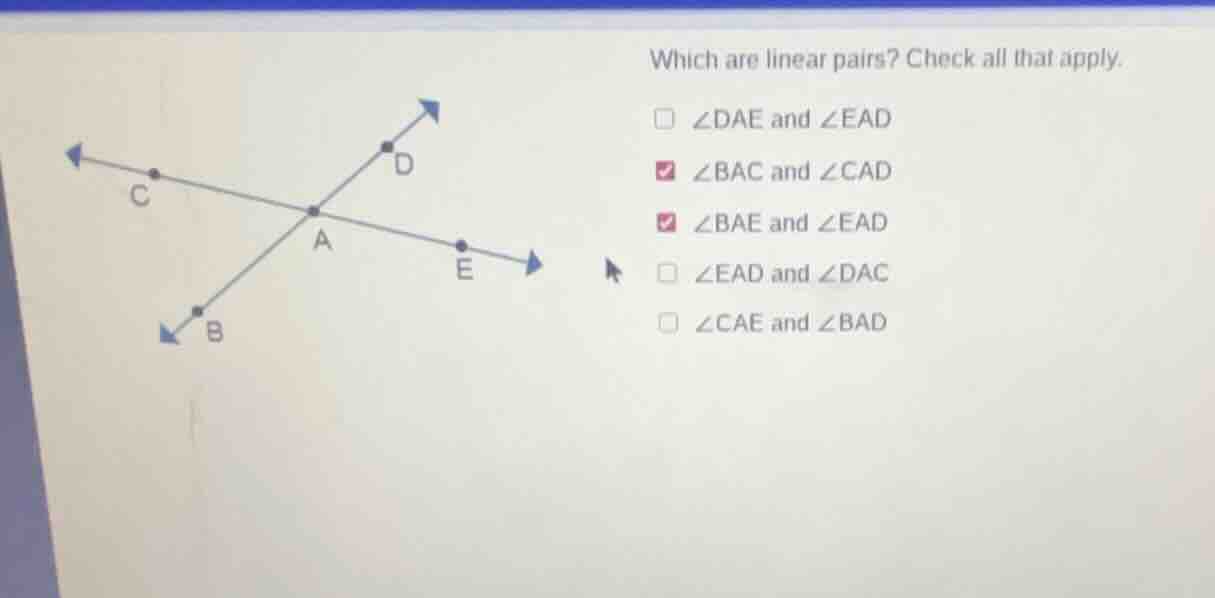
which are linear pairs? check all that apply. \\(\angle dae\\) and \\(\angle ead\\) \\(\angle bac\\) and \\(\angle cad\\) \\(\angle bae\\) and \\(\angle ead\\) \\(\angle ead\\) and \\(\angle dac\\) \\(\angle cae\\) and \\(\angle bad\\)
To determine linear pairs, we use the definition: a linear pair consists of two adjacent angles that form a straight line (sum to \(180^\circ\)) and share a common side and vertex.
Step 1: Analyze \(\angle DAE\) and \(\angle EAD\)
These are the same angle (just named in reverse), so they can't be a linear pair.
Step 2: Analyze \(\angle BAC\) and \(\angle CAD\)
- They share vertex \(A\) and side \(AC\).
- \(B\), \(A\), \(D\) are colinear (form a straight line), so \(\angle BAC + \angle CAD = 180^\circ\). Thus, this is a linear pair.
Step 3: Analyze \(\angle BAE\) and \(\angle EAD\)
- They share vertex \(A\) and side \(AE\).
- \(B\), \(A\), \(E\) are colinear (form a straight line), so \(\angle BAE + \angle EAD = 180^\circ\). Thus, this is a linear pair.
Step 4: Analyze \(\angle EAD\) and \(\angle DAC\)
- \(E\), \(A\), \(C\) are colinear, but \(\angle EAD\) and \(\angle DAC\) do not form a straight line together (their non - common sides are not opposite rays). So they are not a linear pair.
Step 5: Analyze \(\angle CAE\) and \(\angle BAD\)
- \(\angle CAE\) is a straight angle (along \(CE\)) and \(\angle BAD\) is a straight angle (along \(BD\)), but they are vertical angles - like, not adjacent forming a straight line. So they are not a linear pair.

Snap & solve any problem in the app
Get step-by-step solutions on Sovi AI
Photo-based solutions with guided steps
Explore more problems and detailed explanations
The linear pairs are \(\boldsymbol{\angle BAC}\) and \(\boldsymbol{\angle CAD}\), \(\boldsymbol{\angle BAE}\) and \(\boldsymbol{\angle EAD}\) (so the correct options are the ones with these angle pairs checked in the original, i.e., the second and third options in the list: \(\boldsymbol{\angle BAC}\) and \(\boldsymbol{\angle CAD}\), \(\boldsymbol{\angle BAE}\) and \(\boldsymbol{\angle EAD}\))