QUESTION IMAGE
Question
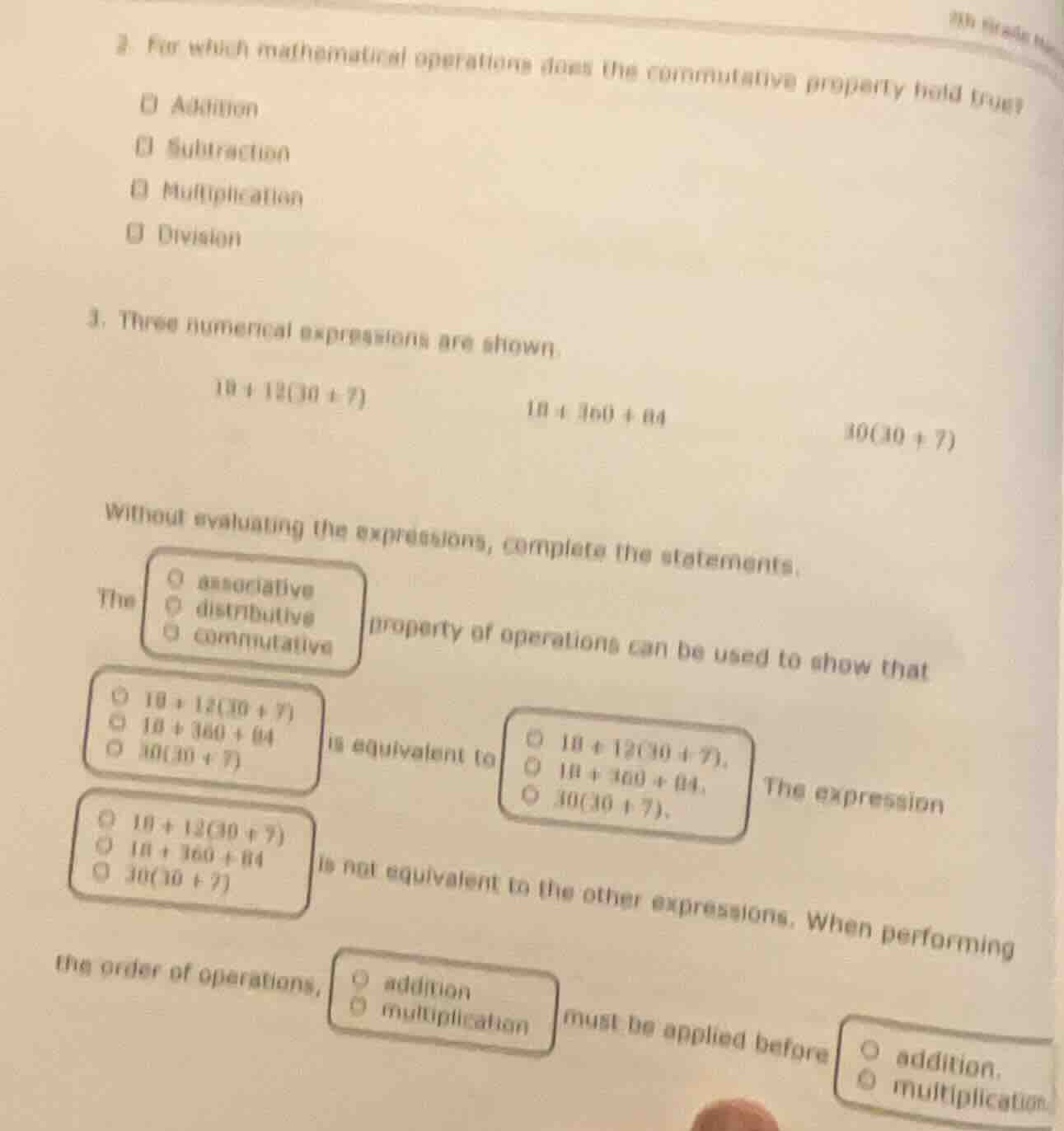
- for which mathematical operations does the commutative property hold true?□ addition□ subtraction□ multiplication□ division3. three numerical expressions are shown.$18 + 12(30 + 7)$ $18 + 360 + 84$ $30(30 + 7)$without evaluating the expressions, complete the statements.the $\bigcirc$ associative $\bigcirc$ distributive $\bigcirc$ commutative property of operations can be used to show that$\bigcirc$ $18 + 12(30 + 7)$ $\bigcirc$ $18 + 360 + 84$ $\bigcirc$ $30(30 + 7)$ is equivalent to $\bigcirc$ $18 + 12(30 + 7)$ $\bigcirc$ $18 + 360 + 84$ $\bigcirc$ $30(30 + 7)$. the expression $\bigcirc$ $18 + 12(30 + 7)$ $\bigcirc$ $18 + 360 + 84$ $\bigcirc$ $30(30 + 7)$ is not equivalent to the other expressions. when performing the order of operations, $\bigcirc$ addition $\bigcirc$ multiplication must be applied before $\bigcirc$ addition $\bigcirc$ multiplication.
Step1: Identify commutative operations
The commutative property states that $a + b = b + a$ and $a \times b = b \times a$. For subtraction: $a - b
eq b - a$, for division: $\frac{a}{b}
eq \frac{b}{a}$.
Step2: Match property to expression equivalence
The distributive property is $a(b+c)=ab+ac$. Here, $12(30+7)=360+84$, so $18+12(30+7)=18+360+84$.
Step3: Find non-equivalent expression
$30(30+7)=900+210$, which does not match the form of the other two expressions.
Step4: Recall order of operations
PEMDAS/BODMAS rules state multiplication is done before addition.

Snap & solve any problem in the app
Get step-by-step solutions on Sovi AI
Photo-based solutions with guided steps
Explore more problems and detailed explanations
Question 2:
A. Addition
C. Multiplication
Question 3:
- The distributive property of operations can be used to show that
- $\boldsymbol{18 + 12(30 + 7)}$ is equivalent to $\boldsymbol{18 + 360 + 84}$.
- The expression $\boldsymbol{30(30 + 7)}$ is not equivalent to the other expressions.
- When performing the order of operations, multiplication must be applied before addition.