QUESTION IMAGE
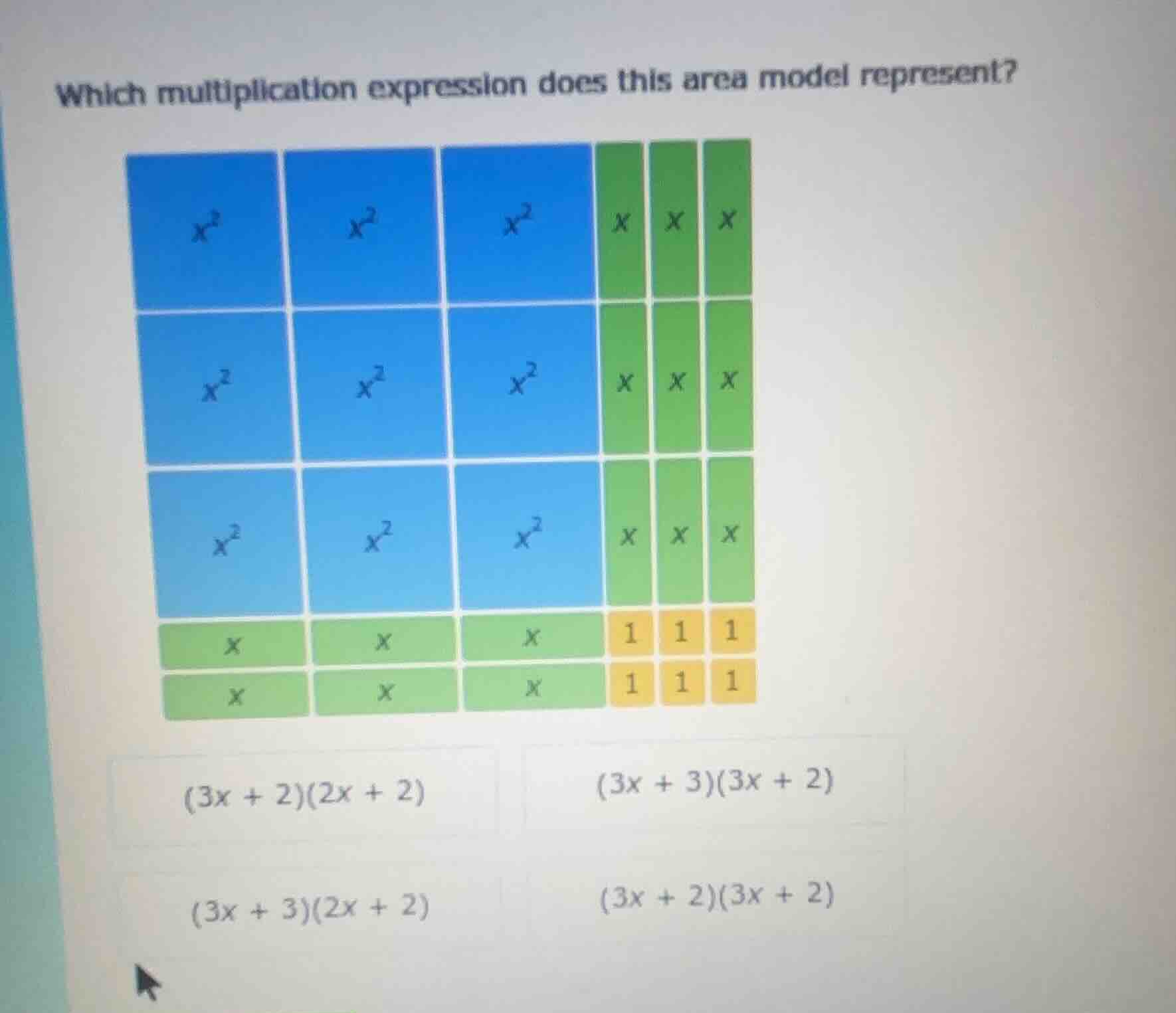
Question
which multiplication expression does this area model represent?
(3x + 2)(2x + 2) (3x + 3)(3x + 2)
(3x + 3)(2x + 2) (3x + 2)(3x + 2)
Step1: Analyze length of x², x, and 1 sections
Count the number of \( x^2 \) tiles: \( 3 \times 3 = 9 \)? Wait, no, looking at the grid: the blue \( x^2 \) tiles are 3 columns (wait, no, let's check rows and columns. Wait, the first part (blue \( x^2 \)): let's see the horizontal and vertical. Wait, the \( x^2 \) are in a 3x3? No, wait the green \( x \) and yellow \( 1 \). Wait, let's find the length of each side.
For the first factor (horizontal): Let's see the number of \( x^2 \), \( x \), and 1 in one row. Wait, the blue \( x^2 \) are 3 (columns), then green \( x \) are 3 (columns), then? Wait no, looking at the grid:
Wait, the top part: blue \( x^2 \) has 3 columns (since 3 \( x^2 \) in a row), then green \( x \) has 3 columns. Then vertically, the blue \( x^2 \) has 3 rows? Wait no, the blue \( x^2 \) tiles: let's count. The blue tiles: 3 columns (each \( x^2 \)) and 3 rows? Wait no, the blue tiles are 3 columns (each \( x^2 \)) and 3 rows? Wait, no, looking at the grid:
Wait, the first part (left of green \( x \)): the blue \( x^2 \) are 3 columns (each \( x^2 \)) and 3 rows? Wait, no, the blue \( x^2 \) tiles: 3 columns (so 3x) and 3 rows? Wait, no, let's check the green \( x \) tiles. The green \( x \) tiles: in the horizontal direction, after the blue \( x^2 \), there are 3 green \( x \) columns (each \( x \)) and then yellow \( 1 \) columns? Wait, no, the yellow \( 1 \) tiles: 3 columns (each 1) and 2 rows? Wait, no, let's look at the vertical and horizontal dimensions.
Wait, the vertical direction (rows): the blue \( x^2 \) has 3 rows? No, the blue \( x^2 \) tiles: 3 rows (each row has 3 \( x^2 \))? Wait, no, the first three rows (top three) have blue \( x^2 \) (3 in a row) and green \( x \) (3 in a row). Then the bottom two rows (rows 4 and 5) have green \( x \) (3 in a row) and yellow \( 1 \) (3 in a row). Wait, no, the grid:
Wait, rows: let's count the number of rows with \( x^2 \): 3 rows (top three). Then rows with \( x \) (green) below? Wait, no, the bottom two rows (rows 4 and 5) have green \( x \) (3 columns) and yellow \( 1 \) (3 columns). Wait, no, the vertical length (number of rows) for the first part (left of green \( x \)): the blue \( x^2 \) are in 3 rows, and the green \( x \) below (rows 4 and 5) are 2 rows? Wait, no, let's check the options.
Wait, the options are:
- \( (3x + 2)(2x + 2) \)
- \( (3x + 3)(3x + 2) \)
- \( (3x + 3)(2x + 2) \)
- \( (3x + 2)(3x + 2) \)
Wait, let's find the length of each side (the two factors). Let's look at the horizontal (first factor) and vertical (second factor).
Horizontal (first factor): Let's count the number of \( x \) and constant terms.
Looking at the horizontal direction (columns):
- The number of \( x^2 \) columns: 3 (so 3x)
- Then the number of \( x \) columns: 3 (so 3x? No, wait, the green \( x \) tiles: in the horizontal direction, after the blue \( x^2 \), there are 3 green \( x \) columns. Then, in the vertical direction (rows):
- The number of \( x^2 \) rows: 3 (so 3x)
- Then the number of \( x \) rows: 2 (so 2x? No, wait, the bottom two rows (rows 4 and 5) have green \( x \) and yellow \( 1 \). Wait, no, let's count the number of \( x^2 \), \( x \), and 1 in each dimension.
Wait, the blue \( x^2 \) tiles: 3 columns (so 3x) and 3 rows (so 3x)? No, that can't be. Wait, the blue \( x^2 \) are 3 columns (each \( x^2 \)) and 3 rows? Wait, no, the blue \( x^2 \) tiles: 3 columns (so 3x) and 3 rows (so 3x)? Then the green \( x \) tiles: 3 columns (so 3x) and 2 rows (so 2x)? No, this is confusing. Wait, let's use the options.
Let's expand eac…

Snap & solve any problem in the app
Get step-by-step solutions on Sovi AI
Photo-based solutions with guided steps
Explore more problems and detailed explanations
\( (3x + 3)(3x + 2) \)