QUESTION IMAGE
Question
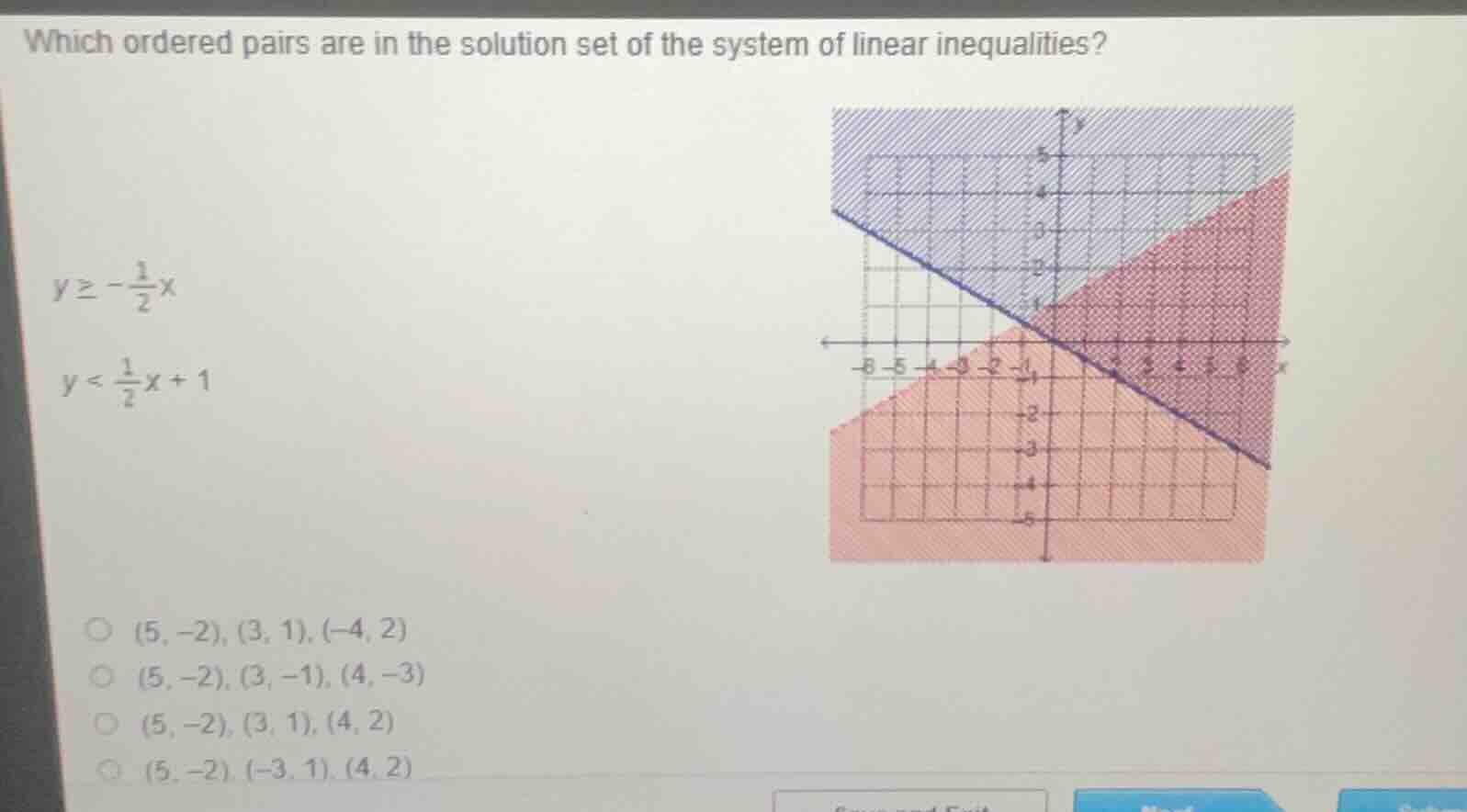
which ordered pairs are in the solution set of the system of linear inequalities?
$y \geq -\frac{1}{2}x$
$y < \frac{1}{2}x + 1$
options:
(5, -2), (3, 1), (-4, 2)
(5, -2), (3, -1), (4, -3)
(5, -2), (3, 1), (4, 2)
(5, -2), (-3, 1), (4, 2)
Step1: Test (5, -2) in both inequalities
First inequality: $-2 \geq -\frac{1}{2}(5) \implies -2 \geq -2.5$, which is true.
Second inequality: $-2 < \frac{1}{2}(5) + 1 \implies -2 < 3.5$, which is true.
Step2: Test (3, -1) in both inequalities
First inequality: $-1 \geq -\frac{1}{2}(3) \implies -1 \geq -1.5$, which is true.
Second inequality: $-1 < \frac{1}{2}(3) + 1 \implies -1 < 2.5$, which is true.
Step3: Test (4, -3) in both inequalities
First inequality: $-3 \geq -\frac{1}{2}(4) \implies -3 \geq -2$, which is true.
Second inequality: $-3 < \frac{1}{2}(4) + 1 \implies -3 < 3$, which is true.
Step4: Eliminate other options
- For option 1: $(-4,2)$: $2 < \frac{1}{2}(-4)+1 \implies 2 < -1$, false.
- For option 3: $(4,2)$: $2 < \frac{1}{2}(4)+1 \implies 2 < 3$ is true, but $2 \geq -\frac{1}{2}(4) \implies 2 \geq -2$ is true; however $(3,1)$: $1 < \frac{1}{2}(3)+1 \implies 1 < 2.5$ true, but $1 \geq -\frac{3}{2}$ true—wait, no, check the second inequality for $(3,1)$: $1 < \frac{1}{2}(3)+1 = 2.5$ is true, but check the first option's $(-4,2)$ fails, option 3's $(4,2)$: $2 < 3$ is true, but $2 \geq -2$ is true, but wait no—wait $(3,1)$ in second inequality: $1 < \frac{1}{2}(3)+1 = 2.5$ is true, but wait the graph: the blue line is solid ($y \geq -\frac{1}{2}x$), red is dashed ($y < \frac{1}{2}x+1$). Wait $(3,1)$: $\frac{1}{2}(3)+1=2.5$, 1<2.5 is true, but $1 \geq -1.5$ is true. Wait no, let's check option 2's (3,-1): works, (4,-3): works, (5,-2): works. Let's check option 3's (4,2): $2 < \frac{1}{2}(4)+1=3$ is true, but $2 \geq -\frac{1}{2}(4)=-2$ is true, but (3,1): $1 < 2.5$ true, $1 \geq -1.5$ true. Wait no, let's check (3,1) in the second inequality: $y < \frac{1}{2}x+1$: 1 < 2.5 is true, but wait the graph: the red region is below the dashed line. (3,1) is below y=0.5x+1 (which is 2.5 at x=3), yes. But wait (4,2): 0.5*4+1=3, 2<3 is true. Wait no, let's check option 2's (3,-1): works, (4,-3): works, (5,-2): works. Now check option 1's (-4,2): $2 < 0.5*(-4)+1=-2+1=-1$? 2 < -1 is false. Option 3's (4,2): $2 < 3$ is true, but (3,1): $1 < 2.5$ is true, but wait $y \geq -\frac{1}{2}x$ for (3,1): 1 >= -1.5 is true. Wait no, let's check (3,1) in the system: yes, but wait the graph: the overlapping region is blue and red. (3,1) is in blue (above solid line) and red (below dashed line). Wait but (4,2): 2 >= -2 (yes), 2 < 3 (yes). Wait no, let's check option 2's (3,-1): yes, (4,-3): yes, (5,-2): yes. Now check option 4's (-3,1): $1 < 0.5*(-3)+1=-1.5+1=-0.5$? 1 < -0.5 is false.
Wait, correction: for (3,1) in $y < \frac{1}{2}x+1$: $1 < \frac{3}{2}+1 = 2.5$, which is true, but wait the graph: the red region is below the dashed line, so (3,1) is below it, yes. But (4,2): $2 < 2+1=3$, true. But wait option 3's (4,2): $y \geq -\frac{1}{2}x$: $2 \geq -2$, true. But why is option 2 correct? Wait no, let's check (3,1) in the first inequality: $1 \geq -\frac{3}{2}=-1.5$, true. Wait no, let's check option 2's (3,-1): $-1 \geq -1.5$, true; $-1 < 2.5$, true. (4,-3): $-3 \geq -2$, true; $-3 < 3$, true. (5,-2): $-2 \geq -2.5$, true; $-2 < 3.5$, true. Now check option 3's (4,2): $2 < 3$, true; $2 \geq -2$, true. But (3,1): $1 < 2.5$, true; $1 \geq -1.5$, true. Wait no, let's check the graph: the blue line is $y=-\frac{1}{2}x$, solid. The red line is $y=\frac{1}{2}x+1$, dashed. The overlapping region is above the solid blue line and below the dashed red line.
For (4,2): $y=2$, $-\frac{1}{2}(4)=-2$, 2 >= -2 (yes); $\frac{1}{2}(4)+1=3$, 2 < 3 (yes). So (4,2) is in the region. But (3,1): 1 >= -1.5 (yes), 1 < 2.5 (yes). Wait but option 3 is (5,-2…

Snap & solve any problem in the app
Get step-by-step solutions on Sovi AI
Photo-based solutions with guided steps
Explore more problems and detailed explanations
(5, -2), (3, 1), (4, 2)