QUESTION IMAGE
Question
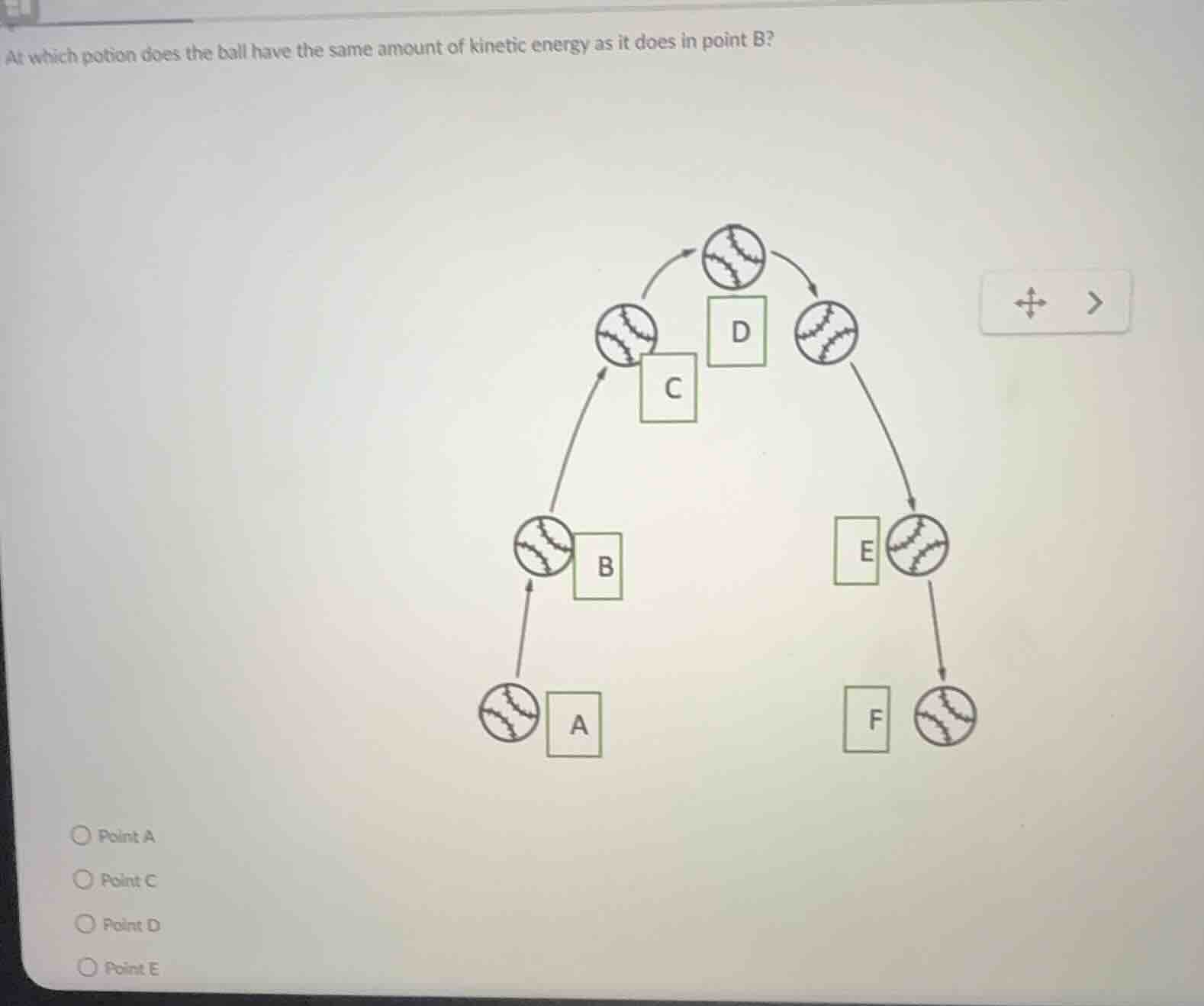
at which potion does the ball have the same amount of kinetic energy as it does in point b?
options: point a, point c, point d, point e
Step1: Recall Energy Conservation
Kinetic energy (KE) and potential energy (PE) are related by conservation of mechanical energy (assuming no air resistance). \( KE + PE = \text{constant} \). So, same KE occurs when PE is same (since total energy is constant). PE depends on height (\( PE = mgh \)), so same height means same PE, hence same KE (if total energy is constant).
Step2: Analyze Heights of Points
- Point B: Let's consider its height.
- Point E: Visually, Point E is at the same height as Point B (symmetric in the trajectory, like a projectile motion where height at same horizontal distance from launch has same PE, hence same KE if no energy loss).
- Point A: Lower height (ball is moving up from A to B, so A has less height, more KE? No, wait, A to B: KE converts to PE. So A has more KE, B has less KE than A.
- Point C: Higher than B? Wait, no, the trajectory: from B to C to D (peak at D). Wait, maybe I misread. Wait, the arrows: A to B (up), B to C (up), C to D (up to peak D), then D to next point (down), then to E, then to F. Wait, no, maybe the trajectory is A -> B -> C -> D (peak) -> next (down) -> E -> F. Wait, but the key is same height. Wait, maybe the diagram: Point B and Point E are at the same vertical height. So same PE, so same KE (since total energy is constant, \( KE_B + PE_B = KE_E + PE_E \), so if \( PE_B = PE_E \), then \( KE_B = KE_E \)).

Snap & solve any problem in the app
Get step-by-step solutions on Sovi AI
Photo-based solutions with guided steps
Explore more problems and detailed explanations
Point E