QUESTION IMAGE
Question
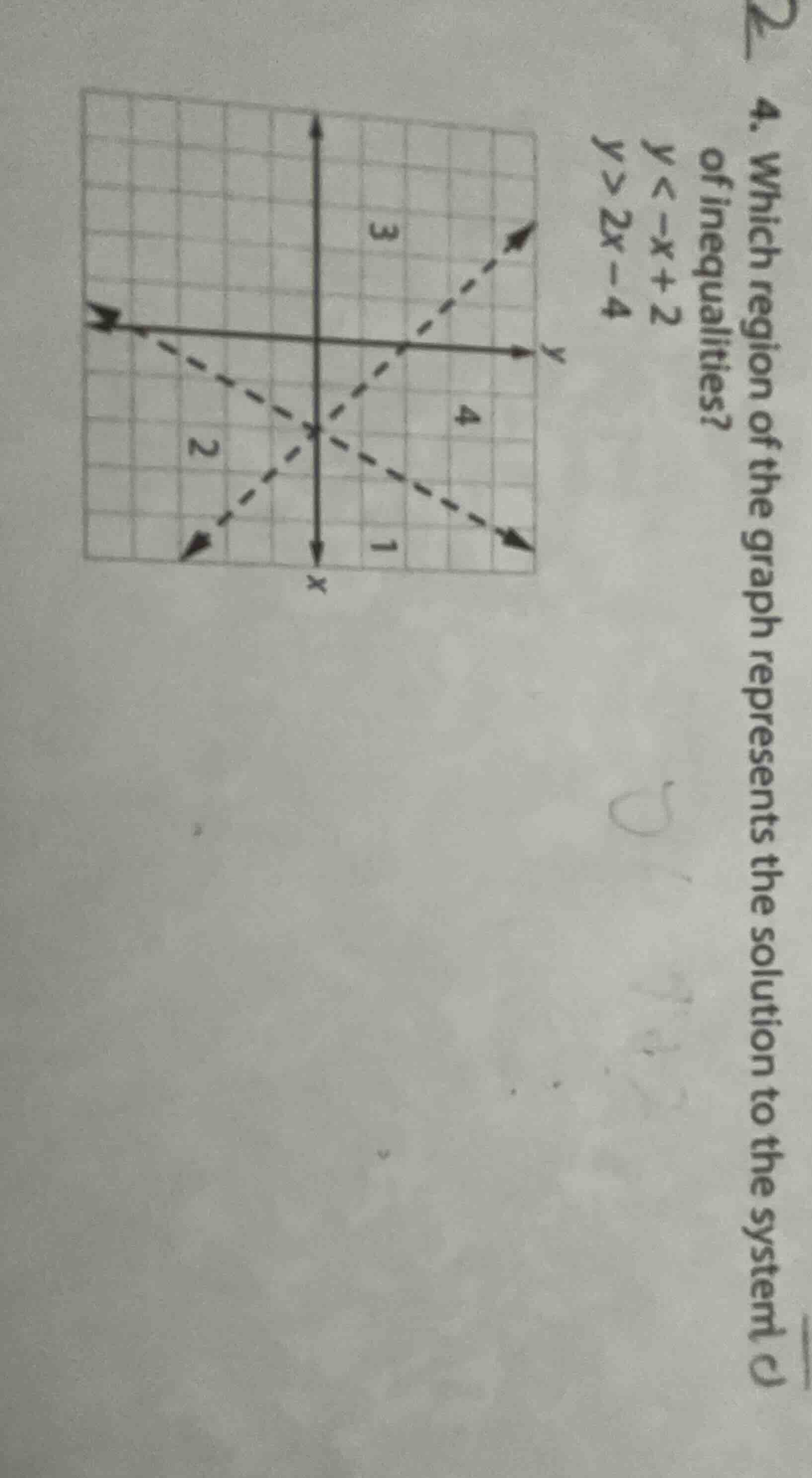
- which region of the graph represents the solution to the system of inequalities?
y < -x + 2
y > 2x - 4
Step1: Analyze \( y < -x + 2 \)
The line \( y=-x + 2 \) has a slope of \(-1\) and a \( y \)-intercept of \( 2 \). Since the inequality is \( y < -x + 2 \), the region is below this dashed line (dashed because the inequality is strict, \( < \), not \( \leq \)).
Step2: Analyze \( y > 2x - 4 \)
The line \( y = 2x-4 \) has a slope of \( 2 \) and a \( y \)-intercept of \(-4\). Since the inequality is \( y > 2x - 4 \), the region is above this dashed line (dashed because the inequality is strict, \( > \), not \( \geq \)).
Step3: Find the Intersection Region
The solution to the system of inequalities is the region that is both below \( y=-x + 2 \) and above \( y = 2x-4 \). To confirm, we can pick a test point in the intersection region, say \( (0,0) \). For \( y < -x + 2 \): \( 0 < 0 + 2 \) (true). For \( y > 2x - 4 \): \( 0 > 0 - 4 \) (true). So the region satisfying both inequalities is where these two half - planes overlap.

Snap & solve any problem in the app
Get step-by-step solutions on Sovi AI
Photo-based solutions with guided steps
Explore more problems and detailed explanations
The region that is below the line \( y=-x + 2 \) (dashed) and above the line \( y = 2x-4 \) (dashed) is the solution region for the system \(
\).