QUESTION IMAGE
Question
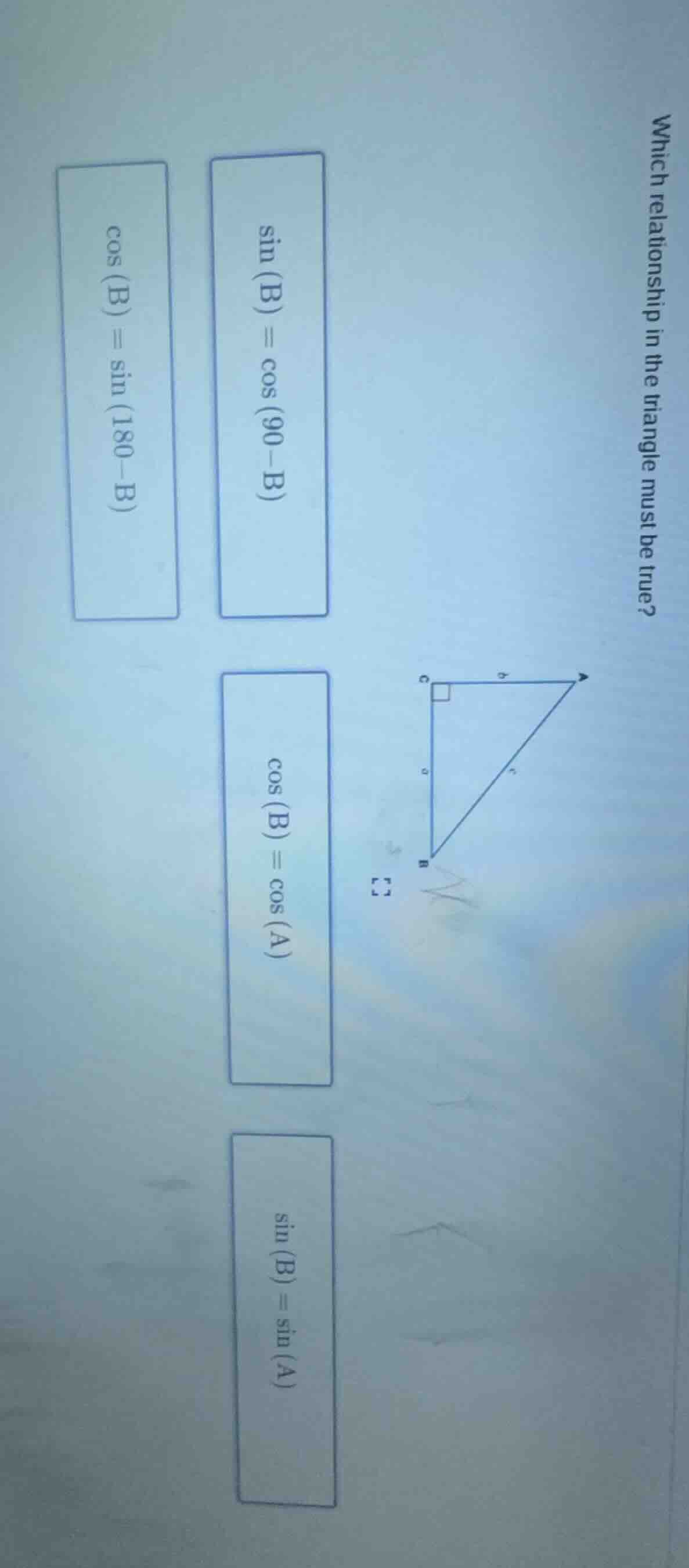
which relationship in the triangle must be true?
options:
$sin(b) = cos(90 - b)$
$cos(b) = sin(180 - b)$
$cos(b) = cos(a)$
$sin(b) = sin(a)$
(with a right - triangle diagram where angle $c$ is the right angle, side opposite angle $a$ is $a$, side opposite angle $b$ is $b$, and hypotenuse is $c$)
Step1: Analyze the right triangle
In a right triangle, the sum of angles \( A \) and \( B \) is \( 90^\circ \) (since \( \angle C = 90^\circ \) and the sum of angles in a triangle is \( 180^\circ \)), so \( A + B = 90^\circ \), which implies \( A = 90^\circ - B \).
Step2: Recall trigonometric identities
We know the co - function identity: \( \sin\theta=\cos(90^\circ - \theta) \) and \( \cos\theta=\sin(90^\circ - \theta) \), and also the supplementary angle identity \( \sin(180^\circ - \theta)=\sin\theta \), \( \cos(180^\circ - \theta)=-\cos\theta \).
Let's check each option:
- Option 1: \( \sin(B)=\cos(90 - B) \)
Since \( A = 90^\circ - B \), then \( \cos(90 - B)=\cos(A) \), and \( \sin(B)=\frac{b}{c} \), \( \cos(A)=\frac{b}{c} \) (by definition of sine and cosine in right - triangle: \( \sin\theta=\frac{\text{opposite}}{\text{hypotenuse}} \), \( \cos\theta=\frac{\text{adjacent}}{\text{hypotenuse}} \); for \( \angle B \), opposite side is \( b \), adjacent is \( a \), hypotenuse is \( c \); for \( \angle A \), adjacent side is \( b \), opposite is \( a \), hypotenuse is \( c \)). So \( \sin(B)=\cos(90 - B)=\cos(A) \)? Wait, no, let's re - check. Wait, \( \sin(B)=\frac{b}{c} \), \( \cos(A)=\frac{b}{c} \), and since \( A = 90 - B \), \( \cos(90 - B)=\sin(B) \) (from co - function identity \( \cos(90 - x)=\sin(x) \)). Wait, the first option is \( \sin(B)=\cos(90 - B) \), which is the co - function identity, so this is correct? Wait, no, let's check other options too.
- Option 2: \( \cos(B)=\sin(180 - B) \)
We know that \( \sin(180 - B)=\sin(B) \) (supplementary angle identity: \( \sin(180 - x)=\sin(x) \)). And \( \cos(B)=\frac{a}{c} \), \( \sin(B)=\frac{b}{c} \), so \( \cos(B)
eq\sin(180 - B) \) in general.
- Option 3: \( \cos(B)=\cos(A) \)
\( \cos(B)=\frac{a}{c} \), \( \cos(A)=\frac{b}{c} \), unless \( a = b \) (isosceles right - triangle), which is not given, so this is not always true.
- Option 4: \( \sin(B)=\sin(A) \)
\( \sin(B)=\frac{b}{c} \), \( \sin(A)=\frac{a}{c} \), unless \( a = b \) (isosceles right - triangle), which is not given, so this is not always true.
Wait, let's re - express the co - function identity correctly. The co - function identity is \( \sin\theta=\cos(90^{\circ}-\theta) \). Since \( A + B=90^{\circ} \), then \( 90^{\circ}-B = A \), so \( \sin(B)=\cos(90^{\circ}-B)=\cos(A) \)? No, wait \( \sin(B)=\frac{b}{c} \), \( \cos(A)=\frac{b}{c} \), and \( \cos(90 - B)=\sin(B) \) (from \( \cos(90 - x)=\sin(x) \)). So the first option \( \sin(B)=\cos(90 - B) \) is a trigonometric identity (co - function identity) and holds for any acute angle \( B \) in a right triangle.

Snap & solve any problem in the app
Get step-by-step solutions on Sovi AI
Photo-based solutions with guided steps
Explore more problems and detailed explanations
\( \sin(\text{B})=\cos(90 - \text{B}) \) (the first option among the given options)