QUESTION IMAGE
Question
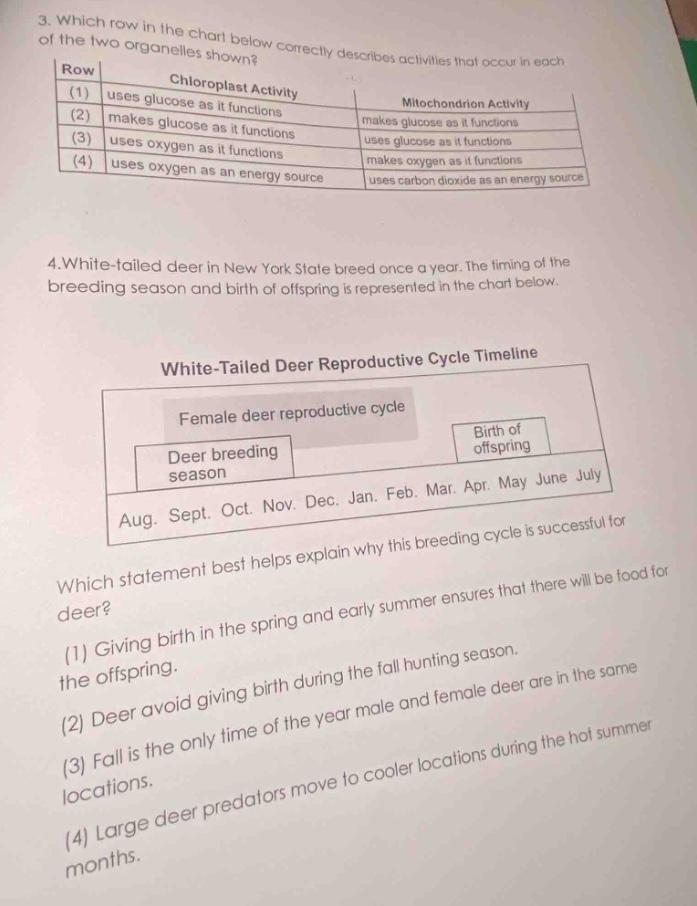
- which row in the chart below correctly describes activities that occur in each of the two organelles shown?
| row | chloroplast activity | mitochondrion activity |
|---|---|---|
| (2) | makes glucose as it functions | uses glucose as it functions |
| (3) | uses oxygen as it functions | makes oxygen as it functions |
| (4) | uses oxygen as an energy source | uses carbon dioxide as an energy source |
- white - tailed deer in new york state breed once a year. the timing of the breeding season and birth of offspring is represented in the chart below.
white - tailed deer reproductive cycle timeline
| female deer reproductive cycle | ||
|---|---|---|
| aug. | sept. oct. nov. dec. jan. feb. mar. | apr. may june july |
which statement best helps explain why this breeding cycle is successful for deer?
(1) giving birth in the spring and early summer ensures that there will be food for the offspring.
(2) deer avoid giving birth during the fall hunting season.
(3) fall is the only time of the year male and female deer are in the same locations.
(4) large deer predators move to cooler locations during the hot summer months.
Question 3
To determine the correct row, recall the functions of chloroplasts and mitochondria. Chloroplasts (in photosynthetic organisms) perform photosynthesis, which makes glucose (using CO₂, H₂O, and light). Mitochondria perform cellular respiration, which uses glucose (and oxygen) to produce energy. Let’s analyze each row:
- Row (1): Chloroplasts do not use glucose (they make it); Mitochondria use glucose, not make it. Eliminate.
- Row (2): Chloroplasts make glucose (photosynthesis); Mitochondria use glucose (cellular respiration). This matches their functions.
- Row (3): Chloroplasts produce oxygen (during photosynthesis), they do not “use” oxygen as a function; Mitochondria use oxygen, not make it. Eliminate.
- Row (4): Neither organelle uses oxygen/carbon dioxide as “energy sources” (energy comes from glucose breakdown, with O₂ as a reactant and CO₂ as a product). Eliminate.
To explain the breeding cycle’s success, we analyze the options:
- Option (1): Offspring are born in spring/early summer (Apr–July, per the timeline). Spring/summer has abundant vegetation (food) for deer, so this supports survival.
- Option (2): The breeding cycle is about offspring survival, not avoiding hunting season for birth (hunting season timing isn’t linked to birth here). Eliminate.
- Option (3): Males and females being in the same location is not the main reason for the cycle’s success (reproduction success depends on offspring survival, not mate location). Eliminate.
- Option (4): Predator movement in summer is not directly tied to the deer’s breeding cycle success (offspring survival depends more on food than predator location shifts). Eliminate.

Snap & solve any problem in the app
Get step-by-step solutions on Sovi AI
Photo-based solutions with guided steps
Explore more problems and detailed explanations
(2) makes glucose as it functions; uses glucose as it functions